
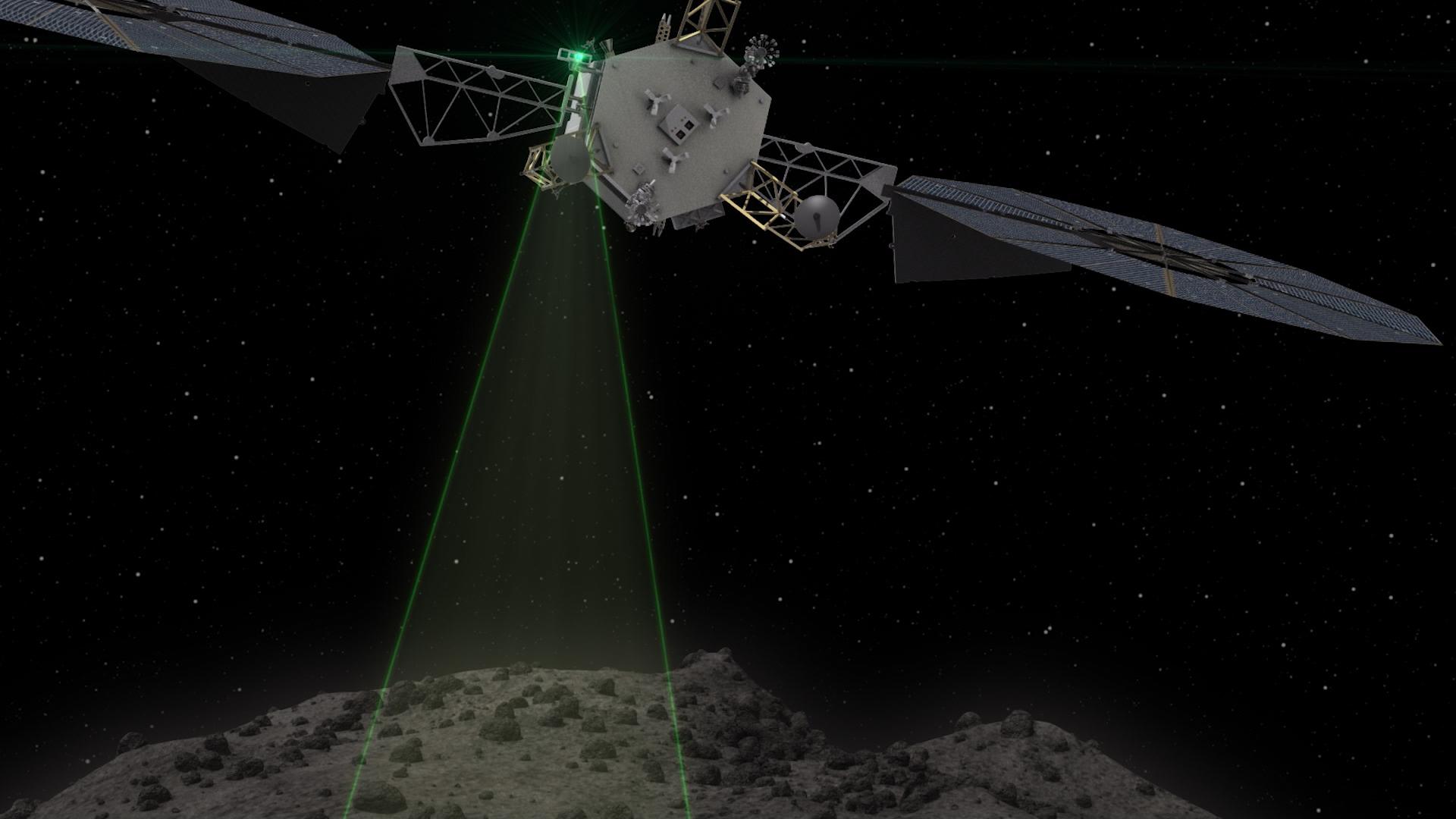
Six years after it parachuted a capsule of Ryugu dust into the Australian outback, Japan's Hayabusa2 spacecraft has done something it was never designed to do: fly past another asteroid at a distance close enough to touch, without stopping, without sampling, and without a second chance to get it right.
On July 5, 2026, at around 18:30 Japan Standard Time, Hayabusa2 swept past the near-Earth asteroid (98943) Torifune at a relative velocity of roughly 5 kilometers per second, passing within an estimated 1 kilometer or so of the asteroid's center, according to JAXA. A companion technical overview posted to arXiv gives a slightly looser range, placing closest approach anywhere from 1 to 10 kilometers from Torifune's center, while an entry on the asteroid itself cites an approach distance of about 800 meters. The spread isn't a scandal; it reflects the ordinary uncertainty of nailing down a fast, single-pass encounter with a target hundreds of meters wide from tens of millions of kilometers away, refined as tracking data comes in before and after the event. What all three sources agree on is the headline: this was an extraordinarily tight pass, executed at high speed, with no do-over.
A Spacecraft With No Hands Left
Hayabusa2's original mission ended, technically, in December 2020, when it dropped samples from asteroid Ryugu to Earth and then fired its thrusters to head back out into deep space for an extended mission. It no longer carries the sampling horn, the projectile-firing device, or the small rovers it deployed at Ryugu — all of that hardware was used up. What's left is a camera-and-sensor platform with propulsion, which is precisely why Torifune was a remote-sensing-only encounter rather than a repeat of the Ryugu touchdowns, as an analysis from NewSpace Economy lays out. Optical cameras on board were expected to resolve surface features down to 1 to 2 meters at closest approach — enough to characterize boulders, craters, and regolith texture on a body that has never been imaged up close.
Torifune itself is a modest object: an Apollo-type near-Earth asteroid about 476 ± 9 meters across, discovered in February 2001 by the LINEAR survey and classified as an S-type asteroid — meaning its surface is weathered silicate rock rich in pyroxene and olivine, the same broad mineral family as many stony meteorites. The encounter took place at a solar distance of 0.81 astronomical units, putting the flyby inside Earth's orbit, closer to the Sun than Earth itself sits, according to the arXiv overview.
Why Speed Was the Point, Not a Problem
A natural question is why JAXA would engineer an encounter this fast and this close, rather than slowing down for a longer look, the way Hayabusa2 did at Ryugu. The answer is that speed was the experiment. Both JAXA and the arXiv preprint describe the Torifune pass as a demonstration of high-precision orbital guidance — the ability to steer a spacecraft to a specific point in space, relative to a moving target, with tight tolerances and minimal last-second course correction. Notably, the arXiv overview specifies that the spacecraft's orientation was fixed for the encounter, with only minimal pointing adjustments made during the pass itself, underscoring how much of the precision had to be baked into the approach trajectory beforehand rather than corrected on the fly.
That kind of guidance has a very specific application beyond scientific reconnaissance: it is a rehearsal, in miniature, for the kind of targeting needed to intentionally guide a probe into a small body hard enough to change its trajectory — the basic concept behind kinetic-impactor planetary defense. JAXA's own announcement frames the Torifune data explicitly as supporting technology for guiding a probe to deliberately impact a small body for planetary defense purposes. In other words, Hayabusa2 didn't need to slow down and stay — it needed to prove it could hit a moving, distant, poorly-mapped target on the first and only attempt, which is exactly the skill an actual deflection mission would require.
The secondary science goal is more traditional: studying how material moves around the inner solar system. Comparing Torifune's surface — its crater density, boulder distribution, and mineral signatures — against what Hayabusa2 already measured directly at Ryugu gives researchers a second data point on how S-type and C-type near-Earth asteroids evolve and interact, without the years and fuel cost of another full rendezvous mission.
Why It Matters
Planetary defense has moved, in the space of a few years, from pure thought experiment toward tested technology, as agencies work through the individual capabilities — tracking, deflection, and precision guidance — that an actual mission would require. What's harder, and less flashy, is the guidance problem underneath that effort: reliably finding and hitting a small, fast-moving, poorly characterized rock with essentially no margin for error. That is the unglamorous, load-bearing technology the Torifune flyby was built to test, and it's the same technology any future real-world deflection mission — hopefully never needed — would depend on. A spacecraft that can no longer sample anything just proved it can still do useful, mission-relevant work: threading a needle at 5 kilometers per second and coming home with the data to prove it worked.
The Torifune encounter is also a waypoint, not a destination. Hayabusa2's extended mission is aimed at a far stranger final target: 1998 KY26, a asteroid only about 30 meters across, which the spacecraft is scheduled to rendezvous with in 2031. Everything learned from the guidance demands of the Torifune flyby — hitting a fixed aim point relative to a body it had never seen up close, at speed, with limited attitude adjustment — feeds directly into refining the approach for that vastly smaller and more challenging target five years from now.
Sources
- Overview of Hayabusa2 extended mission's flyby of Near-Earth Asteroid (98943) Torifune (arXiv preprint)
- JAXA: The timing of the flyby of asteroid Torifune by asteroid explorer Hayabusa2
- 98943 Torifune — Wikipedia
- Hayabusa2's Extended Mission: The Flyby of Asteroid Torifune in July 2026 — NewSpace Economy
