
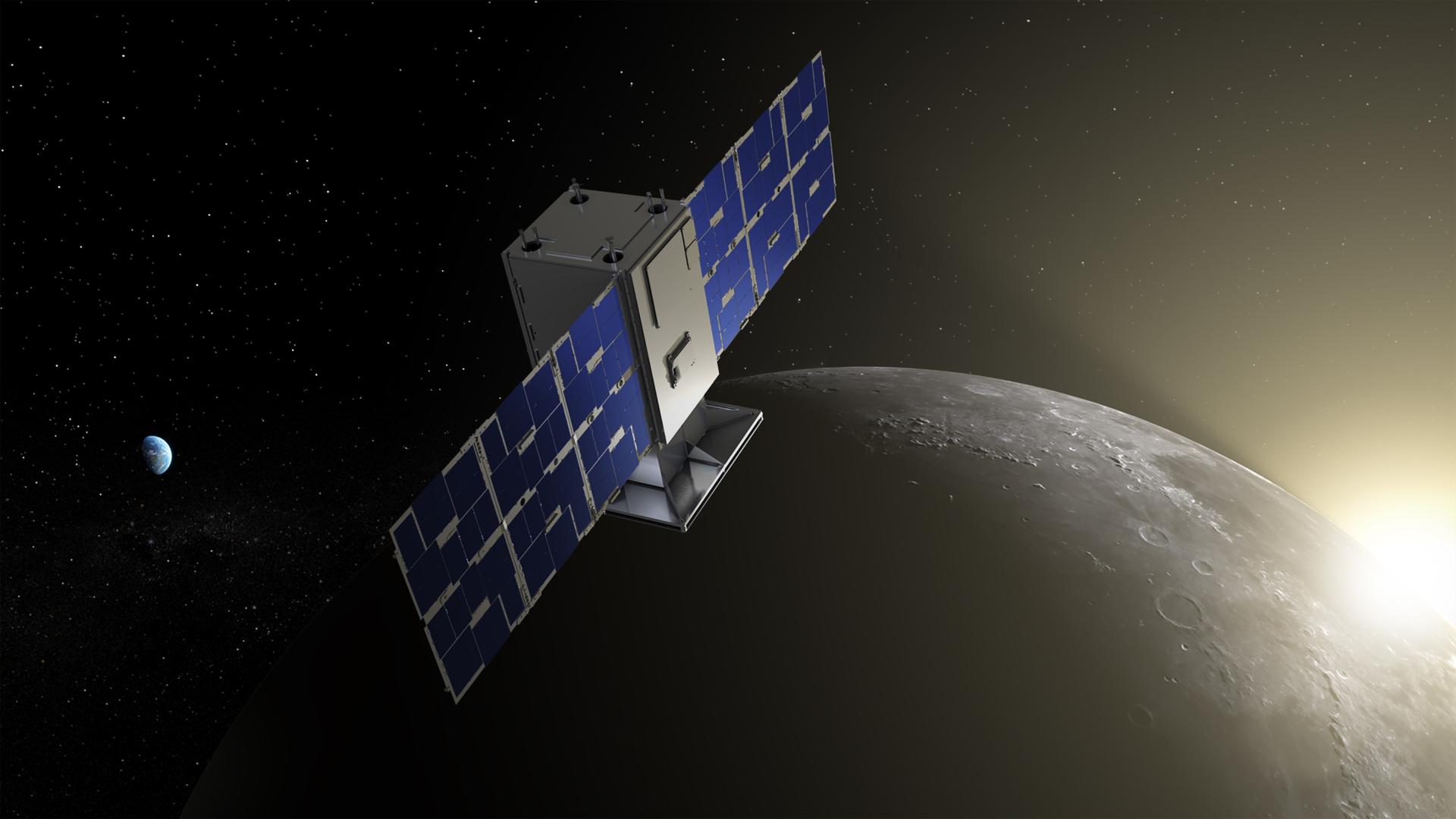
A spacecraft roughly the size of a microwave oven has finished a job that started as a fairly modest technology demonstration and ended up shaping how NASA plans to run its lunar operations for years to come. On July 6, 2026, NASA announced that CAPSTONE — the Cislunar Autonomous Positioning System Technology Operations and Navigation Experiment — has completed its NASA-sponsored mission activities, closing out just over four years of flight after launching in June 2022.
CAPSTONE was never meant to be flashy. It carried no astronauts, no landers, no science instruments aimed at answering a headline-grabbing question about the solar system. What it carried was a bet: that a small, commercially built and operated CubeSat could validate the navigation and communications tools NASA needs before it commits astronauts and billion-dollar infrastructure to lunar orbit. Four years later, that bet appears to have paid off.
What CAPSTONE Actually Tested
The headline achievement is a navigation system called autoNGC, which NASA says made its first-ever lunar deployment aboard CAPSTONE. The concept is straightforward to describe and hard to pull off: rather than relying primarily on ground-based tracking and communication with Earth to figure out where it is, the spacecraft uses its own star-tracker camera to image the Moon, Earth, and other celestial bodies, then calculates its position from those observations — at times outperforming ground-based methods, according to NASA. It's a form of autonomous optical navigation — the spacecraft essentially eyeballing its way through cislunar space.
Why does that matter operationally? Deep-space missions have traditionally leaned on NASA's Deep Space Network and other ground assets to determine a spacecraft's position and trajectory, a process that takes time, ties up scarce antenna resources, and doesn't scale well as more missions head to the Moon and beyond in the coming decade. A spacecraft that can determine its own position reduces that dependency, in principle freeing up ground infrastructure and giving future missions more autonomy when they're out of easy contact with Earth.
CAPSTONE also tested delay/disruption-tolerant networking, or DTN — a communications protocol built for exactly the kind of environment deep space presents, where signals can be delayed, interrupted, or dropped entirely rather than flowing over a continuous, reliable link the way data does on a terrestrial network. NASA says the system works by storing information onboard when no connection is available and automatically forwarding it once communications are restored; in one demonstration, engineers began transmitting data from CAPSTONE to Earth, the connection dropped before the transfer finished, and the spacecraft stored the remaining data and resumed transmission automatically at the next opportunity. Alongside that, the mission exercised software-defined satellite infrastructure, testing how flexible, reprogrammable onboard systems can adapt a spacecraft's capabilities after launch rather than locking them in at the factory.
A Halo Orbit With Gateway's Name On It
Underlying all of this technology testing was an orbital first: CAPSTONE was the first spacecraft to fly and characterize a near-rectilinear halo orbit, or NRHO, around the Moon. It's a peculiar, elongated path that swings the spacecraft close to the lunar surface at one end and far out toward a Lagrange point at the other — a shape chosen for its fuel efficiency and, notably, the same type of orbit NASA has selected for Gateway, the lunar space station planned as a staging point for future Artemis crewed missions.
That choice makes CAPSTONE's mission more than a generic proof-of-concept. Every week the little CubeSat spent tracing that orbit generated real flight data on how spacecraft behave in an NRHO — station-keeping requirements, tracking peculiarities, communication geometry — reducing risk for Gateway before it ever launches hardware into the same neighborhood.
Why It Matters
NASA's plans for a sustained lunar presence depend on infrastructure that doesn't yet exist and operational concepts that had, until CAPSTONE, only been modeled on paper or tested in simulation. Autonomous navigation and delay-tolerant networking aren't glamorous, but they're load-bearing: if every lunar mission needs continuous, high-touch support from the Deep Space Network to know where it is, NASA's ability to run multiple simultaneous lunar operations — landers, Gateway, crewed missions, commercial payloads — gets bottlenecked fast. A spacecraft that can locate itself from onboard imagery, and a network protocol built to tolerate the inevitable communication gaps of deep space, are both pieces of infrastructure NASA needs working before Artemis operations scale up.
CAPSTONE also matters as a demonstration of a business model. It was the first U.S. commercial mission to the Moon, designed and built by Terran Orbital and owned and operated throughout its life by Advanced Space, a private company, rather than NASA itself. That NASA could hand a technology-maturation mission of this consequence to a commercial operator — and have it deliver first-of-their-kind results in a genuinely hostile, unforgiving orbital environment — is itself a data point NASA is likely to lean on as it structures future partnerships with industry for lunar and deep-space work.
The Mission Isn't Quite Over
NASA's involvement has ended, but CAPSTONE's flying days aren't necessarily done. Advanced Space, which continues to own and operate the spacecraft, says it will continue to use CAPSTONE as a technology development testbed even without NASA sponsorship. What exactly that means going forward — which experiments, which partners, how long the spacecraft remains viable in its NRHO — hasn't been detailed publicly, but it underscores that the vehicle's usefulness wasn't strictly tied to NASA's funding clock. Greg Stover at NASA Headquarters, Sun Hur-Diaz, and Ben Anderson, both at NASA's Goddard Space Flight Center, were credited in NASA's announcement with commentary on the mission's technical achievements and their implications for future exploration, reflecting the cross-center collaboration that shepherded the mission from a novel concept through a 15-month extension beyond its original scope.
For a spacecraft with a build volume you could fit on a kitchen counter, CAPSTONE leaves behind an outsized technical legacy: the first characterized NRHO, the first lunar optical autonomous navigation, and a communications architecture built for a Moon that NASA hopes will soon be a lot busier than it is today.
Sources
- NASA's CAPSTONE Completes Extended Mission Testing Lunar Technologies - NASA
- CAPSTONE Celebrates Three Years of Groundbreaking Achievements in Lunar Navigation and Autonomy - SpaceNews
- CAPSTONE (Cislunar Autonomous Positioning System Technology Operations and Navigation Experiment) - eoPortal
- CAPSTONE - Advanced Space
