
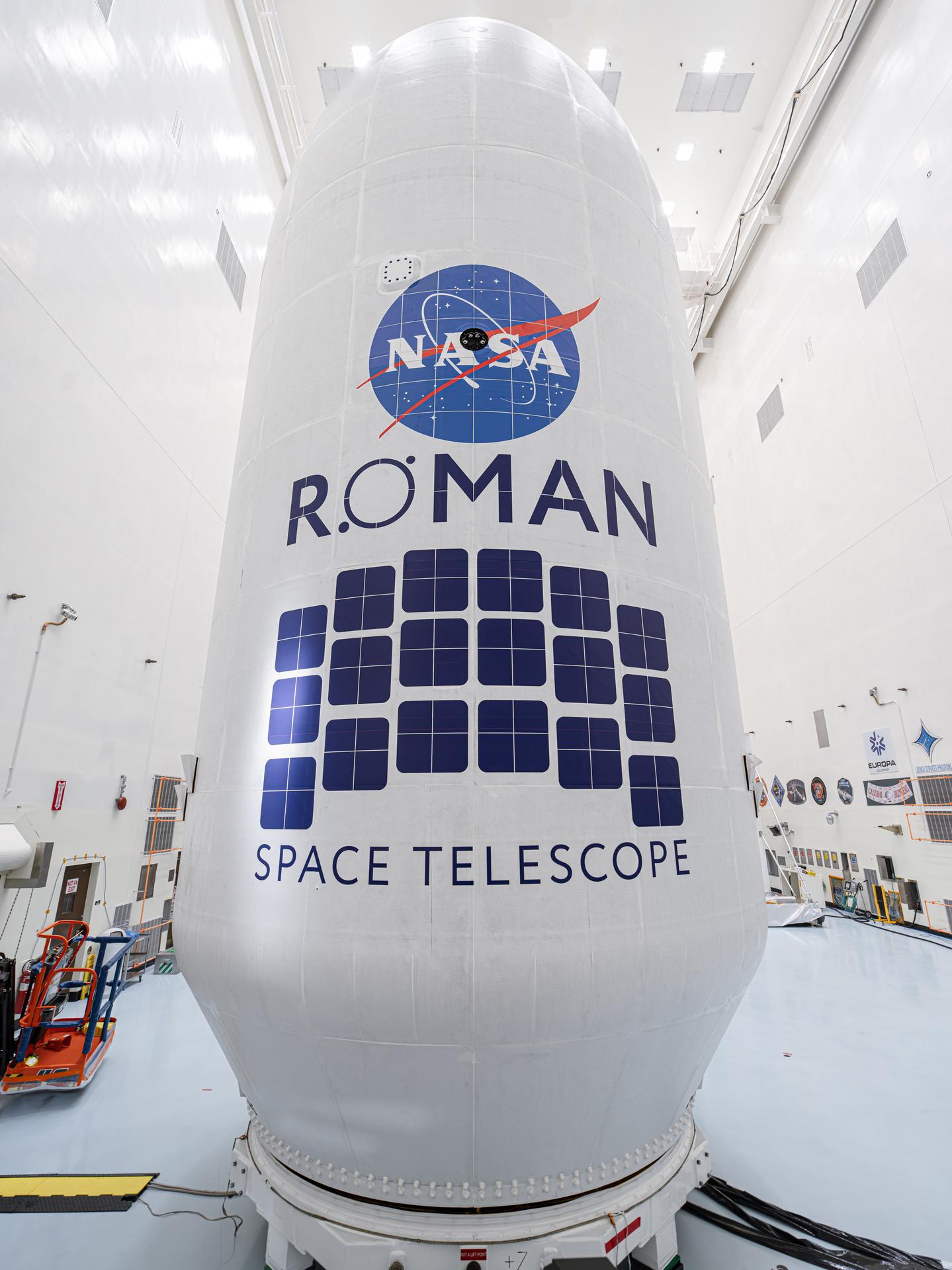
At 7:26 a.m. EDT on Aug. 30, 2026, a SpaceX Falcon Heavy lifted off from Launch Complex 39A at Kennedy Space Center, carrying NASA's Nancy Grace Roman Space Telescope away from Earth in the pre-dawn dark. "What a glorious dawn launch," NASA's Jackie Townsend, the Roman telescope's project manager, said at a press briefing shortly after liftoff — a line NPR made the headline of its own coverage, and for once the description undersells the stakes: Roman is the space agency's next major flagship observatory, capping more than a decade and roughly $4 billion in development to answer questions Hubble and even the James Webb Space Telescope were never designed to tackle.
The mission is not headed for low Earth orbit or even the relatively cramped territory around the Moon. Roman is bound for the second Sun-Earth Lagrange point, L2, a gravitationally stable perch roughly one million miles from Earth where the James Webb Space Telescope already operates. Getting there will take about three months of coasting.
The early signs were good. According to NASA's launch statement, the observatory's solar panels and sunshade — both critical, both irreversible if they fail — deployed successfully within 83 minutes of liftoff. Space.com reported a clean separation from the Falcon Heavy's second stage roughly 31 minutes after liftoff, and about 70 minutes after launch, controllers handed the spacecraft off from near-Earth tracking networks to NASA's Deep Space Network, the same antenna system that talks to spacecraft at the outer planets. NASA Administrator Jared Isaacman said the telescope was "delivered ahead of schedule and on budget" — a rare enough combination in flagship astrophysics that it's worth stating plainly rather than taking at face value from a press release; it echoes what independent launch coverage from Space.com and NPR corroborates about the mission proceeding cleanly.
What Makes Roman Different
Roman's centerpiece is a 300-megapixel infrared camera built around 18 individual detectors. On paper, that's not dramatically sharper than Hubble's vision. What sets it apart is the size of the picture it takes. NPR reports Roman's field of view is at least 100 times larger than Hubble's, and NASA states the telescope will survey the sky roughly 1,000 times faster than its predecessor.
Hubble, after more than three decades in orbit, still sees the universe through what amounts to a soda straw — extraordinary detail, but one small patch of sky at a time. Roman inverts that trade-off. Instead of staring at a single galaxy or star field, it will sweep across wide swaths of the sky and catalog everything in view. NASA estimates the telescope will transmit 1.4 terabytes of data every day, a volume that reflects just how much sky it's designed to cover. Space.com reports that Roman's survey of our own Milky Way alone is expected to catalog roughly 20 billion stars — what Roman senior project scientist Julie McEnery called, during launch-day commentary, the largest catalog of astronomical objects ever produced.
That combination — wide field, high resolution, infrared sensitivity — is purpose-built for a specific kind of science: finding statistical patterns across enormous numbers of galaxies rather than portraits of individual ones.
Why It Matters
Roman's primary targets are two of the biggest unsolved problems in physics: dark matter and dark energy. Neither has ever been directly observed. Dark matter is inferred from its gravitational pull on galaxies and galaxy clusters; dark energy is inferred from the accelerating expansion of the universe itself. Both explanations rest on indirect evidence, and testing them requires exactly what Roman is built to deliver — statistically enormous surveys covering huge volumes of sky and enough galaxies to detect subtle patterns in how light bends and how galaxies cluster over cosmic time.
A telescope that can image 1,000 times faster than Hubble and see 100 times more sky at once isn't just a faster version of the same tool — it changes what kind of questions are answerable at all. Individual observatories like Hubble and Webb excel at close, detailed study of specific objects. Roman is designed for census-taking on a cosmic scale, the kind of survey work that underpins large-scale tests of cosmological models. The same wide-field design that suits dark energy surveys also makes Roman a powerful exoplanet hunter, since scanning huge numbers of stars simultaneously is exactly how transit and microlensing surveys find new worlds.
If the mission performs as designed, Roman won't just add one more picture to the astronomical record — it will generate a dataset large enough to constrain, or upend, the models scientists currently use to describe the dark matter and dark energy that make up most of the universe's contents.
What Comes Next
For now, Roman is in transit, still months away from its L2 destination. Commissioning is already underway during the cruise — checking out its instruments, calibrating the camera, and confirming systems function as expected in the cold, stable environment of deep space — with the process wrapping up around the time the observatory reaches L2. NASA has targeted early 2027 for the release of Roman's first public images, the moment when the mission shifts from engineering milestone to active science instrument.
Until then, the successful deployment of the solar panels and sunshade, and the clean handoff to the Deep Space Network, represent the easy part. The three-month cruise to L2 — with commissioning running throughout — is where flagship missions historically face their most nerve-wracking moments, and where Roman will need to prove it can deliver on the ambitious survey it was built for.
