
Six months after four astronauts swung around the Moon, the observations from that flyby are now available to anyone. On Oct. 7, NASA uploaded more than 800 GB of Artemis II lunar science data to its Planetary Data System, the archive researchers use for planetary mission data. It also published an Artemis II Preliminary Lunar Science Report, an overview of what the crew saw and did.
NASA calls the release the first planetary science dataset captured primarily by humans in more than half a century. The phrasing matters. Robotic orbiters have mapped the Moon in great detail for decades, so the value here is not new coverage. NASA says the crew's quick decisions about what to observe, their perceptions of color and their discussions of the surface complement decades of Apollo and robotic data.
What's in the archive
According to NASA, the release contains:
- More than 11,000 full-resolution images and video clips, taken with handheld cameras and cameras mounted on Orion
- 8.5 hours of crew audio
- Images the crew annotated themselves
- Three companion documents: the Preliminary Lunar Science Report, a Lunar Science Operations Report, and a Lunar Science Data User Guide
The crew was NASA astronauts Reid Wiseman, Victor Glover and Christina Koch, plus Canadian Space Agency astronaut Jeremy Hansen. Their lunar flyby took place on April 6, 2026, and the full mission lasted 9 days, 1 hour and 32 minutes, Universe Today reports.
A note on the numbers: Space.com's coverage of the Oct. 7 briefing gave smaller figures for what it described as the first batch of data. This article uses NASA's totals for the full release throughout.
Five flashes on the night side
The finding that got the most attention at the briefing was a set of impact flashes. These are brief bursts of light produced when small meteoroids hit the lunar surface fast enough to make a visible glint. The crew reported seeing them, and the science team has since confirmed five. "Definitely impact flashes on the moon," Wiseman said, according to Space.com.
Impact flashes last only a moment and are easy to miss. Catching them depends on someone looking at the right patch of dark surface at the right time. A crew watching continuously and calling out what they see is well suited to that kind of event, and Universe Today says the direct observations will help scientists constrain how often such impacts occur.
A Moon with more color than expected
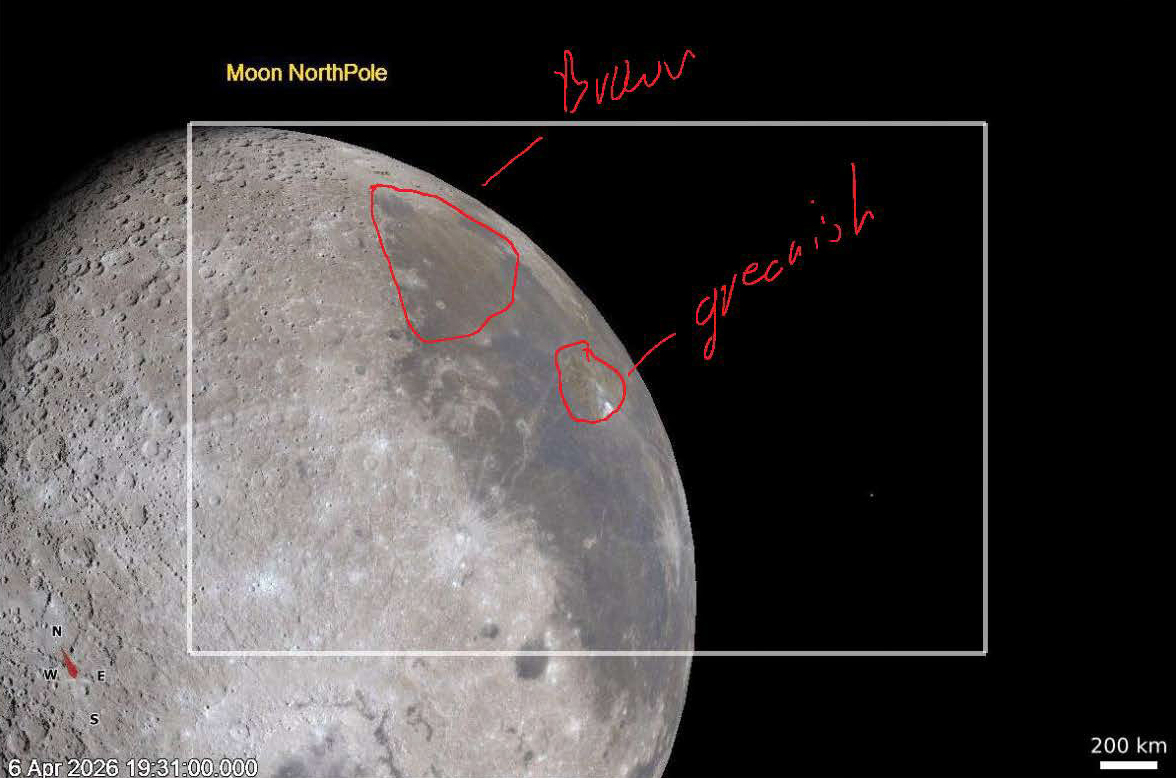
Photographs usually show the Moon as gray. The crew's descriptions did not. The Artemis II reports describe lunar color ranging from green to blue. Scientist Ariel Deutsch pointed to greens and yellowish hues the crew noted around the Aristarchus Plateau, Space.com reported. Deutsch said the colors signal remnants of different styles and epochs of volcanic activity, and the crew contrasted them with the browns and grays of nearby volcanic plains.
NASA has also published a companion field guide to the report, "Artemis II: Sights & Sounds of Science," which Universe Today describes. The Universe Today write-up quotes Koch describing the whole Earth as "electric blue" as seen from the spacecraft. For the Moon, Universe Today says scientists can compare the crew's handheld-camera observations with data from NASA's Lunar Reconnaissance Orbiter.
A first look at part of the far side
The flyby's geometry also produced a first in history. Alex Stoken told reporters that the crew was the first in human history to see a particular section of the far side while it was illuminated, Space.com reported.
Fifty-four minutes in the Moon's shadow
The most dramatic observation was an eclipse. From Orion, the crew saw the Moon fully block the Sun for 54 minutes, according to Universe Today's summary of the report. Universe Today notes that is far longer than a solar eclipse lasts on Earth. Nearly an hour gave the astronauts an unusually long look at the solar corona and at zodiacal light, the soft light reflected by interplanetary dust.
The crew also looked back at Earth. A photo taken on the mission's second day, lit by the Moon rather than the Sun, shows auroras at both poles, a plume of Saharan dust and the lights of cities. It is a reminder that the archive covers more than the Moon.
Why It Matters
NASA says the crew trained in classrooms, simulations and field environments for lunar observation. The crew's observations are archived next to the images and audio that support them, along with a user guide so outside researchers can work with the material.
That matters for what comes next. NASA says what it learned from Artemis II is already informing planning for Artemis III. Future surface work will likely lean on astronauts making quick observation calls, and Artemis II offered a chance to practice that from orbit. The confirmed impact flashes and the color reports are early signs that trained human observers can add something even at a body robotic spacecraft have studied for decades.
The release also gives a broad audience direct access to an unusual record: 8.5 hours of people describing the Moon as they flew past it, available alongside the pictures they were taking.
