
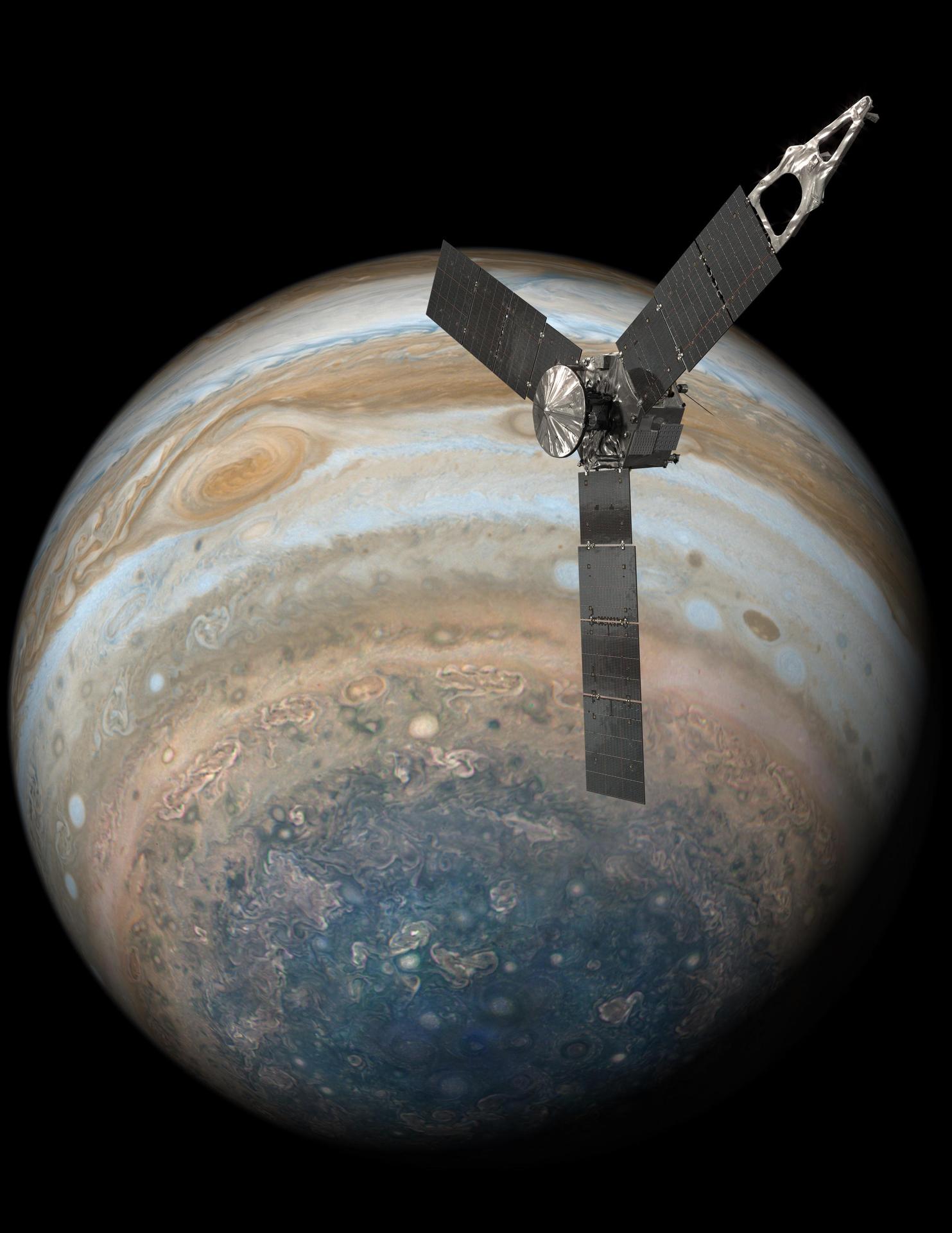
The usual picture of Jupiter's magnetodisk is simple: a broad sheet of electric current that lies near the planet's magnetic equator and turns with the planet. Because Jupiter's magnetic dipole is tilted, the sheet wobbles up and down as Jupiter spins. A spacecraft in its path should see the sheet pass about twice per rotation, which means about once every five hours, since a Jovian day lasts about 9.9 hours.
NASA's Juno spacecraft has recorded something messier. A team led by Shandong University analysed Jupiter's magnetic field and energetic-particle activity, using new Juno data. They found that during magnetic reconnection events, the current sheet does not glide past in one tidy pass. It ripples. Juno crossed it again and again within a single rotation and picked up the same reconnection signature nearly every time. The study, "Rippling current sheet generated by magnetodisk reconnection on Jupiter," appeared in Science China Earth Sciences on August 5, 2026. Universe Today covered it on October 13.
From a tilted disk to a moving wave
The paper's abstract starts with a known problem. Earlier observations had picked up small-scale "flapping" motions in Jupiter's magnetodisk, and nobody had pinned down where they came from. The tilted-dipole wobble explains the large, regular swing of the sheet. It does not explain faster, smaller movements on top of that swing.
The Shandong-led team links those movements to magnetic reconnection. In reconnection, magnetic field lines break and rejoin in a new arrangement, and stored magnetic energy goes into the surrounding particles. The team reports that when reconnection is under way, the current sheet "behaves as a kink-like wave" as it moves past the spacecraft. The sheet does not cross Juno cleanly. It keeps moving back and forth over it, so Juno recorded several reconnection signals in one planetary rotation.
Universe Today, summarising the work, says these ripples last anywhere from several minutes to more than an hour. On almost every crossing, Juno saw the same magnetic signature along with bursts of energized electrons and ions. That points to one large disturbance being sampled again and again, not a string of unrelated events.
Many small breaks across a wide swath
The proposed mechanism is spread out. The researchers did not find one dominant reconnection site. They describe many small reconnection sites spanning roughly 100 degrees of longitude. Each one breaks magnetodisk field lines locally. Together they push the current sheet out of equilibrium and leave it with a rippled shape.
The ripples are not left behind in space while the planet turns. The abstract says the rippling structure rotates with the magnetosphere. A spacecraft sitting in roughly one place relative to Jupiter would therefore see the corrugated sheet sweep past it repeatedly, and that is the pattern Juno recorded.
Not quite like Earth
Earth has a comparable structure: the current sheet in its magnetotail, the long stretch of magnetic field pushed away from the Sun by the solar wind. Kink-like waves appear there too. According to Universe Today's account, the key difference is direction. At Earth, the kink wave moves away from the reconnection site. At Jupiter, the rippled structure turns along with the rapidly rotating magnetosphere.
The difference shows how much rotation controls Jupiter's environment. A kink wave that moves away from its reconnection site at Earth appears, at Jupiter, as a structure carried around by Jupiter's spin and passed through again and again, which would explain why a spacecraft gets several looks at the same event.
Why It Matters
The magnetodisk is not just a geometric feature. It holds and moves a great deal of charged material. Universe Today notes that the results bear on how particles from Io's volcanoes are accelerated and transported, and on how Jupiter's ionosphere is coupled to the magnetodisk. If reconnection regularly crumples the current sheet over about 100 degrees of longitude, the sheet's ability to energize particles and move them around may be more patchy and changeable than a smooth-disk model would suggest.
The study also has practical uses. Repeated crossings in a single rotation give researchers several samples of one reconnection episode, where they would otherwise have had a single snapshot. The repeated bursts of energized electrons and ions show that the particle response follows the rippling sheet. That is useful evidence for anyone modelling where Jupiter's energetic particles come from.
The full paper sits behind a paywall. What is public is the abstract and the press coverage, and neither gives event counts, dates of the individual Juno orbits used or uncertainty estimates. Readers who want to judge how far the result generalizes will need the full text. The central claim is clear, though: at least during reconnection, Jupiter's magnetodisk behaves less like a rigid tilted plate and more like a flag rippling in the wind.
The spacecraft behind it
According to NASA's mission page, Juno launched on August 5, 2011, and reached Jupiter in 2016 after a five-year, 1.7-billion-mile journey. Its first orbit took 53 days, reaching from Jupiter's cloud tops to the frontiers of its magnetic field. NASA describes Juno as the first orbiter to peer so closely beneath the giant planet's dense clouds. Universe Today reports that its extended mission is scheduled to run until September 2028, which leaves time to catch more of these ripples as they pass.
