
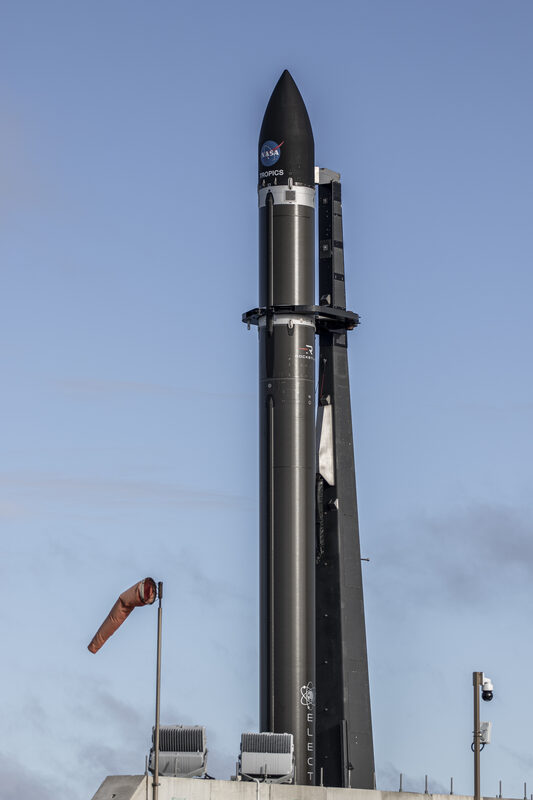
At 12:01 a.m. New Zealand time on September 3, an Electron rocket lifted off from Rocket Lab's Launch Complex 1 on the Mahia Peninsula, arced over the Pacific, and dropped a synthetic-aperture-radar satellite into a 575-kilometer orbit. Nothing about the sequence made headlines in the way a first flight or a failure would. That, increasingly, is the point.
The mission, nicknamed "Owl Around The World," was Rocket Lab's 94th Electron launch since the vehicle debuted, and its 15th of 2026 alone — a cadence the company now treats as routine enough to fold into a single-paragraph press release rather than a multi-day countdown story. The payload was a StriX radar satellite for Synspective, a Japan-based company building a constellation of SAR spacecraft that can image the ground regardless of cloud cover or daylight. It was the eleventh Synspective satellite Rocket Lab has flown.
A Customer Relationship Measured in Years, Not Launches
What makes this flight worth a closer look isn't the satellite itself but the contract underneath it. Rocket Lab has been Synspective's sole launch provider since 2020. Six years and eleven satellites later, that relationship now extends further: Rocket Lab says 16 more Synspective missions are already booked to complete the constellation's deployment before 2030. SpaceNews, in its own reporting on the launch, singled out Synspective as one of two customers who together account for a significant part of Rocket Lab's launch activity — a reminder that Electron's business isn't a portfolio of one-off contracts so much as a small number of deep, recurring relationships with constellation operators who need frequent, dedicated rides to specific orbits.
That's a different value proposition than the rideshare model larger vehicles lean on. A SAR constellation like Synspective's needs satellites spread across specific orbital planes to maximize revisit rates over a given patch of ground, and waiting for room on a shared rocket headed to a different orbit doesn't serve that goal. Rocket Lab's pitch — and Synspective's repeated purchase of it — is that a dedicated small launcher on a predictable cadence is worth paying for even when it costs more per kilogram than a rideshare seat.
Rocket Lab, for its part, has taken to describing itself as "the world's most frequently launched small-lift orbital rocket," a claim that's hard to dispute at this point given the pace: 15 missions in the first eight months of 2026 works out to roughly one Electron flight every 16 days on average. The company also notes a perfect, 100 percent mission-success record across all of its Synspective launches to date — a streak that matters more to a repeat customer than to headline writers, since a single failure in a dedicated-orbit constellation build-out can set a company's coverage plans back by months.
Flying Under a New Licensing Regime
The launch also landed inside a regulatory shift that's been reshaping how every US-licensed commercial vehicle gets off the ground. On March 17, 2026, the Federal Aviation Administration announced that all commercial launch and reentry licensing now occurs under a single framework, Part 450, which consolidates four earlier rule sets into one. Operators had to complete the transition to Part 450 by March 9, 2026, to keep flying without interruption, and the FAA's list of vehicles that made the cut is a roster of the industry's current workhorses: SpaceX's Falcon 9, Falcon Heavy, and Dragon; Blue Origin's New Shepard; Firefly's Alpha; ULA's Atlas and Vulcan — and Rocket Lab's Electron.
The FAA says it has issued 14 Part 450 licenses since the rule took effect in March 2021 — a volume the old, vehicle-specific licensing structure wasn't built to streamline. Part 450 was designed to let an operator license a vehicle once, covering a portfolio of operations, vehicle configurations, and mission profiles, rather than seeking a fresh approval for every variation. For a company flying Electron on a near-monthly cadence out of Mahia, that kind of streamlined, one-license-covers-many approach isn't a footnote. It's close to a prerequisite for the flight rate Rocket Lab has been advertising.
Why It Matters
Individually, a single Electron launch carrying a single radar satellite is a minor entry in the 2026 launch log. Collectively, the pattern it represents is not. Rocket Lab has now flown Electron 94 times, and the fact that a mission like this one generates a routine "mission success" release rather than a nail-biting webcast is itself evidence that dedicated small-lift launch has moved from experimental to operational. Synspective's decision to keep buying — with missions now booked out toward the end of the decade — is a vote of confidence from a customer with the most to lose if reliability slips, since a SAR constellation's commercial value depends on maintaining consistent global revisit times.
The regulatory backdrop matters too, even if it's less visible than a rocket plume. The FAA's move to a single Part 450 framework is meant to let the launch industry scale past the days when each vehicle needed its own bespoke set of licensing rules. Whether that consolidation actually reduces friction for high-cadence operators — or simply relocates the paperwork — will become clearer as more of the vehicles now flying under Part 450 rack up repeat missions. Electron, with its short build cycle and frequent flights, is as good a stress test of that streamlined process as any vehicle currently flying.
