
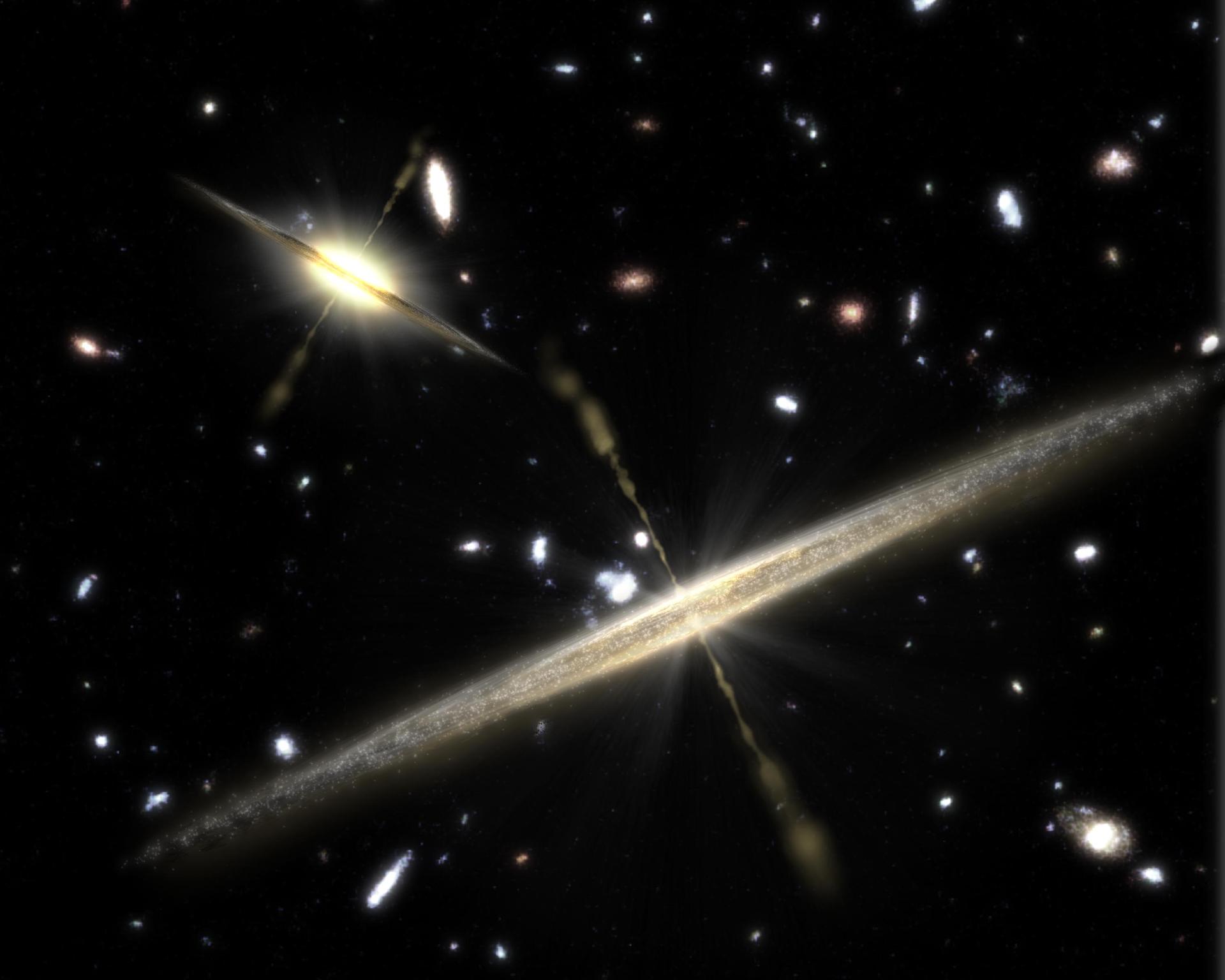
The textbook picture of a galaxy puts a supermassive black hole at its center, sitting quietly at the bottom of the gravitational well. A new simulation study from Yale suggests that picture is too tidy, at least for smaller galaxies. In the simulated universe the team built, many black holes are not at the center at all. They drift through their host galaxies for billions of years, and their whereabouts may preserve a record of how the first black holes formed.
The work, led by Emma Jane Weller and Priyamvada Natarajan of Yale together with Colin Burke, a recent National Science Foundation Prize postdoctoral fellow at Yale who is now on the faculty of the University of North Texas, appears in The Astrophysical Journal Letters. According to Yale News, the authors used the ASTRID cosmological simulation to follow black holes through galaxies ranging from 10 million to 1 trillion solar masses of stars, across roughly 12.6 billion years of evolution.
A simulation that lets black holes move
The key design choice is what ASTRID does not do. Many simulations pin each black hole to the center of its galaxy, which guarantees a central black hole by construction. Yale News notes that ASTRID does not force black holes to stay at galaxy centers. That freedom lets them behave as gravity dictates. When galaxies merge, the black hole from the smaller galaxy can end up displaced rather than sinking to the middle of the new, larger system.
Space.com describes ASTRID as tracing about 13.5 billion years of cosmic history, reaching back to roughly 300 million years after the Big Bang. In its account, the team modelled galaxies of 10 million to 1 billion solar masses in stars over about 12.6 billion years. The two outlets describe the mass range differently; the preprint abstract gives 107 to 1012 solar masses, matching Yale News. The wider point holds in both: the study covers a long stretch of cosmic time and a broad range of galaxy sizes.
What the occupation fraction shows
The companion preprint, "The black hole occupation fraction as a fossil record of seeding, dynamics, and galaxy assembly" (arXiv:2607.09853), gives the quantitative version. The authors measured the black hole occupation fraction, meaning the share of galaxies that host a black hole, split into total, central and wandering populations. They tracked it in ASTRID from redshift 5 to redshift 0, for galaxies with stellar masses between 107 and 1012 solar masses.
Three results stand out from the abstract:
- The total occupation fraction stays close to unity across most stellar masses and redshifts. Nearly every galaxy in that range hosts a black hole, wherever it sits.
- At low masses, the central occupation declines toward the present day while the wandering occupation rises. Small galaxies lose centered black holes and gain wanderers.
- Star-forming low-mass galaxies preferentially host wandering rather than central black holes.
Yale News adds the flip side: low-mass galaxies that have stopped forming stars are more likely to contain centered black holes. So a galaxy's star-formation state correlates with whether its black hole is home or roaming.
Why small galaxies keep the record
Low-mass galaxies are where the effect is strongest, and also where the information is best preserved. According to Yale News, low-mass galaxies retain information about the population of black hole seeds they started with, even after billions of years of growth and mergers. The preprint reports that the heavy-seed occupation is substantially smaller at the low-mass end. In other words, what a small galaxy hosts today depends on how the earliest black holes were born.
This connects to a long-running debate. Black holes may have started as "light" seeds, the remnants of the first stars, or as "heavy" seeds formed by more massive collapse processes such as the direct collapse of pristine gas. Yale News identifies Natarajan as a leading proponent of the heavy-seed picture. Space.com reports that if wandering black holes carry a record of their birth, they could help settle the light-seed versus heavy-seed debate.
Finding a black hole that isn't where it should be
A prediction from a simulation is only useful if it can be tested. Yale News says the researchers describe a framework that would include deep X-ray observations, optical and infrared spectroscopy, radio measurements, and searches for brief flares caused by stars being torn apart by black holes. As Weller put it, each of these methods can probe different parts of the population.
Off-center black holes are likely hard to catch. A black hole with no gas to feed on emits little, and in a dwarf galaxy any signal is faint to begin with. Combining several methods, as the team suggests, is one way to cover different parts of the population.
Why It Matters
Black hole seeding happened in the early universe, far beyond direct observation of the seeds themselves. Astronomers have to infer it from what survives. This study proposes that one survivor is the demographics of low-mass galaxies: how many host a black hole, and whether it sits at the center or wanders. If real galaxies match the simulation, a census of black holes in dwarf galaxies could become a way to test seed models.
It also cautions against a common assumption. Searches that look only at galaxy nuclei could undercount black holes in small systems, because in this simulation a growing fraction of them are elsewhere. The total occupation stays close to one, but the central occupation falls.
Caveats apply. Everything above comes from a simulation, and the results depend on how ASTRID models black hole formation, dynamics and mergers. The real universe has to be checked against the predictions, and the observational approaches Yale News describes are the route to doing that.
Sources
- Roaming black holes may tell the hidden history of galaxies (Yale News, Sept. 23, 2026)
- The black hole occupation fraction as a fossil record of seeding, dynamics, and galaxy assembly (arXiv:2607.09853)
- Rogue black holes could wander the cosmos sharing the histories of their home galaxies (Space.com)
