
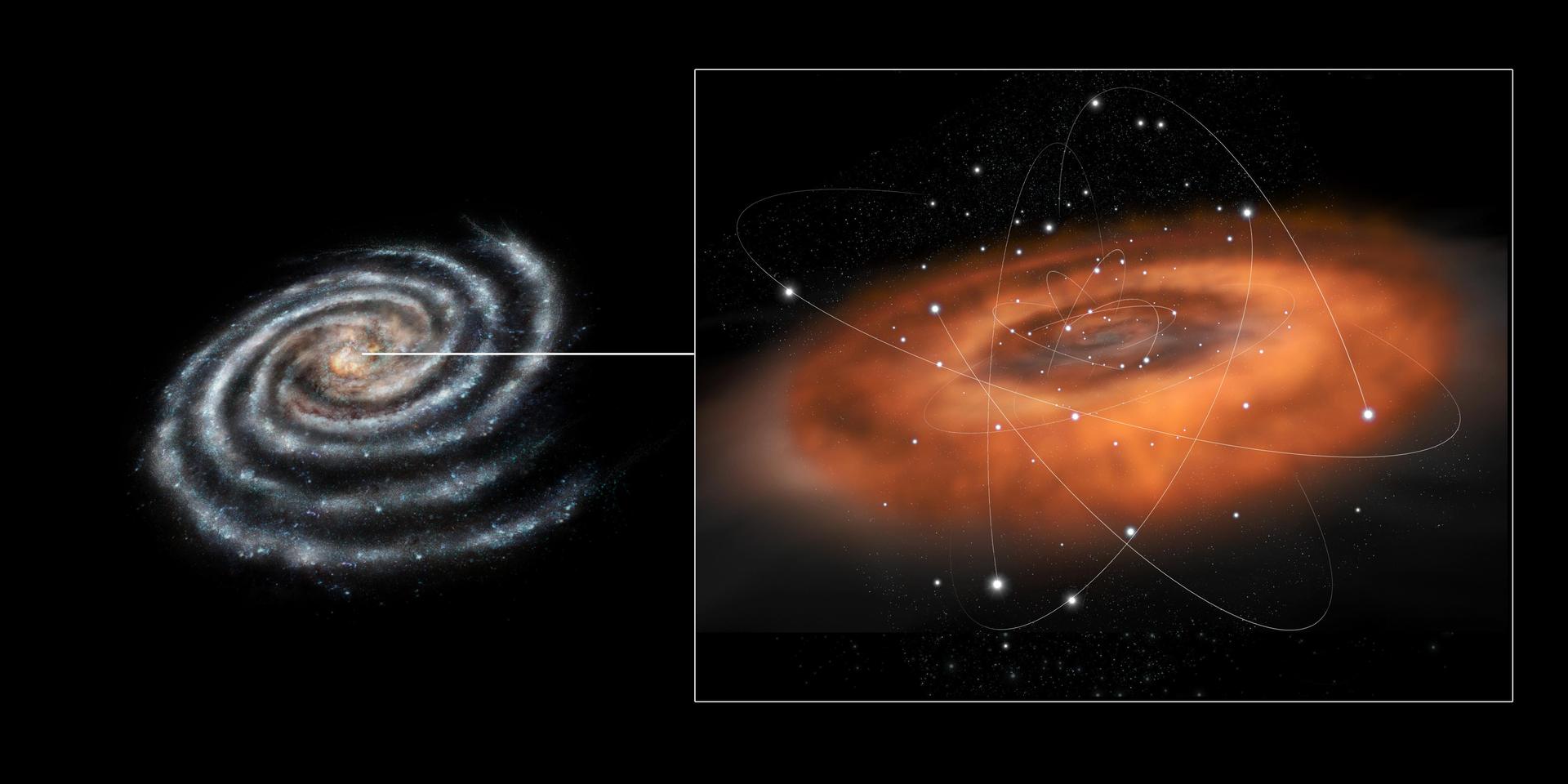
The gas swirling around Sagittarius A*, the supermassive black hole at the center of the Milky Way, is not pristine. According to a new study using the James Webb Space Telescope, it carries roughly 1.8 times the Sun's abundance of heavy elements, and the most likely source is generations of stars that lived and exploded near the galaxy's center.
The work, led by Nicole Ford, a PhD student at McGill University's Trottier Space Institute, appeared in The Astronomical Journal (Ford et al. 2026, AJ 172, 267), and McGill announced it on Oct. 19. Co-authors include Mayura Balakrishnan, Sebastiano von Fellenberg and Daryl Haggard. The team used JWST's MIRI MRS instrument to map the central 0.1 parsec around Sgr A*, a region that includes the Galactic Center Minispiral, a structure of warm ionized gas and dust.
A chemical census at subparsec scales
Sgr A* has a mass of about 4 million Suns. The gas around it is not a smooth disk but a set of distinct structures. The study looked at three, distinguished by radial velocity: the Bar, the Northern Arm, and a group of fast-moving Blue-shifted Compact (BC) structures. For each, the researchers measured abundances of neon, argon, sulfur, nickel and iron.
The headline result is that the Minispiral gas is mildly super-solar, at about 1.8 times solar metal abundance. In astronomers' usage, "metals" covers the elements heavier than hydrogen and helium, which stars forge and then return to their surroundings when they die. The McGill team says the gas was probably enriched by stars that exploded and released material into the black hole's surroundings over time.
There is a second clue in the chemistry. The composition of the gas is similar to that of many of the stars in the black hole's orbit, which the researchers read as a sign that the gas and those stars may have formed together.
Lit by Wolf-Rayet stars, scrubbed of dust
The spectra also say something about what is lighting up the gas. Using fine-structure emission lines spanning ionization potentials of roughly 7 to 55 eV, the team found a radiation field consistent with Wolf-Rayet stars, with an ionization parameter (log U) in the range of roughly -1.6 to -0.6. Wolf-Rayet stars are massive, evolved stars, and the result points to them as the driver of the gas's ionization.
The measurements of nickel and iron revealed significant dust destruction. Those elements normally get locked up in dust grains, so seeing them in the gas phase suggests the grains have been broken apart.
Some of the most dramatic gas sits closest to the black hole. Several compact structures, including a feature known as X7, appear within about 0.05 parsec of Sgr A* in the plane of the sky and move with blue-shifted radial velocities of roughly 600 km/s or more. Their enhanced ionization and strong dust processing suggest, according to the paper, that these features may experience localized fast shocks.
Why the black hole is on a diet
Sgr A* is the nearest quiescent supermassive black hole, and the study was partly motivated by how little it eats. "We know there's a black hole at the centre of our galaxy pulling material into itself, but we see that it's eating a lot less material than other supermassive black holes, and more slowly," Ford said in the McGill announcement.
Metallicity could, in principle, matter here. The McGill release notes that metals influence how quickly gas cools, which in turn influences how readily it can be drawn into a black hole. But as Universe Today notes in its coverage, a metallicity of 1.8 times solar is only modest and cannot really drive faster cooling and inflow. In other words, the enrichment is real, but on that reading it does not on its own explain why Sgr A* is fed so sparingly.
The picture is complicated further by Sgr A East, a supernova remnant that overlaps Sgr A* on the sky. A companion study in The Astrophysical Journal led by Balakrishnan tested whether the gas preserved evidence of past bursts of energy from the black hole. McGill says it found the gas emission is shaped by local conditions, making it difficult to isolate the black hole's influence, so the surrounding gas cannot provide a reliable history of the black hole's activity. Universe Today reports that another recent paper on Sgr A East points to the remnant as a source of both metal enrichment and heat in the gas near the black hole.
Why It Matters
The environment around a supermassive black hole sets the menu it eats from. By measuring several elements across distinct gas structures, the JWST data give a chemical fingerprint of that menu, and the researchers read it as the product of exploded stars rather than something unconnected to the stars that surround the black hole.
That matters for two reasons. First, the similarity between the gas and the orbiting stars suggests the black hole's fuel supply and its stellar neighbors may share a history. Second, the modest level of enrichment suggests metal-driven cooling is probably not the deciding factor in how much Sgr A* accretes. Ford said that understanding how the black hole attracts material will require comparing these observations with simulations of how gas evolves over longer timescales.
Because Sgr A* is closer to Earth, and therefore easier to see, than any other supermassive black hole, it offers a unique opportunity to study the fuel supply of a quiet black hole in detail. The McGill researchers suggest the findings could also advance understanding of how metals are distributed around supermassive black holes in more distant galaxies.
Sources
- Ionization Structure and Metal Enrichment of the Galactic Center Minispiral Observed with JWST (arXiv:2605.13995)
- The gas around Milky Way's central black hole is rich in metals, study finds (McGill University Newsroom)
- The Gas Near Sagittarius A-star is Enriched in Metals, Probably from Supernovae Explosions (Universe Today)
