
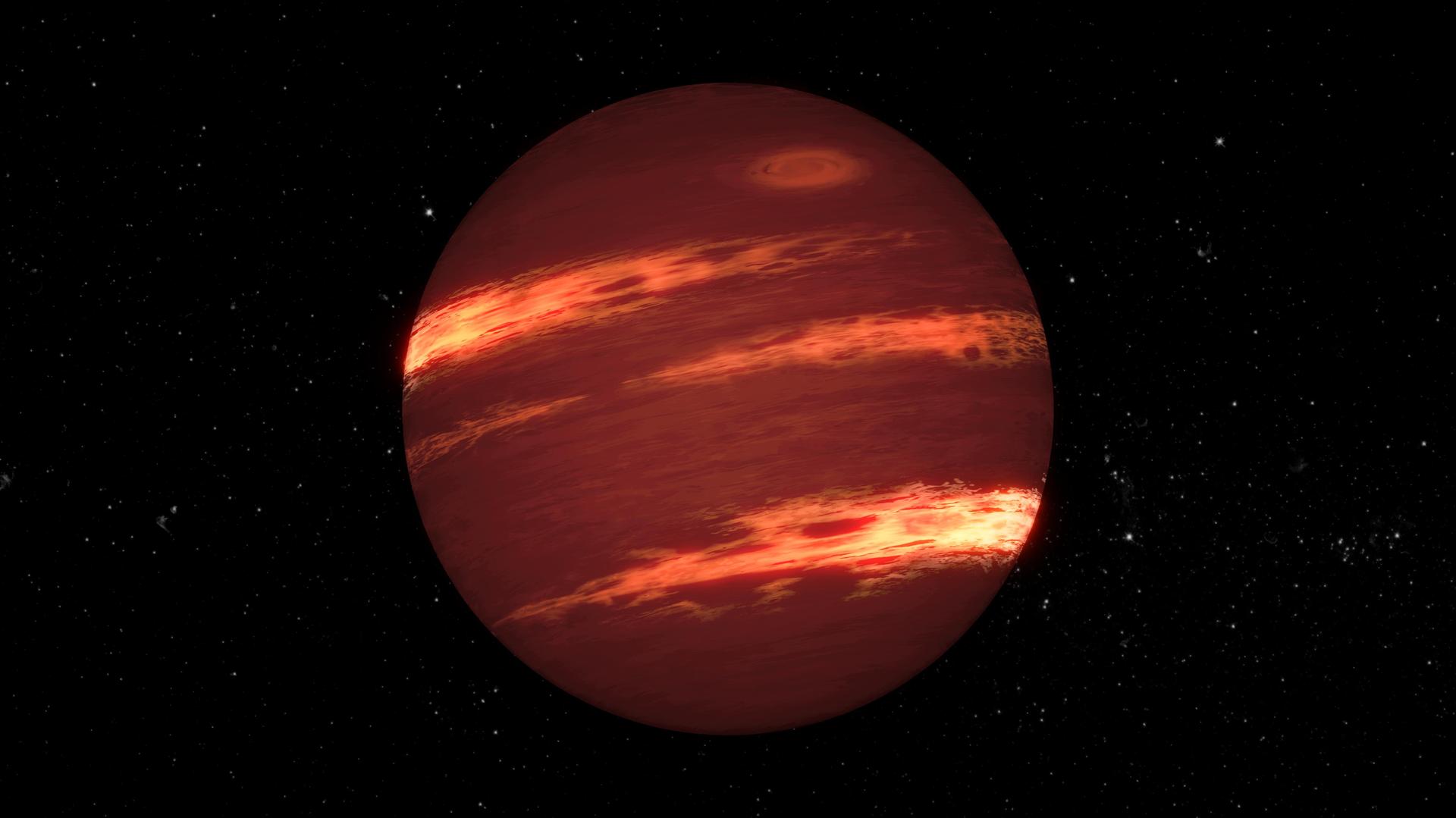
WISE 0855 is close to us but hard to study. The brown dwarf sits about 7.2 light-years away in the constellation Hydra, according to Universe Today. Its upper atmosphere is about 265 K, or roughly -8 °C, which makes it the coldest brown dwarf known. Kevin Luhman discovered it in 2014 in data from NASA's WISE survey. It is classed as a Y dwarf, is about the size of Jupiter, and, according to Universe Today, weighs between 3 and 10 Jupiter masses. That puts it between the lightest stars and the giant planets.
A team led by Brittany Miles, an assistant astronomer at the University of Arizona's Steward Observatory, pointed the James Webb Space Telescope at the object for 11 hours. They wanted to know whether its atmosphere changes over time and what drives those changes. Their answer: patchy water clouds, along with chemical signatures that vary together as the object turns. The work appears as arXiv:2609.20664, "Water Cloud and Chemical Modulations in the Coldest Brown Dwarf," with co-authors including Mang, Morley, Skemer, Rowland and Lacy.
What Webb actually measured
The observations are a time series, not a single snapshot. Webb's NIRSpec instrument took spectra every 15 minutes for 11 hours, covering wavelengths from 2.87 to 5.27 microns at a resolution of about R~1000, according to the arXiv abstract. Universe Today reports that the team used NIRSpec's Bright Object Time-Series (BOTS) mode and lined up 44 back-to-back snapshots.
The method relies on rotation. As a brown dwarf spins, different parts of its atmosphere turn toward the telescope. If clouds or gas concentrations are uneven, the spectrum shifts slightly from one exposure to the next. Recording those shifts across many wavelengths lets researchers probe the atmosphere's structure even though the object appears as a single point of light.
The biggest changes came from carbon monoxide. The paper reports CO absorption as the strongest variable feature, with peak-to-peak swings of up to 10% at some wavelengths. Universe Today places the largest swings between 4.5 and 4.8 microns, the CO band.
Two patterns at different depths
The team used principal component analysis (PCA), a statistical method that splits a messy dataset into a few independent patterns. The paper reports that the variations in carbon monoxide and phosphine (PH3) correlate with one another. According to Universe Today, the strongest pattern accounts for about 60.5% of the variability and tracks an overall dimming and brightening, linked to surface temperature variation and possibly to changes in water clouds. A second pattern, accounting for about 4.7%, appears in the carbon monoxide and phosphine absorption bands and differs from the overall brightness curve, which suggests it comes from much deeper in the atmosphere.
The paper says the CO and PH3 variations must originate from "quenched" atmospheric pressures, while variations in water cloud thickness occur at lower pressures. In a quenched region, mixing from below sets the gas abundances faster than chemical reactions can restore equilibrium. So two different processes at two different depths seem to be shaping the light at once.
The case for water clouds
WISE 0855 is cold enough that water clouds are plausible, but astronomers have questioned for a decade whether it has them. Universe Today explains the debate: the spectrum could be explained by water clouds blocking light from deeper layers, or by "disequilibrium chemistry," where updrafts flood the upper atmosphere with gases such as carbon monoxide, carbon dioxide and phosphine. According to Universe Today, the team compared the spectra against two atmospheric modeling codes, PICASO and coolTLUSTY. Both fit much better when water clouds were included. The best-fitting picture has patchy clouds near the top of the atmosphere, at roughly 1 to 4 bar.
The paper itself describes this as "evidence of patchy water clouds." That wording is more careful than the University of Arizona release, which ran on Astrobiology.com under the headline "First Detection Of Variable Water Clouds Outside Of Our Solar System." The release calls WISE 0855 cloudy and chemically complex. It also differs from Universe Today on two figures: it gives the distance as about 7.5 light-years rather than 7.2, and the mass as about twice Jupiter's rather than 3 to 10 Jupiter masses.
What's still unknown
Universe Today notes that the rotation period of WISE 0855 is still unknown, because gas moving around the surface obscured the object's actual rotation. The researchers think they could determine it with roughly 20 more hours of Webb time. Until then, it is hard to say how much of the object's surface the 11 hours covered, or whether a given rise and fall in brightness comes from rotation alone or from the weather changing during the observation. Longer monitoring would help separate the two.
There is also the question of where the paper stands. The University of Arizona release, as posted on Astrobiology.com, says the study was published in The Astrophysical Journal. The arXiv listing, submitted on 17 September 2026, instead says "accepted to AJ." We could not confirm a journal version, so readers should treat the arXiv version as the reference text.
Why It Matters
WISE 0855 is about the size of Jupiter and has no bright host star whose light has to be subtracted. Miles argues in the University of Arizona release that the basic physics of convection, clouds and chemistry that governs Jupiter also applies to this cold, free-floating world, and so may apply to the gas giant exoplanets that astronomers are beginning to study with Webb. As she put it, "Even though brown dwarfs are not true planets, they exhibit planet-like behavior."
The study also makes a broader point about method. One averaged spectrum would have hidden what this time series shows: an atmosphere with structure at more than one depth. Clouds change at one level while mixing from below changes the chemistry at another. Before Webb, Miles says in the release, researchers had only photometry, which mixed up the effects of clouds, chemistry and temperature. Webb's medium-resolution spectra let the team tell them apart.
The 10% CO swings are also a caution for modelers. A single uniform model fitted to one observation of a cold object might misread its chemistry or cloud cover, depending on which side happened to face the telescope. As more cold brown dwarfs are observed with Webb, variability like this may need to be part of the analysis from the start.
Sources
- Water Cloud and Chemical Modulations in the Coldest Brown Dwarf (arXiv:2609.20664)
- JWST Tracks Shifting Water Clouds and Churning Gases on the Coldest Known Brown Dwarf (Universe Today)
- First Detection Of Variable Water Clouds Outside Of Our Solar System (Astrobiology.com, University of Arizona release)
