
On February 5, 1963, Maarten Schmidt sat in his office at Caltech and stared at a spectrum that did not make sense. The radio source 3C 273 had been pinpointed to an optical object — a point source, star-like — and its spectrum showed emission lines that Schmidt initially could not identify. Then he noticed: the lines were hydrogen emission lines, redshifted by 15.8 percent. If the redshift was cosmological — if it reflected the expansion of the universe — then 3C 273 was approximately 2 billion light-years away. At that distance, its apparent brightness implied a luminosity more than four trillion times the Sun's: brighter than an entire galaxy of 100 billion stars, concentrated into something that appeared, in photographs, as a point. Schmidt called what he had found a "quasi-stellar radio source." The term was shortly contracted to quasar.
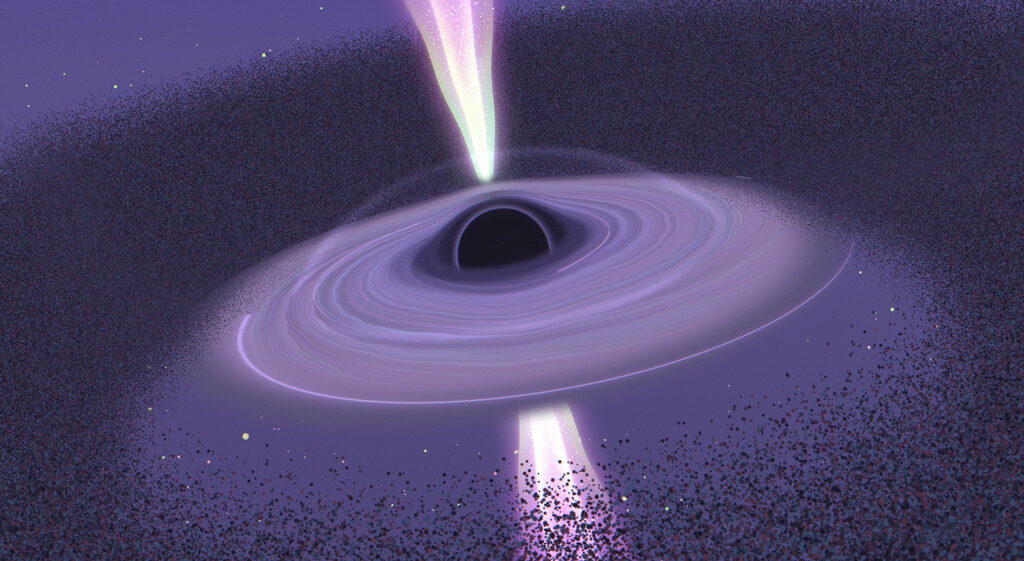
The physics of what powers a quasar took years to work out, and the answer was black holes — but black holes of a scale nobody had previously imagined. A quasar is powered by a supermassive black hole, containing tens of millions to tens of billions of solar masses, accreting material at high rates. As gas falls toward the black hole, it forms an accretion disk that converts gravitational potential energy to radiation with an efficiency of roughly 10 percent — far higher than nuclear fusion, which achieves only 0.7 percent. The disk radiates across the electromagnetic spectrum from X-rays to radio, and can be accompanied by relativistic jets of plasma extending for millions of light-years in opposite directions. A quasar can outshine its entire host galaxy by a factor of 100.
The quasar era
Quasars are not uniformly distributed in time. They were most abundant when the universe was 2 to 4 billion years old — a redshift of 2 to 3 — when galaxies were forming stars rapidly and gas was plentiful. The quasar number density at that epoch is roughly 1,000 times higher than today. In the local universe, quasars are rare; most large galaxies contain supermassive black holes in their centers, but those black holes are now starved of fuel and quiescent. Our own galaxy's central black hole, Sagittarius A*, is four million solar masses and accretes at an extremely low rate. It was almost certainly a quasar billions of years ago.
This correlation between quasar activity and galaxy formation is not coincidental. The energy output of a luminous quasar is comparable to the binding energy of the gas in its host galaxy. When a quasar turns on at full power, it can drive winds of gas out of the galaxy — quenching star formation by removing the raw material. Conversely, the inflow of gas that feeds the black hole also feeds star formation in the galactic disk. The tight observed correlation between the mass of a galaxy's central black hole and the velocity dispersion of the surrounding bulge stars — found in essentially every large galaxy measured — is thought to reflect this coevolution: black hole growth and galaxy growth regulate each other through feedback. Quasars are the phase when that feedback is operating at maximum intensity.
The highest-redshift quasars
Webb has pushed the quasar frontier into the first billion years of cosmic time. The current record holders — objects like ULAS J1120+0641 at redshift 7.09 and more recent Webb discoveries pushing above redshift 10 — contain black holes of a billion solar masses or more, dating to when the universe was less than 700 million years old. Growing a billion-solar-mass black hole in under a billion years, from essentially zero, requires either sustained accretion at the theoretical maximum rate, accretion in brief but extremely intense episodes, or a seed black hole that starts very massive — perhaps formed directly from the collapse of a massive gas cloud rather than from a stellar-mass progenitor. None of the three explanations is entirely satisfactory, and the existence of these early massive quasars is one of the genuine tensions in current cosmology.
Schmidt's 1963 measurement changed astronomy in a way that took years to fully register. The universe was not a static neighborhood populated by nearby objects. It contained, at enormous distances, events of unimaginable energy — and those events turned out to be clues to how the neighborhood itself was assembled. Every large galaxy has a dead quasar at its center. Studying the live ones, at the edge of what telescopes can see, is how we learn how the dead ones grew.
