
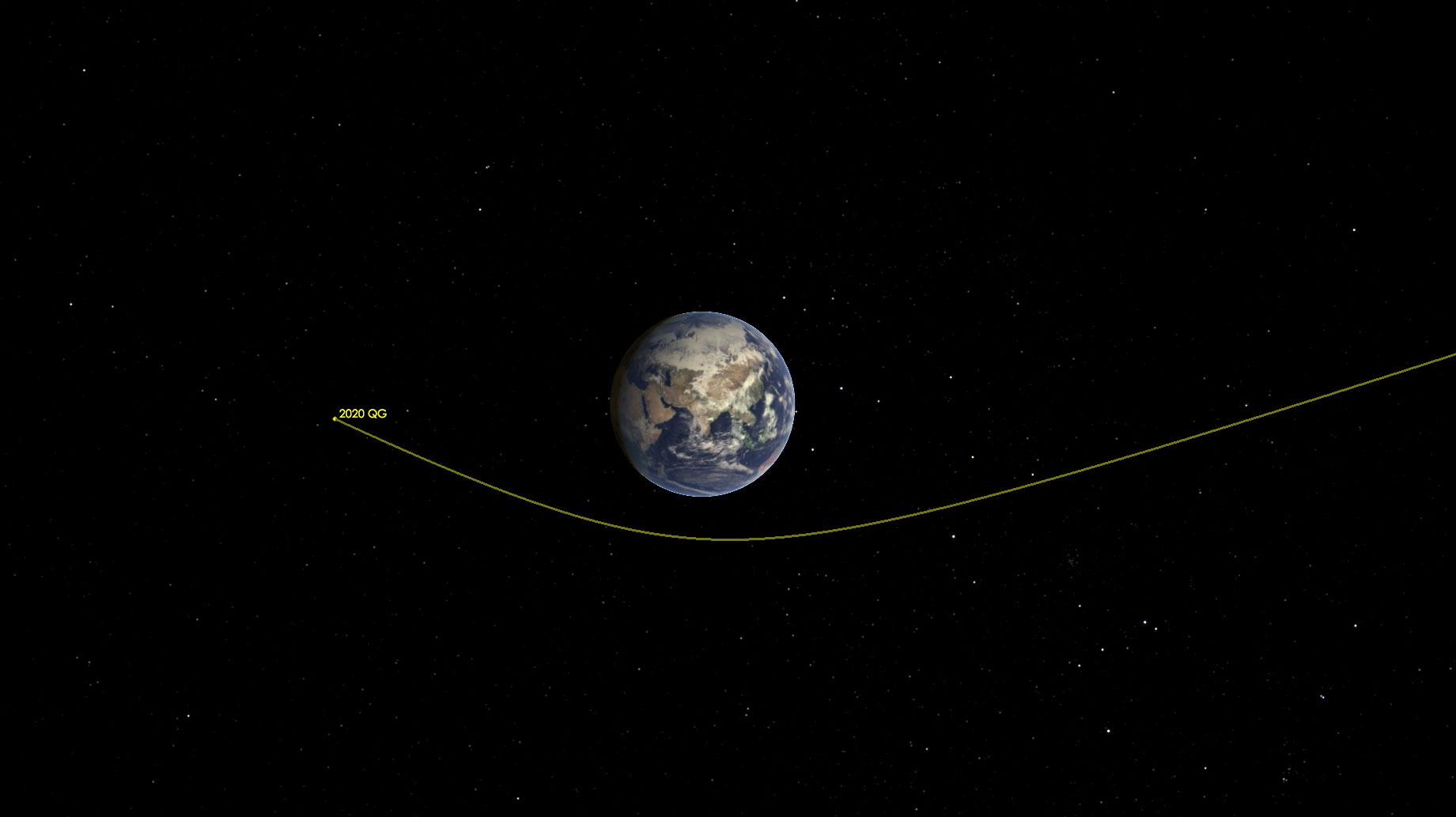
On July 25, 2026, a chunk of rock roughly the size of a house slipped between Earth and the Moon's orbit at 13 kilometers per second — and almost nobody noticed until it was nearly here. The object, designated 2026 OD3, passed at a distance of just 0.6 lunar distances, or about 230,000 kilometers, making it the closest confirmed approach of the week according to tracking data compiled by Spaceweather.com. It was not alone: two other newly designated asteroids, 2026 OB1 and 2026 OQ1, each passed at roughly 2.3 lunar distances on July 25 and July 22, respectively.
None of these objects posed any threat to Earth. But the cluster of close calls is a useful reminder of just how much small-body traffic moves through Earth's neighborhood on a routine basis — and how little advance warning we typically get.
What exactly flew by
2026 OD3 is estimated at about 10 meters across — roughly the footprint of a small house, though asteroids this size are usually irregular chunks of rock or metal rather than anything resembling a structure. At 13 km/s, it covered the distance between Earth and the Moon in under nine hours.
The object isn't just a naked-eye curiosity for skywatchers with good telescopes; it has an official, orbit-determined identity. NASA's Jet Propulsion Laboratory catalogs 2026 OD3 in its Small-Body Database as an Apollo-class near-Earth object — the class of asteroids whose orbits cross Earth's path — under the designation spkid 54642946. JPL's entry, based on 21 observations with a solution epoch of July 25, 2026, lists an orbital period of about 582 days and an Earth minimum orbit intersection distance (MOID) of 0.00036 astronomical units, a formal measure of how close the asteroid's orbit can theoretically bring it to our planet's. That JPL confirmation matters: it means 2026 OD3's flyby isn't a rough estimate or amateur observation but a mathematically verified trajectory, cross-checked against multiple observations of the real object.
Why it matters
Asteroids in the 10-meter class are not civilization-enders. Objects this size typically burn up or detonate harmlessly in the atmosphere, and even a direct impact would most likely produce a localized airburst rather than a global event. The real story isn't the danger — it's the detection gap.
2026 OD3, OB1, and OQ1 were all discovered and designated only shortly before or around their closest approaches, which is typical for objects this small. Ground-based survey telescopes are very good at finding asteroids hundreds of meters or kilometers across, which reflect enough sunlight to be spotted months or years out. A 10-meter rock is a different problem: it's faint, it moves fast across the sky in the days before a close pass, and it's often only bright enough to detect when it's already nearby. That's exactly why Spaceweather.com's tracking table — updated by Dr. Tony Phillips — exists as a running log of these near-miss discoveries, and why the count of known potentially hazardous asteroids keeps climbing: 2,349 as of July 27, 2026, per that same tracking data.
None of this is cause for alarm. It's a demonstration that the system for finding and cataloging near-Earth objects is working as intended — spotting these objects, computing their orbits, and confirming they pose no risk, all within days of their closest approach. The gap being highlighted is one of scale and lead time for the smallest objects, not a failure of the tracking network itself.
How these objects get tracked and verified
Once a telescope survey flags a moving point of light as a possible asteroid, the data doesn't stay siloed. It flows to the International Astronomical Union's Minor Planet Center, the internationally recognized clearinghouse for near-Earth object orbit and discovery data. The Minor Planet Center compiles observations from observatories worldwide, assigns provisional designations — hence names like 2026 OD3 — and maintains the reference lists, including the Potentially Hazardous Asteroid list, that feed into agencies like NASA.
From there, NASA JPL's Center for Near-Earth Object Studies takes the observational data and computes a formal orbital solution, the kind reflected in the Small-Body Database entry for 2026 OD3. More observations over a longer arc generally tighten the orbit solution and its uncertainty — 21 observations, as in this case, is enough to establish a solid trajectory and confirm the object is real and correctly characterized, not a data artifact.
The bigger picture
A week with three notable close approaches isn't unusual — it's closer to normal. Small asteroids pass within a few lunar distances of Earth on a regular basis; most simply go unremarked because they're faint, small, and harmless. What made this week's batch notable is the tightness of 2026 OD3's approach: at 0.6 lunar distances, it came closer to Earth than most operational tracking stations flag as routine, even though it was never on an impact trajectory.
For anyone tracking the numbers, the takeaway is less "we dodged a bullet" and more "the bullets are smaller and more numerous than casual intuition suggests, and the network watching for them is doing its job." As detection sensitivity improves, expect the tally of known close approaches — and the running count of cataloged potentially hazardous asteroids — to keep climbing, not because more rocks are showing up, but because we're getting better at seeing the ones that were always there.
