
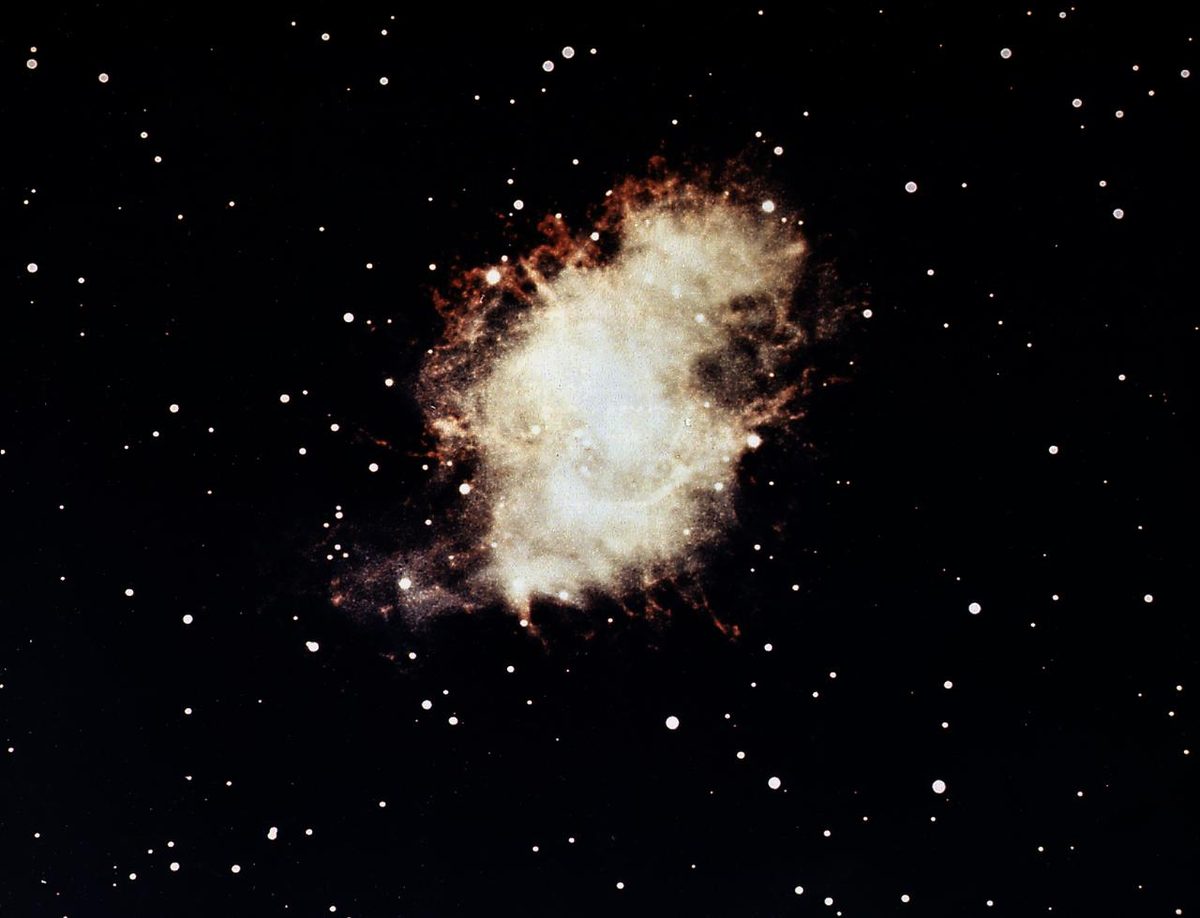
In November 1967, Jocelyn Bell Burnell was working through chart recorder printouts from the Mullard Radio Astronomy Observatory in Cambridge when she noticed a repeating signal that did not look like any known natural source or human-made interference. It pulsed every 1.3373 seconds with a regularity that initially made her and her supervisor Anthony Hewish wonder — briefly and half-jokingly — if it might be artificial. They called it LGM-1, for Little Green Men. Within months, three more similar sources had been found, and the artificial hypothesis was abandoned. These were pulsars: rotating neutron stars, the collapsed remnants of massive stars, spinning with a precision that no natural clock had previously been known to achieve.
The physics behind a pulsar's timekeeping is extreme. A neutron star is roughly 1.4 times the mass of the Sun compressed into a sphere about 20 kilometers across — a density so high that a teaspoon of neutron star material would weigh about a billion tons on Earth. The star is threaded with a magnetic field billions of times stronger than anything achievable in a laboratory, tilted at an angle to the rotation axis. Radio waves beam outward along the magnetic poles. Each time the rotation sweeps a beam past Earth, radio telescopes detect a pulse. Count the pulses and you have a clock.
Millisecond pulsars: the most stable rotators in the universe
Ordinary pulsars spin down gradually as they radiate energy. But a subclass called millisecond pulsars — rotating hundreds of times per second rather than once per second — have been spun up to their extraordinary speeds by accreting matter from a binary companion star. Once the accretion stops, these pulsars coast at high speed for billions of years with negligible spindown. Their rotational stability rivals that of the best atomic clocks, with timing residuals — the deviation of actual pulse arrival times from the predicted schedule — of microseconds or less over years of observation.
The stability is not quite perfect. Neutron stars occasionally experience "glitches" — sudden speed-ups caused by internal structural rearrangements, possibly involving the superfluid layers thought to exist beneath the crust. And the interstellar medium between the pulsar and Earth is not empty: variations in electron density cause frequency-dependent delays in the radio signal that must be calibrated out. These effects are understood well enough that millisecond pulsars have been used to test general relativity with exquisite precision — the Hulse-Taylor binary pulsar lost energy at exactly the rate predicted by gravitational wave emission, a result that earned the 1993 Nobel Prize in Physics.
Pulsar timing arrays and the gravitational wave background
If millisecond pulsars are clocks, a network of them spread across the galaxy is a detector. Gravitational waves — ripples in spacetime — passing through the solar system would stretch and compress the distances between Earth and each pulsar in the network, advancing or delaying pulse arrival times in a correlated pattern across all pulsars simultaneously. This is the principle behind pulsar timing arrays: observe dozens of millisecond pulsars for years or decades, precisely measure the arrival time of every pulse, and look for the spatially correlated timing variations that gravitational waves would produce.
In 2023, four major pulsar timing array collaborations — NANOGrav in North America, EPTA in Europe, PPTA in Australia, and InPTA in India — announced evidence for a gravitational wave background at the sub-nanohertz frequencies that pulsar timing arrays are sensitive to. LIGO detects gravitational waves at frequencies of tens to hundreds of hertz, produced by stellar-mass black hole mergers. Pulsar timing arrays are sensitive to much lower frequencies — nanohertz — produced by much more massive systems: supermassive black holes at the centers of galaxies, with masses of millions to billions of solar masses, spiraling together over millions of years.
What the signal means
The gravitational wave background detected by pulsar timing arrays is not from a single source. It is the superposition of signals from an enormous population of supermassive black hole binaries across the observable universe — every galaxy merger in cosmic history that produced two supermassive black holes close enough to eventually coalesce, all contributing to a stochastic background of spacetime ripples that washes over the solar system continuously.
The signal's amplitude and spectral shape carry information about the population of supermassive black hole binaries and their merger rate. Early results are consistent with theoretical predictions but with enough uncertainty that distinguishing between different models requires more data and more pulsars. The Square Kilometre Array, when it comes online, will dramatically expand the pulsar timing array with hundreds of new millisecond pulsars and sensitivity that should resolve the background into individual sources.
Jocelyn Bell Burnell's 1967 discovery opened a window onto some of the most extreme physics in the universe. Half a century later, those same rotating neutron stars have become instruments sensitive to the low-frequency gravitational wave universe — a use she could not have imagined, built on a physical precision that still seems improbable for something spinning in empty space 1,000 light-years away.