
When the James Webb Space Telescope started returning images of the very early universe in 2022, astronomers noticed something they hadn't expected: small, intensely red, compact objects scattered through the deep field data. They were dubbed "little red dots," or LRDs, and they immediately became a problem. There were far more of them than any model of galaxy formation predicted, they were extremely luminous for their size, and — strangest of all — almost none of them showed up when astronomers pointed X-ray telescopes at the same patches of sky. That last point mattered a lot, because X-rays are usually the smoking gun for a feeding supermassive black hole.
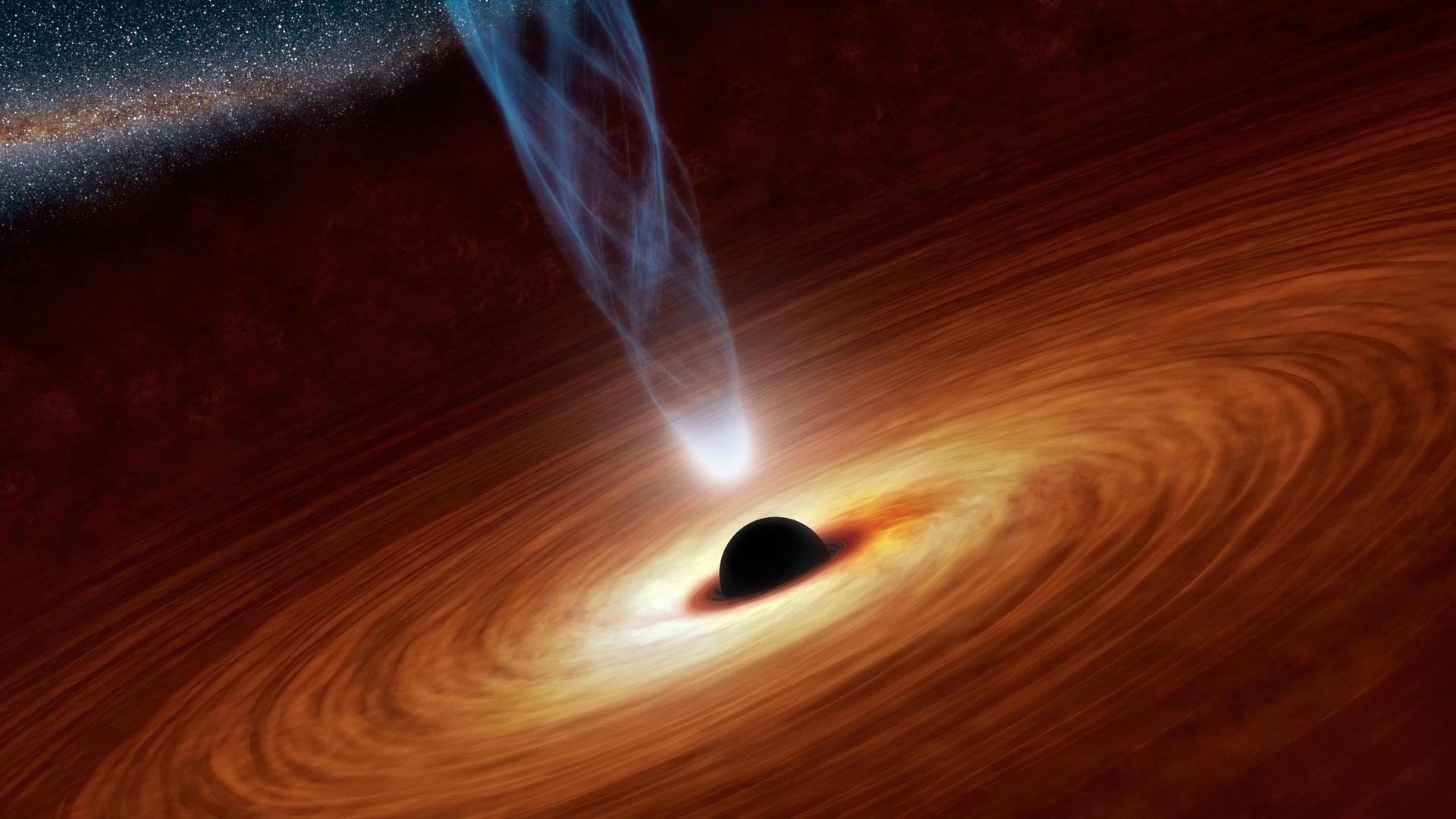
A new study led by Pierluigi Rinaldi of the Space Telescope Science Institute and the University of Arizona, published July 29, 2026 in The Astrophysical Journal (DOI 10.3847/1538-4357/ae80cd), argues the mystery has a fairly mundane resolution: little red dots aren't a new class of object at all. They're ordinary supermassive black holes going through a brief, heavily shrouded phase of rapid growth — and the reason most of them don't glow in X-rays is that their own surrounding gas and dust is smothering the signal.
A spiral galaxy as a Rosetta Stone
Little red dots are, almost by definition, hard to study in detail — they show up at redshifts so high that even Webb can barely resolve them into anything more than a point of light. Rinaldi's team took a different approach: instead of chasing the most distant examples, they went looking for something LRD-like that was close enough to actually dissect.
They found it in a galaxy nicknamed "the Saguaro" — formally WISEA J123635.56+621424.2 — sitting at a redshift of about 2, roughly 3.3 billion years after the Big Bang. That's still ancient by everyday standards, but it's far closer than the redshift-5-and-beyond objects where most little red dots have been found, and close enough that Webb could resolve the galaxy as a face-on spiral rather than a single smudge. Buried at its center, the team identified a compact, reddened nucleus with the same telltale colors and profile as a genuine little red dot.
That gave them a rare opportunity: a little red dot embedded in a galaxy where the surrounding structure, and not just the point source, could actually be studied. The team combined imaging and spectroscopy from Webb and Hubble with X-ray data from the Chandra X-ray Observatory to look at the nucleus from every angle available.
The X-rays were there — just buried
Chandra's contribution turned out to be the key. Rather than finding nothing, as X-ray searches of high-redshift LRDs typically do, Chandra picked up faint, obscured X-ray emission coming from the Saguaro's nucleus. It was a weak signal, consistent with an active galactic nucleus (AGN) — a supermassive black hole accreting material — but heavily muffled by intervening gas and dust.
"What the X-ray light observations show is that this galaxy has an active galactic nucleus, and a very obscured one at that," said Carys Gilbert, a Master's student at the University of Cape Town and a co-author of the study. That obscuration is the piece that had been missing from the little red dot picture. If the black holes powering LRDs are wrapped in thick cocoons of gas and dust, then X-rays — which are relatively easy to absorb compared to infrared light — would be exactly what disappears first, even while the object remains bright enough for Webb to spot in redder wavelengths. A distant LRD showing no X-rays doesn't mean there's no black hole. It may just mean the black hole is too well hidden for X-ray telescopes to catch it at that distance and sensitivity.
"Little red dots are far more complex than just being a dot," Rinaldi said. "They're just the tip of the iceberg — of a supermassive black hole interacting with its nearby surroundings." The team's broader argument is that LRDs are not a separate population of exotic objects requiring new physics, but rather a phase — a heavily obscured, rapid-growth stage that supermassive black holes pass through before settling into the more familiar, less shrouded AGN seen in the more nearby universe. George Rieke, another co-author, put it in terms of a family tree: "These results finally show us how to find their progeny" — meaning astronomers may now be able to trace how these obscured objects evolve into the black holes seen at lower redshift, including in galaxies like the Saguaro itself.
Why It Matters
Little red dots became one of the more stubborn puzzles to come out of Webb's first years of operation. Their sheer abundance early in cosmic history strained models of how quickly supermassive black holes and galaxies can form, and their near-invisibility in X-rays left open the possibility that they represented something genuinely new — perhaps a distinct, short-lived class of "black hole stars" or an entirely unfamiliar mode of structure formation that standard astrophysics didn't predict.
By finding a nearby, resolvable analog and catching its black hole in the act of being obscured rather than absent, this study offers a more conventional explanation: LRDs are a phase, not a species. That reframing matters because it changes what astronomers should be looking for. Instead of treating each little red dot as an isolated oddity, the Saguaro result suggests researchers should be tracing how these obscured nuclei connect to the broader population of galaxies and AGN at lower redshift — essentially building out the "family tree" Rieke describes, and using nearby, well-resolved obscured AGN as guideposts for interpreting the thousands of little red dots Webb is finding at the edge of the observable universe.
