
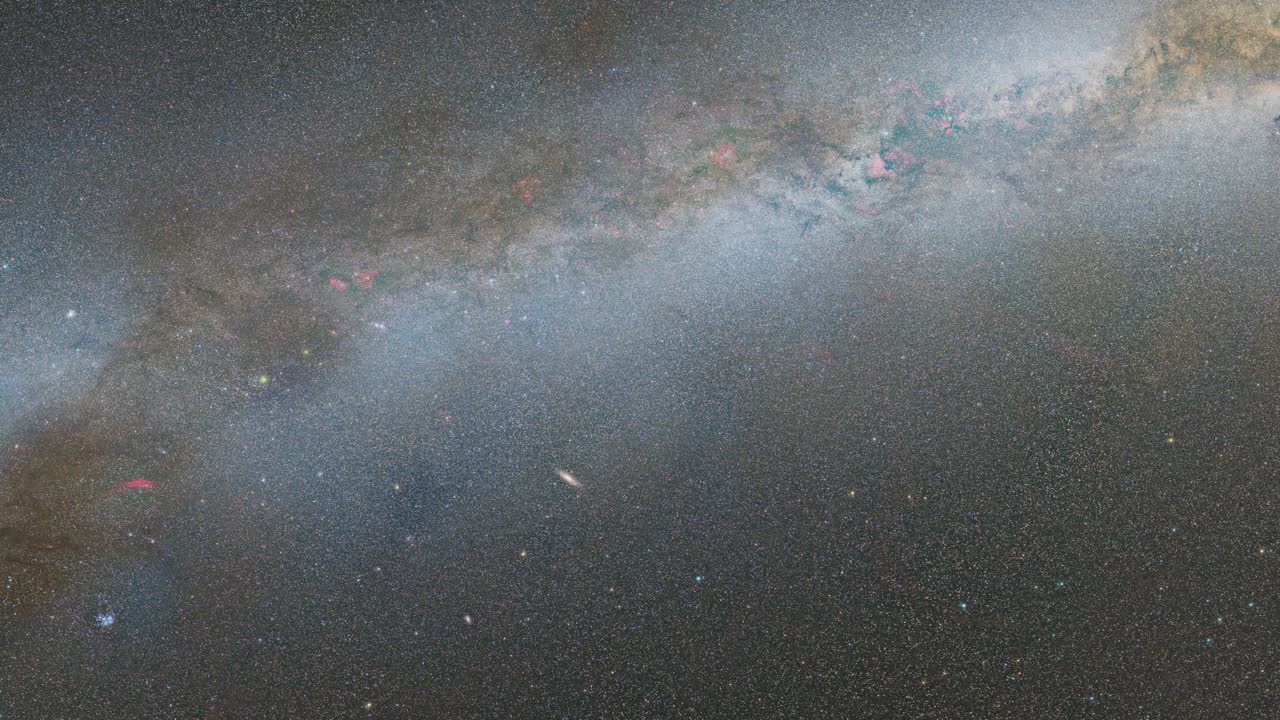
Andromeda, the spiral galaxy 2.5 million light-years away that has long anchored humanity's sense of scale in the universe, is quietly running out of steam. A study published July 27, 2026 in The Astrophysical Journal finds that Andromeda's star-formation rate has dropped roughly 80% over the past 500 million years — and the decline has accelerated sharply in just the last 40 million years, an eyeblink on galactic timescales.
The finding comes from an unusually granular look at the galaxy next door. Rather than treating Andromeda as a single glowing disk and estimating its overall star-birth rate from integrated light, the research team — led by Tobin Wainer of the University of Washington, with co-author Ben Williams (also UW), Zhuo Chen (UW), L. Clifton Johnson (Northwestern), and Raja GuhaThakurta (UC Santa Cruz) — used Hubble's Panchromatic Hubble Andromeda Treasury (PHAT) and PHAST surveys to individually resolve roughly 200 million stars across two-thirds of the galaxy's disk. They then broke that map into thousands of grid squares, each just 300 light-years across, and used the ages of stars within each square to reconstruct a local star-formation history.
"We need to measure the individual stars because they are the fossil record of the galaxy's formation," Williams said. Star colors and brightnesses encode age, and a census of ages across the disk functions like tree rings — a record of how vigorously different parts of the galaxy have been forming stars over time, not just now but stretching back hundreds of millions of years.
What the Data Show
The numbers trace a clear arc. Roughly 2 billion years ago, Andromeda experienced a major burst of star formation. Since then, the rate has been easing off — but the pace of that decline has itself been changing. Half a billion years ago, the galaxy was still forming stars at about one solar mass per year. By 40 million years ago, that had fallen to roughly 0.5 solar masses per year. Today, it sits at just 0.2 solar masses per year — an 80% drop overall, with the steepest portion of the slide concentrated in the most recent 40 million years.
Two suspects stand out. The first is a star-forming ring located about 32,000 light-years from Andromeda's center: much of the overall decline traces back to decreasing activity within that ring. The second is Andromeda's satellite galaxy M32, which sits roughly 16,000 light-years away in the plane of the sky and may have disturbed Andromeda's disk around 60 million years ago — plausibly close enough in time to explain the recent, steeper falloff.
"We can't explicitly say that we are seeing a decrease in star formation because of M32. But it's right there, and it's definitely the most likely suspect," Wainer said.
Not Running on Empty
It would be easy to read "80% decline" as a galaxy in crisis, but the researchers are careful to frame this as a lull rather than a shutdown. The decline looks more like a natural winding down from a previously more active state than the result of reduced material from which new stars can form — a taper following the earlier burst, not a fuel shortage.
Wainer offered a more relatable analogy: "It's just like after running a marathon, sometimes you've got to take a bit of a breather."
Why It Matters
Andromeda is the nearest large spiral to our own Milky Way, and it's close enough that Hubble can resolve individual stars in it rather than just measuring its aggregate glow — a level of detail astronomers can't get for almost any other galaxy of comparable size. As Williams put it, "Hubble is the only telescope that can give you high enough spatial resolution over a large enough area to be able to do that in Andromeda." That makes Andromeda a proxy and a testbed: a galaxy whose star-formation history can be read star by star, the way none of the billions of more distant galaxies ever could be.
Understanding why and how a massive, evolved spiral galaxy's star formation rises and falls over hundreds of millions of years — and identifying specific mechanisms like a fading ring or a satellite-galaxy flyby — gives astronomers a calibrated case study for interpreting the fuzzier, more distant galaxies where this kind of star-by-star detail is impossible. It's also a reminder that galaxies are not static: Andromeda has its own internal weather, with regions turning on and off over timescales that are short by cosmic standards but far longer than any human institution has existed to watch them unfold.
