
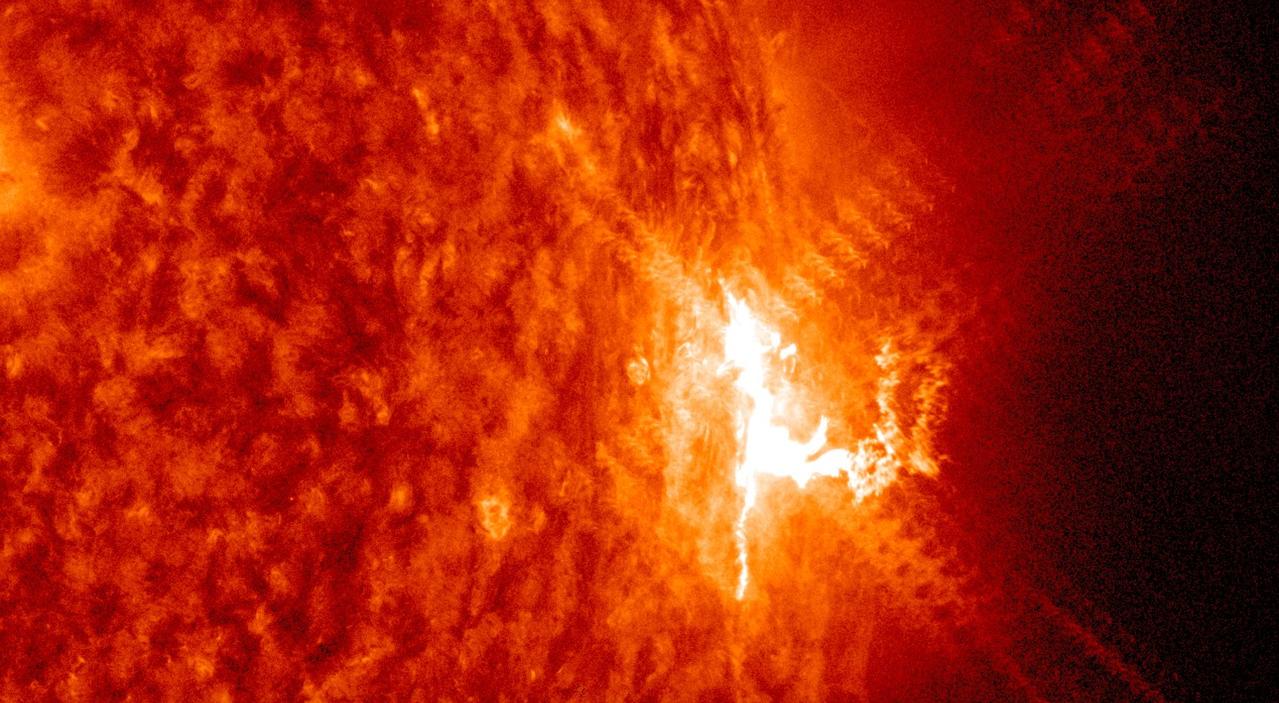
The Sun has spent the past two days doing several things at once. A filament of magnetized plasma tore away from the Sun's central meridian at around 6 UTC on July 27, at almost the exact moment a second eruption — a prominence blast — lifted off near the Sun's northwest limb. NOAA's Space Weather Prediction Center (SWPC), in its July 28 summary, was still logging minor radio blackout conditions left over from a run of flares out of active region AR4494, and forecasters were watching a CME launched two days earlier that is due to reach Earth around July 30.
None of this is, on its own, a crisis. But taken together it describes a Sun that has been unusually busy, and it's worth walking through what actually happened, in what order, and what — if anything — Earth needs to brace for.
A double eruption, and a near miss
The headline event is the synchronized double eruption that began around 6 UTC on July 27 and was detailed in SWPC's July 28 summary: a filament eruption from the Sun's central meridian — the imaginary line running pole to pole through the middle of the visible disk, meaning it was facing Earth — paired almost simultaneously with a prominence eruption near the Sun's northwest limb. Filaments and prominences are the same physical structure (cooler, denser plasma suspended above the surface by magnetic fields) viewed differently: a "filament" when seen against the disk as a dark thread, a "prominence" when seen at the edge, glowing against space.
Even a filament breaking away from the Earth-facing part of the Sun doesn't guarantee an Earth-directed blast, since the geometry of the eruption and the shape of any resulting coronal mass ejection (CME) determine where the material actually goes — which is why forecasters still needed to model the July 27 event before saying which parts, if any, were headed this way.
Layered on top of the double eruption was ordinary background noise: the visible disk logged 12 C-class flares on July 28, the strongest a C5.2 from active region AR4494, following AR4494's M3.2 flare on July 26 and its M1.0 flare on July 27. Flares are ranked on a logarithmic scale — A, B, C, M, and X, each class ten times more powerful than the last — so M-class flares are moderate events capable of brief radio disruption, well short of the major X-class flares that can trigger widespread blackouts.
What's actually headed our way
Forecasters have been tracking Earth-directed CME activity in the current stretch. The one drawing the most attention launched on July 26 and is forecast to arrive late on July 30. SWPC's outlook calls for active-to-G1 (minor) geomagnetic storm levels on July 28, easing to quiet-to-unsettled conditions on July 29 — essentially a lull before the July 26 CME's impact raises conditions again.
That forecast tracks with reporting from July 27 describing a geomagnetic storm already reaching Earth, with additional and more powerful solar wave activity still following behind — a fair description of a Sun that has been sending out CMEs faster than each one has had time to fully play out at Earth before the next arrives.
As of the July 28 update, five numbered active regions were visible on the solar disk, including the newly designated AR4498, meaning AR4494 has company and more flare activity is plausible even if it isn't the dominant source of what reaches Earth.
The radio blackout, decoded
SWPC's summary page has been showing R1 (Minor) radio blackout conditions in effect. In practical terms, R1 means weak-to-minor degradation of high-frequency (HF) radio on the sunlit side of Earth — the kind of thing that might cause a brief dropout on a shortwave or aviation HF link — plus occasional minor disruptions to low-frequency navigation signals. It's the lowest rung of NOAA's five-step radio blackout scale and is a routine byproduct of M-class flare activity, not evidence of anything unusual by itself.
Why It Matters
A G1 (minor) geomagnetic storm is the mildest category on NOAA's five-step storm scale, and for most people on Earth it will be invisible. The practical effects tend to cluster at high latitudes: aurora that might dip into the northern-tier U.S. states or equivalent latitudes elsewhere, minor fluctuations in power grid operations, and small effects on satellite operations — nothing on the order of the disruptive storms that can knock out transformers or scramble GPS-dependent systems.
What makes this week worth tracking isn't the intensity of any single event but the cadence. A synchronized double eruption, back-to-back M-class flares, and an incoming CME all inside a few days point to a Sun in an active phase, with five numbered regions now on the visible disk. For aurora chasers, that cadence is the practical takeaway: SWPC's forecast of active-to-G1 conditions on July 28 easing before the July 26 CME's arrival around July 30 is a reasonable window to watch, especially at high latitudes. It's also a reminder of how solar weather forecasting actually works — CMEs take one to three days to cross the roughly 93 million miles from the Sun to Earth, giving forecasters a short but real lead time to issue watches before impact, unlike a solar flare's light and radiation, which arrive in about eight minutes.
