
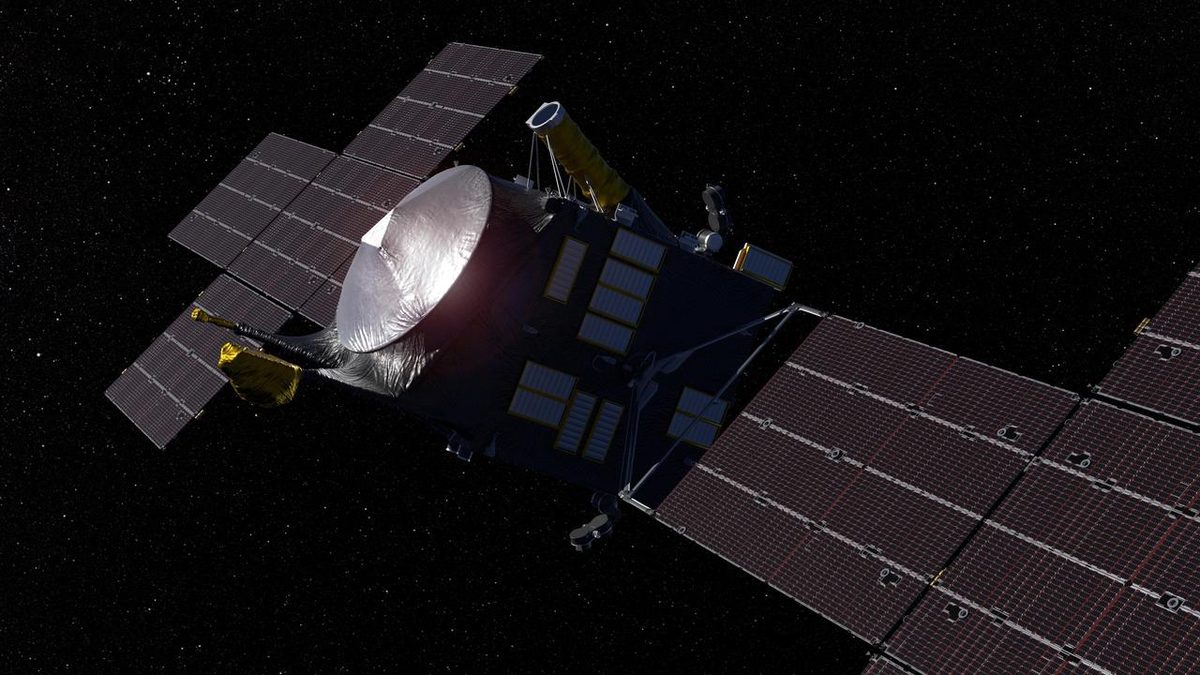
For decades, 16 Psyche occupied a singular place in planetary science's imagination: the naked iron heart of a world that never finished becoming one. The story was elegant and intuitive. Early in the solar system's history, a Mars-sized protoplanet had violently collided with another body, stripping away its rocky mantle and leaving the metallic core exposed. What remained was drifting in the main asteroid belt, a 280-kilometer chunk of nickel-iron that represented something we could never otherwise see — the kind of deep interior normally buried beneath thousands of kilometers of rock and magma. NASA's Psyche mission was conceived partly to test this theory. The spacecraft is on track to arrive in August 2029 after a six-year journey and began returning data. The story it is telling is considerably more complicated.
A mission built on a hypothesis
The original classification of 16 Psyche as an exposed planetary core came from its apparent density and spectral signature. Ground-based observations suggested the asteroid was dense and metallic-looking in certain wavelength ranges, and radar data implied a surface with high metal content. The hypothesis was compelling enough that planetary scientists and even space mining enthusiasts started treating it as settled fact. Psyche was written into textbooks as the closest thing to a planetary core humans might ever access. Proposals for robotic or even crewed mining operations circulated in aerospace circles, pricing out the iron, nickel, and cobalt locked in its bulk.
The Psyche spacecraft, built at JPL and launched in October 2023 — delayed by nearly a year due to software issues with the flight computer — carries a multispectral imager, a gamma-ray and neutron spectrometer, a magnetometer, and a radio science investigation that uses X-band communication to map the asteroid's gravity field. Together, these instruments are designed to answer the core question: is this thing actually a core? The early data is making that question much harder to answer in the affirmative.
What the numbers are actually showing
The first major surprise came from the gravity measurements. As Psyche settled into its initial orbit at around 700 kilometers altitude and later descended closer, the radio science team began constructing a mass model. The density they derived — roughly 3,400 to 4,100 kilograms per cubic meter depending on the interior model assumed — is lower than expected for a solid metal body. Pure iron-nickel sits at around 7,000 to 8,000 kilograms per cubic meter. Even accounting for significant porosity, the numbers suggest either that Psyche contains substantially more silicate rock than predicted, or that its interior is riddled with voids — a rubble pile of metallic and rocky fragments rather than a coherent core remnant.
The magnetometer data have added another layer of complexity. A true stripped planetary core would be expected to retain a remanent magnetic field, a fossil imprint of the ancient dynamo that once churned through its molten interior. The Psyche spacecraft has detected no such global field. There are localized magnetic anomalies — patches where the field is stronger — which could reflect heterogeneous composition or impact-magnetized regions, but the uniform planetary-core signature is absent. This is not a fatal blow to the core hypothesis; plenty of iron meteorites, presumed to be core fragments, also lack remanent magnetism. But combined with the density problem, it chips away at the simple picture.
The surface itself has delivered visual surprises. Images from the multispectral imager show a terrain more varied in color and texture than expected for a homogeneous metal world. There are bright regions and dark regions, crater ejecta with different spectral properties from the surrounding material, and one particularly striking area with reddish coloration that is chemically inconsistent with a pure-metal surface. The current working interpretation is that the surface is a patchwork: some metallic regions, some silicate-rich regions, perhaps significant amounts of sulfides, and possibly organics or other volatile-bearing materials delivered by impactors over billions of years. The word that keeps appearing in team presentations is "heterogeneous."
Rethinking what Psyche actually is
The emerging alternative to the stripped-core model is that Psyche may be a primitive, undifferentiated body — or a partially differentiated one that never fully separated into a metallic core and rocky mantle. In this scenario, the asteroid's metal content is not concentrated in a core but distributed throughout the bulk, mixed with silicates in a configuration that never reached the temperatures required for full differentiation. Another possibility, gaining traction among some researchers, is that Psyche is a "rubble pile" of fragments from multiple parent bodies — a gravitationally bound collection of debris from different collisional events rather than a single coherent world with a clean geological history.
This would not make Psyche less scientifically interesting. It would make it differently interesting. A partially differentiated or undifferentiated body preserves a chemical record of the early solar system that a core fragment does not. The volatile content, the distribution of siderophile versus lithophile elements, the isotopic ratios accessible to the gamma-ray spectrometer — these could speak directly to conditions in the primordial solar nebula before planetary differentiation erased them. Where the core hypothesis offered a window into planetary interiors, the new picture might offer a window into planetary origins.
The mission team is careful not to overinterpret early data. Psyche is still in its science phase, progressively lowering its orbit to achieve finer resolution on both the gravity field and the surface. The gamma-ray and neutron spectrometer, which maps elemental composition by detecting cosmic-ray-induced reactions in the surface material, requires extended integration time to build statistically meaningful maps. A complete elemental abundance map — the most direct test of what Psyche is actually made of — is still months away.
What it means for the science of planet formation
Beyond Psyche itself, the mission is forcing a more honest accounting of how planetary scientists classify asteroids from afar. The spectral and radar data that supported the core hypothesis were real; the interpretation layered on top of them was the problem. Ground-based observations of an asteroid 370 million kilometers away, averaged over the whole disk and subject to space weathering effects that alter surface spectra, turned out to be insufficient to determine whether an asteroid is a remnant core or something else entirely. That methodological lesson will ripple through how the field categorizes the M-type asteroids — the metallic-appearing class to which Psyche belongs — of which hundreds are known but none previously visited.
There is also a subtler implication for models of the early solar system. The prevalence of giant impacts in the first tens of millions of years after solar system formation — the collisions that strip mantles and expose cores — is a parameter in those models. If Psyche, the canonical example of a core remnant, turns out not to be one, it weakens one line of evidence for the particular impact history those models assume. It does not overturn them; the iron meteorite record still requires core-forming differentiation in some parent bodies. But it narrows the data set and adds uncertainty to the frequency and character of early giant impacts.
The spacecraft will continue its science campaign through at least 2025, with orbit altitudes descending toward 75 kilometers in the final phase — close enough that the imager will resolve individual boulders and the spectrometer will map compositional variation at scales of a few kilometers. Whatever Psyche turns out to be, the answer will be found in those data, not in the elegant story scientists told before they had any.
