
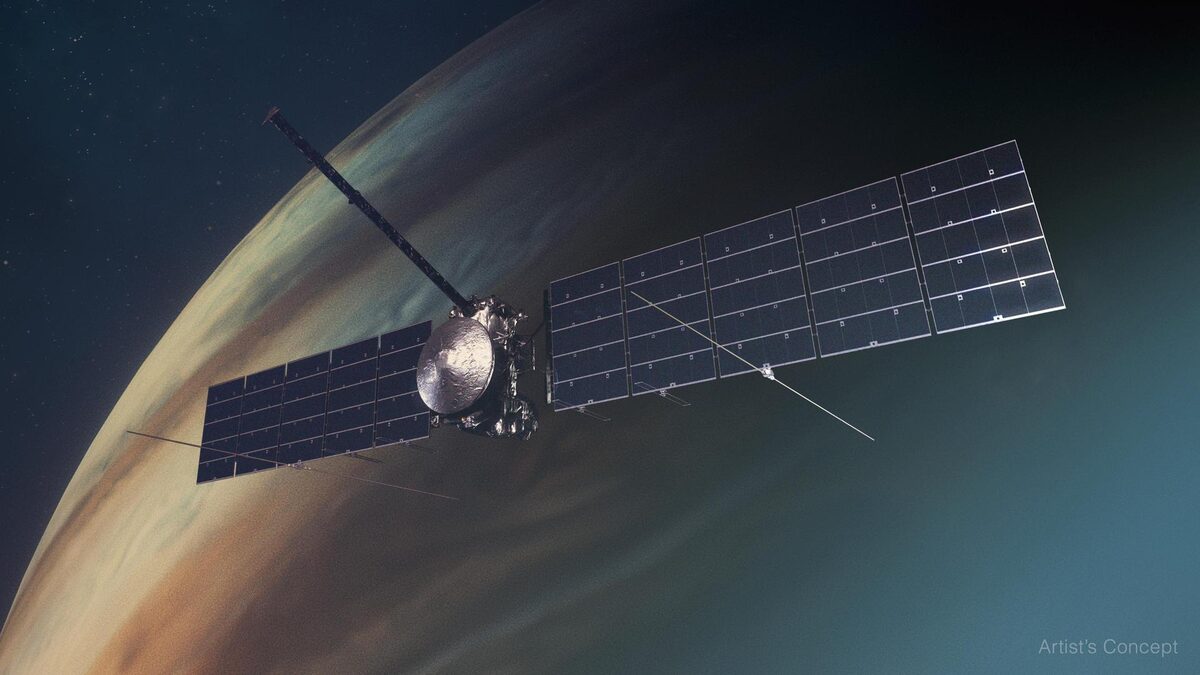
On Thursday, Dec. 3, a spacecraft with solar arrays spanning more than 100 feet will drop toward Earth, bend around the planet, and leave faster than it arrived. NASA's Europa Clipper makes its closest approach at 3:14 p.m. EST, passing about 1,950 to 2,133 miles (3,140 to 3,450 km) above the surface west of Africa. The encounter is a gravity assist, and it is one of the last stops on a route of 1.8 billion miles (2.9 billion km) that ends with the spacecraft orbiting Jupiter in April 2030.
Clipper won't stop working while it passes, though. NASA says all nine of its science instruments will be on during the flyby. For a mission built to study Jupiter's moon Europa, a pass by Earth, where scientists already have plenty of data to compare against, is a rare chance to check the instruments against known answers.
Borrowing momentum from a planet
"We're coming down into the gravity well of Earth, following its curve, and shooting out again," said Robert Pappalardo, Europa Clipper's project scientist at NASA's Jet Propulsion Laboratory, in NASA's Nov. 25 mission update.
That's a fair plain-language description of a gravity assist. As Universe Today points out in its explainer, the same move can speed a spacecraft up or slow it down, depending on how the flyby is set up. Europa Clipper needs the speed. Missions headed for the inner solar system use the trick the other way: Universe Today notes that BepiColombo relied on multiple gravity-braking maneuvers to slow down enough to orbit Mercury. In both cases the planet's gravity does work that would otherwise take propellant.
That matters for a spacecraft like Clipper. NASA gives its mass as about 12,800 pounds (6,000 kg), and Universe Today notes that about half of its launch mass was propellant. The flybys get it to Jupiter while it conserves propellant for the burn that will put it into orbit there, the single largest burn of the mission. Every bit of speed it gets for free from a planet helps that effort.
The Earth pass is the second gravity assist of the cruise. Clipper launched on Oct. 14, 2024, aboard a SpaceX Falcon Heavy from Launch Complex 39A at Kennedy Space Center, at 12:06 p.m. EDT. In March 2025, it flew past Mars at about 550 miles (884 km), using the planet's gravity to brake and reshape its orbit around the Sun. One more assist comes at the end: according to NASA, the spacecraft will use the gravity of Jupiter's moon Ganymede to slow down and be captured by Jupiter's gravity.
A test against known answers
Earth is useful because its answers are already known. NASA says teams will compare the data they acquire during the flyby with existing Earth data and fine-tune their instruments as needed, and Universe Today notes that Earth's magnetosphere is especially well understood.
"We're practicing the intricacies of the operation," said Erin Leonard, Europa Clipper project staff scientist at JPL. "But we're also practicing how to work together to produce the best science." The flyby is a rehearsal of the procedures for operating the instruments and collecting data, as well as a test of the instruments themselves.
NASA highlights a few instruments:
- The magnetometer. NASA says the calibration efforts are especially important for this instrument, which will study how Jupiter's magnetic field interacts with Europa and aims to confirm the ocean believed to lie beneath the moon's icy shell. The magnetometer sits on a boom (Universe Today calls it the Magboom) as far from most of the spacecraft's magnetic sources as it can get. Distance only helps so much, though. Universe Today reports that the spacecraft has more than 300 separate magnetic sources of its own, from magnets in propellant-system valves to current loops in the solar arrays, and the magnetometer must account for them. Pappalardo said the flyby will let the team calibrate the instrument absolutely, using its observations at Earth to refine other calibrations done before launch and in flight.
- E-THEMIS, the thermal imager. On the approach, it will scan Earth every eight hours. It has done this kind of work before. During the Mars flyby, Space.com reported, E-THEMIS took more than 1,000 grayscale images over 18 minutes, one per second, and the team compared them with long-term thermal maps from NASA's Mars Odyssey orbiter. Phil Christensen of Arizona State University is the instrument's principal investigator.
- Europa-UVS, the ultraviolet spectrograph. Its Earth observations will be compared with those of NASA's Lunar Reconnaissance Orbiter, which will train its LAMP ultraviolet instrument on Earth during the flyby to study the geocorona, the outermost part of the atmosphere. NASA's update names Kurt Retherford of Southwest Research Institute as principal investigator.
Clipper also carries a gravity experiment that uses its telecommunications system rather than a separate instrument, according to NASA's mission page. Universe Today's article says all 11 of the spacecraft's science instruments will be active, but NASA's own count is nine instruments, and that's the figure we use here.
Why It Matters
The magnetometer calibration is probably the most important part of this flyby. One of Europa Clipper's main jobs is to determine whether a salty ocean lies beneath Europa's ice. The approach depends on magnetism: as Europa moves through Jupiter's strong magnetic field, Universe Today explains, a salty ocean would be conductive and would generate a separate magnetic field. To find that signal, the team has to account for the spacecraft's own 300-plus magnetic sources, and Pappalardo says the instrument must be pinned to something known to understand the actual value it is measuring. A small error in that correction could make the ocean signal look stronger or weaker than it is.
Earth offers that known reference. The same logic applies to E-THEMIS and Europa-UVS. If their Earth data match existing references, scientists can be more confident in what they report from Europa, where there's no comparable ground truth to check against. The mission plans 49 close flybys of the moon, and how well those measurements hold up depends partly on how well the instruments were calibrated beforehand.
The flyby also gives the operations team a full run-through with every instrument on at once, years before the Europa observations that count.
Can you see it?
Possibly, depending on where you are. NASA says the spacecraft should be observable with relatively large hobby telescopes for those near the closest approach trajectory, notably in southern Europe and in Africa. That wording points to serious amateur equipment rather than a casual sky-watching event.
After Dec. 3, Clipper heads on toward Jupiter. Its next major event is the Ganymede flyby, followed by arrival at Jupiter in April 2030.
Sources
- NASA's Europa Clipper Zooming by Earth on Way to Jupiter's Icy Moon (NASA/JPL, Nov. 25, 2026)
- Europa Clipper mission page (NASA Science)
- Slingshot Earth: NASA's Europa Clipper Will Gain Speed and Tests Its Instruments During Its Earth Flyby (Universe Today, Nov. 26, 2026)
- Europa Clipper probe snaps ghostly thermal portrait of Mars en route to Jupiter (Space.com)
