
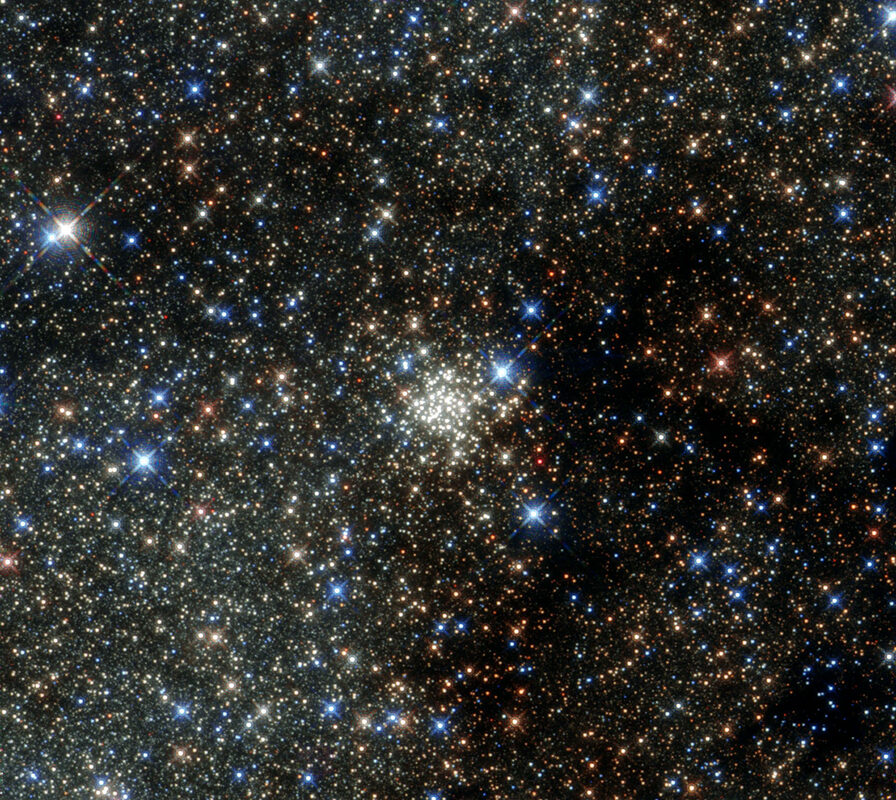
Most astronomical surveys are made to record what is happening now. The one behind NASA's latest Hubble image is made to explain what will happen later. On November 25, 2026, NASA released a new Hubble view of the Milky Way's galactic bulge. It shows a field packed so tightly with stars that it looks more like grain than a starscape. The image comes from Hubble observing program #17776, led by S. Terry. Its main job is to give a future mission something to compare against: NASA's Nancy Grace Roman Space Telescope, whose Galactic Bulge Time Domain Survey covers much of the same region and will watch for the brief brightenings caused by gravitational microlensing.
Put simply, Hubble is taking the "before" picture so that Roman's "after" pictures can be read correctly.
A crowded target
The bulge is the dense, roughly spheroidal crowd of stars around the Milky Way's center. According to NASA, it holds nearly a quarter of the galaxy's stellar mass. That density is why the bulge suits microlensing work, and also why it is so hard to study. When so many stars sit along one line of sight, one star will now and then pass almost exactly in front of another as seen from our solar system.
When that happens, the gravity of the nearer object (the lens) bends and focuses light from the more distant star (the source). The source appears to brighten for a while and then fades back to normal. If the lens star has a planet, the planet can leave its own short, distinctive mark on the light curve. Because the method depends on mass rather than on light given off by the lens, it can detect objects that are faint or completely dark. Planets far from their stars, free-floating worlds and stellar-mass black holes are all within reach.
Roman will use this technique to search for exoplanets. Its Galactic Bulge Time Domain Survey (GBTDS) will monitor the region over and over. Universe Today reported earlier this year that the GBTDS is planned to run for 15 months.
The problem Hubble is solving
A microlensing event is a one-time occurrence. The alignment happens, the brightening plays out, and the stars move on. That leaves astronomers with a recurring question: which of the many blended points of light in a crowded field was the lens, which was the source, and what are they like?
Pre-event imaging helps answer that. If you have sharp pictures of a field taken before an event, you can identify and measure the stars that were there beforehand. NASA says the Hubble data will let astronomers characterize the stars before lensing events take place. Once Roman records an event, researchers can go back to the Hubble archive and work out the properties of the foreground objects involved, including stars and any planets they host.
Wavelength matters too. Hubble observed in red visible and near-infrared light, bands that NASA says overlap Roman's sensitivity. That overlap is what lets researchers compare Hubble's observations with Roman's.
The survey's design
A paper describing the program, "An HST Wide Field Survey of the Galactic Bulge: Overview, Strategy, and First Results" (arXiv:2605.06778), gives the details. The survey covers 1.1 square degrees toward the bulge and was chosen to overlap the Roman GBTDS footprint. For Hubble, whose instruments have small fields of view, that is a lot of sky.
The team got that coverage by using two cameras at once. The survey uses coordinated parallel observations with Wide Field Camera 3 (WFC3) and the Advanced Camera for Surveys (ACS), so each pointing yields two fields instead of one. Both cameras image through the F606W and F814W filters, which correspond roughly to visible-red and near-infrared light. According to the paper, about 70 percent of the survey was observed in Hubble's Cycle 32 and the remaining 30 percent in Cycle 33.
The paper is the first in a planned series and is published in The Astrophysical Journal Letters. In its May coverage, Universe Today identified the survey lead as Sean Terry of the University of Maryland and NASA Goddard, and described the work as an effort to help interpret Roman's bulge results.
Built on earlier Hubble work
Hubble has spent a long time on the bulge. NASA points to two earlier legacy programs: the WFC3 Galactic Bulge Treasury Program, and SWEEPS (the Sagittarius Window Eclipsing Extrasolar Planet Search), which used ACS to observe 180,000 bulge stars. Program #17776 continues that line, with its field chosen to overlap the area Roman will survey.
This kind of handoff between observatories is common in astronomy, and the Hubble survey is a clear example of it. An older telescope with very sharp imaging and a long archive lays the groundwork. A newer one then collects the events. Neither telescope alone could provide what the two provide together.
Why It Matters
Microlensing is one of the few ways to take a census of planets that other methods mostly miss, and one of the few ways to find isolated dark objects such as black holes drifting through the galaxy. Its weak point is interpretation. A lensing light curve on its own often cannot settle the mass of the lens or its distance. Independent information about the stars in the field, measured before the event, can narrow those answers considerably.
Because Hubble has already imaged much of Roman's field in overlapping wavelengths, astronomers should have that baseline ready when Roman's events start arriving. That should turn more detections into well-characterized systems instead of loose statistics. It also means part of the science return from Roman's 15-month bulge survey will lean on Hubble observations made before the survey begins.
NASA's release lists Claire Andreoli of NASA Goddard as the media contact. Further papers in the series are expected to report additional results from the survey.
