
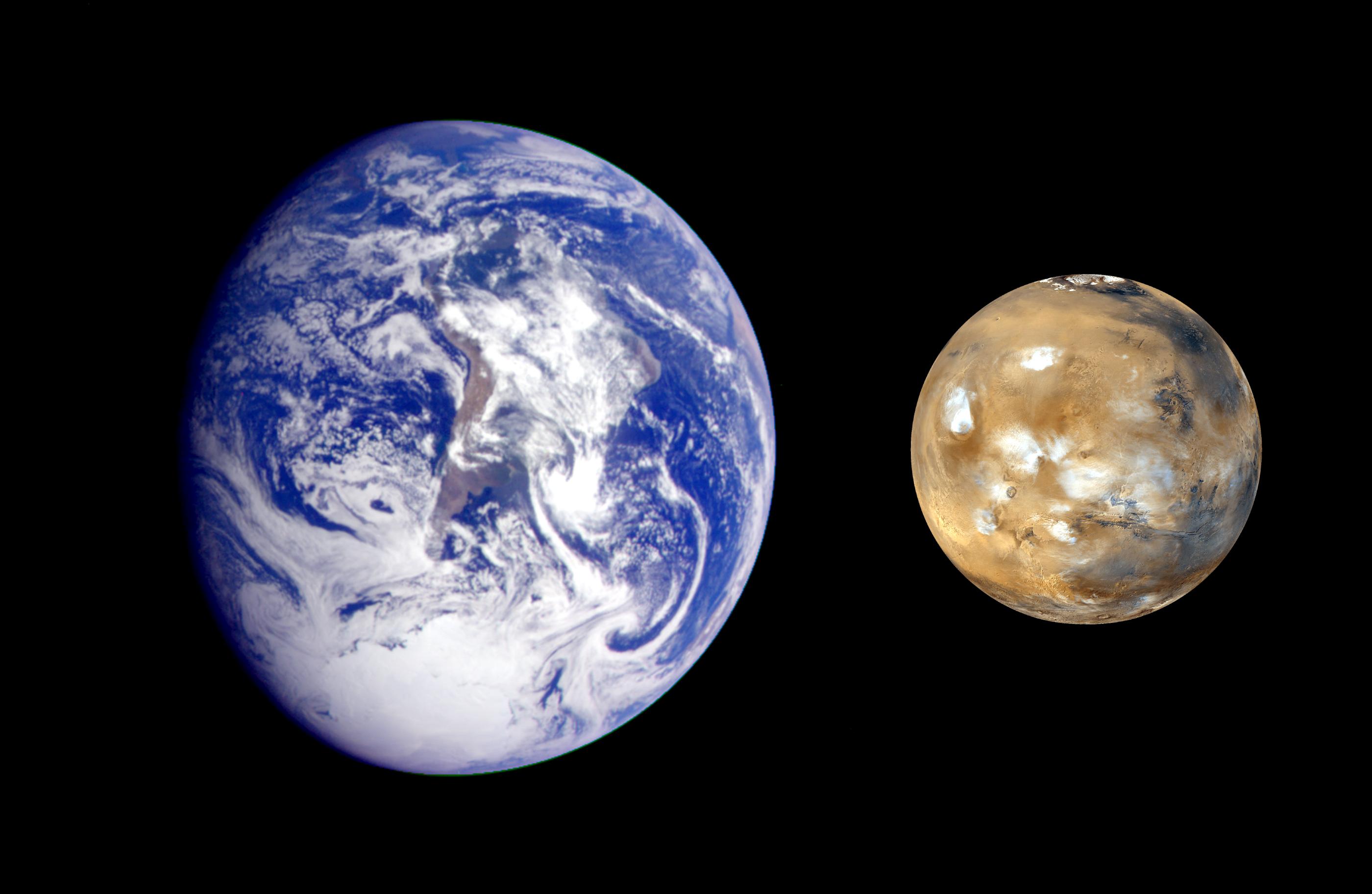
Earth and Mars formed about 4.5 billion years ago in the same young solar system. A new study says they were not built the same way. Researchers led by the University of Copenhagen's Globe Institute report in Nature Astronomy that Earth got most of its mass through one growth process and Mars got most of its mass through another. Their evidence is a group of easily lost elements that includes sodium, zinc and potassium.
"The most surprising result was that Earth and Mars appear to have formed in different ways," said Prof. Anders Johansen, who co-led the work with Asst. Prof. Haiyang S. Wang, according to the university's release.
Three ways to build a planet
Planet-formation models usually fall into three groups. In the first, rocky planets grow when planetesimals, large rocky bodies, collide with each other again and again. In the second, called pebble accretion, large rocks accumulate smaller, pebble-sized particles. The third, a hybrid model, combines the two. The Copenhagen team's results support the hybrid model, and they suggest the mix differed from planet to planet.
Planetary scientists have not settled which process, or which combination, best explains how rocky planets such as Earth and Mars formed. So the team looked for a chemical record of the process.
Volatiles as a fingerprint
The preprint of the study, posted to arXiv on 25 August 2026 as "Volatile depletion in rocky planets as a chemical fingerprint of hybrid accretion," explains the approach. The authors modeled how volatile elements are stripped away, or devolatilized, during pebble accretion. They also modeled collisional growth from planetesimals that were already depleted in volatiles. Comparing the resulting depletion patterns with a planet's measured composition should show which route, or which mix, built it.
The team focused on volatile elements in the crust and mantle, including sodium, zinc and potassium, and used advanced statistical modeling to find the most likely formation scenarios. The arXiv paper describes the method as Bayesian inference. For Earth, the comparison point was the bulk silicate Earth, meaning the planet's rocky portion apart from the core. As Johansen put it, the compositions of the mantles of Earth and Mars remain an imprint of the formation process even after 4.5 billion years.
What the numbers say
For Earth, the model that fit best has at least 75% of the planet's mass coming from two protoplanets that grew by pebble accretion. Planetesimals supplied the remainder, up to about 25%. The preprint describes these planetesimals as compositionally akin to the asteroid Vesta. In this picture Earth is mainly the combination of two large bodies that grew by collecting pebbles, plus a smaller share of material that arrived through collisions.
Mars comes out almost the reverse. Universe Today reports that roughly three-quarters of Mars's mass appears to come from planetesimals, with the remaining quarter from pebble accretion. The preprint's figures are 73 plus or minus 5 percent Vesta-like planetesimals and 27 plus or minus 5 percent pebble-accreted material. Mars, by this measure, grew mainly through collisions, and pebbles played a smaller part.
The point is not that one formation model wins everywhere. Both mechanisms seem to have operated in the inner solar system, and their relative contributions varied enough to produce two neighboring rocky planets with different growth histories.
Who did the work
Wang and Johansen led the study. Co-authors came from ETH Zurich, the Nevada Center for Astrophysics and the Lunar and Planetary Laboratory, among other institutions, per Universe Today. The paper is open access in Nature Astronomy, so researchers in the field can examine the modeling choices directly.
Caveats worth keeping in mind
The study is a statistical inference built on a model, and the researchers stress that it contains uncertainties. The exact chemical composition of the solar system's original building blocks is unknown, so the models rely on assumptions. Universe Today lists three: the composition of the young solar system's disk, planetesimals chemically similar to Vesta, and the traditional assumption that volatiles are lost more efficiently during pebble accretion than during giant impacts. The researchers say the main conclusion holds when results are adjusted for these assumptions, though "the exact percentages may vary somewhat." The preprint also notes that a planetesimal depletion pattern not seen among known meteorite parent bodies would allow the planetesimal share of Earth to reach 40%. The Earth result is stated as limits ("at least 75%," "up to about 25%"), not as exact proportions. The study adds a chemical constraint to a debate that is still open. It does not settle that debate.
Why It Matters
How a rocky planet is assembled affects what it is made of, and volatile elements matter for whether a planet can support life. If neighboring planets can be built by different mixes of pebble accretion and planetesimal collisions, a planet's position in a system does not settle its composition. Universe Today notes that a better understanding of rocky-planet formation could help inform the search for habitable exoplanets. In the university's release, Johansen says that understanding how planets lose volatile elements should make it easier to predict how much water and other life-supporting substances they retain.
The researchers also describe their method as a more direct way of understanding planet formation than the more widely used isotope-based approach, which can often be interpreted in multiple ways. The preprint says its findings have broad implications for interpreting the chemical diversity of rocky exoplanets.
