
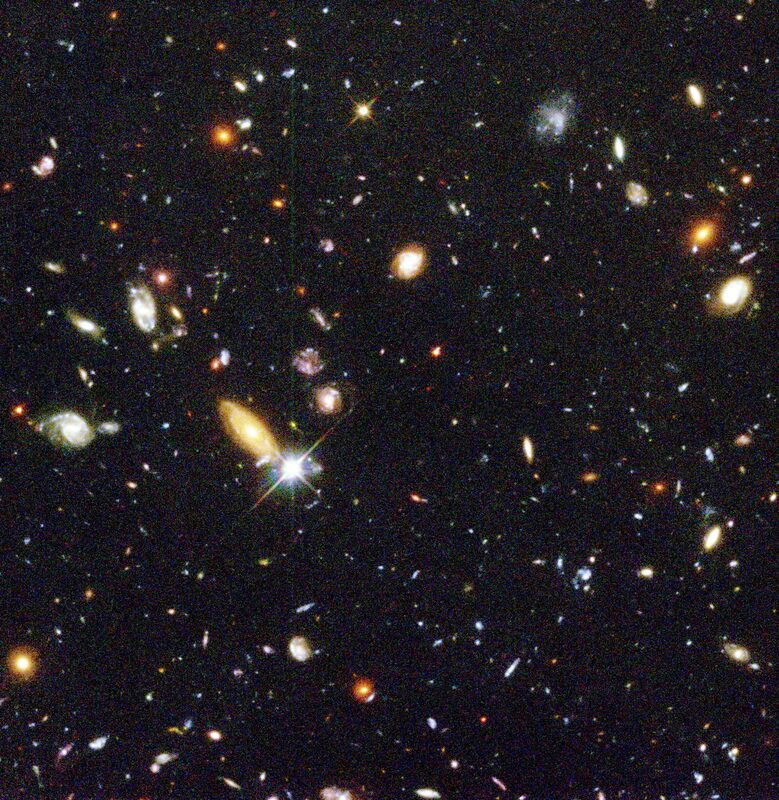
The hot Big Bang, the dense and glowing state that eventually produced atoms, stars and us, had to come from somewhere. In the picture the Mainz researchers work from, it follows a much stranger episode. Cosmic inflation, a burst of extreme expansion, ran from roughly 10-35 to 10-33 seconds after the beginning, according to a press release from Johannes Gutenberg University Mainz. Afterwards, the release says, the universe was supercooled and had to be reheated, filling it with hot matter and radiation. Cosmologists call this step reheating, and how it happened is still an open question.
A new theory paper in Physical Review Letters proposes an unusual heater: swarms of black holes smaller than a single atom, each evaporating and releasing its energy back into the cosmos. What the new work adds is a way around an observational problem that seemed to rule the idea out.
The idea, and its ghost
The paper, by Yann Gouttenoire, Nicholas Leister and Pedro Schwaller, is titled "Opening the Window of Ultra-Light PBHs by Exorcising the Poltergeist". The letters PBH stand for primordial black holes. These are hypothetical objects that would have formed in the early universe, not from collapsing stars. The authors focus on the lightest end of the range, black holes lighter than 109 grams. Universe Today equates that mass to 1,000 metric tons, the weight of a large container ship. According to the Mainz release, the smallest of these black holes may have been smaller than an atom.
Black holes that small don't last. The abstract describes a scenario in which the hot Big Bang "may have emerged" from their evaporation: if such objects dominated the universe, the release explains, their explosions could fill the cosmos with the hot plasma from which matter formed. That is the second reheating the Mainz release describes, coming after inflation itself had ended.
The problem lies in how this scenario has usually been modeled. Standard treatments assume a monochromatic population, meaning every black hole has the same mass. The paper's abstract says these treatments predict nearly simultaneous evaporation and abrupt reheating, along with a large "Poltergeist" signal in scalar-induced gravitational waves.
According to Leister in the Mainz release, earlier research assumed the black holes were all the same size and vanished at the same time. A sudden burst of that magnitude would have produced a very strong Poltergeist gravitational-wave signal, much stronger than anything detected so far in the gravitational-wave background. A model that predicts more signal than observations allow is in trouble, and the release says this made reheating by black holes unlikely under that assumption.
Black holes come in sizes
The fix the team proposes doesn't add new physics. It drops a simplifying assumption. The Mainz release says the assumption that the black holes were all alike is not compatible with predictions based on Einstein's general relativity, which would lead to a variety of masses instead. The authors include what the abstract calls the "irreducible" collapse mass tail predicted by general relativity: the mass distribution, written dfPBH/dlnM, scales as M3.78.
"Irreducible" is the important word. The claim is that some spread of masses is unavoidable, not that one might be added to rescue the model. Once that spread is included, the black holes stop vanishing together. As the Mainz release puts it, a variety of masses leads to gradual evaporation over time, with the lightest black holes going first.
Staggered evaporation means gradual reheating. The abstract reports that the mass tail "smooths reheating" and suppresses the signal "by orders of magnitude." The Mainz release puts it plainly: because black holes of different masses explode at different times, the universe heats up gradually rather than in one sudden burst, and the resulting ripples in spacetime remain faint. In Universe Today's coverage, the models showed that the suppressed gravitational waves were small enough to maintain atom creation.
The paper's abstract states the result: the ultra-light primordial black hole window, which the Poltergeist argument had closed, is reopened.
Who did the work
The study comes from Schwaller's group at Johannes Gutenberg University Mainz, working with the Institut d'Astrophysique de Paris, according to the university release. Universe Today credits the PRISMA++ Cluster of Excellence and the Mainz Institute for Theoretical Physics. The arXiv listing carries the institute report number MITP-26-023.
The paper was first posted to arXiv on 20 May 2026 and revised on 2 November. It appears in Physical Review Letters volume 137, issue 18, as article 181002, which the Mainz release dates to 29 October 2026. In the release, Leister describes ultra-light black holes that could have dominated the very early universe, holding almost all of its energy, a striking image of a cosmos briefly ruled by objects that may have been smaller than atoms.
What it does and doesn't show
This is modeling work. The Mainz release says the modeling shows primordial black holes "might have been responsible" for reheating the universe a second time, and that wording matters. The paper doesn't show that primordial black holes existed, or that they are what actually reheated the universe. It shows that one strong argument against the idea depended on an over-simplified assumption, and that a more realistic mass distribution weakens that argument considerably.
That is how theoretical cosmology often moves forward. A scenario gets constrained, sometimes nearly killed, by a predicted signature that clashes with data. Then someone checks whether the prediction was solid in the first place. Here the weak point was the assumption that every black hole has the same mass, which the Mainz team says conflicts with general relativity.
Why It Matters
Reheating is one of the least understood links in the history of the cosmos. Schwaller says there is strong evidence for inflation, yet between reheating and the earliest processes we can trace today, such as the formation of the first atomic nuclei, "we know surprisingly little about what happened." Any mechanism proposed for that gap has to deliver energy, and it also has to avoid leaving fingerprints that contradict observations. The Poltergeist signal was exactly that kind of fingerprint for ultra-light primordial black holes. Showing that it shrinks by orders of magnitude once a realistic mass spread is included puts these objects back among the candidates.
The result also illustrates a broader point about using gravitational waves to study the early universe. A signal that changes by orders of magnitude depending on whether a model assumes one mass or a natural spread of masses is a reminder that the details of a model matter as much as the observations. There is a catch, too. Leister says future gravitational-wave experiments probably won't be able to probe this theory, because the expected signals are suppressed. What the findings do, in his words, is open the window to further cosmological research by showing that a universe dominated by primordial black holes is possible.
For now, microscopic black holes as the universe's first heaters is a viable hypothesis, not an established fact. Before this paper, the Poltergeist signal was a serious objection to it. After this paper, that objection looks much weaker.
Sources
- Opening the Window of Ultra-Light PBHs by Exorcising the Poltergeist (arXiv:2605.21477; Phys. Rev. Lett. 137, 181002)
- Tiny primordial black holes may have been heaters of the universe (PRISMA++ / JGU Mainz, Nov 19, 2026)
- Exploding Microscopic Black Holes Warmed Young Universe (Universe Today, Nov 29, 2026)
