
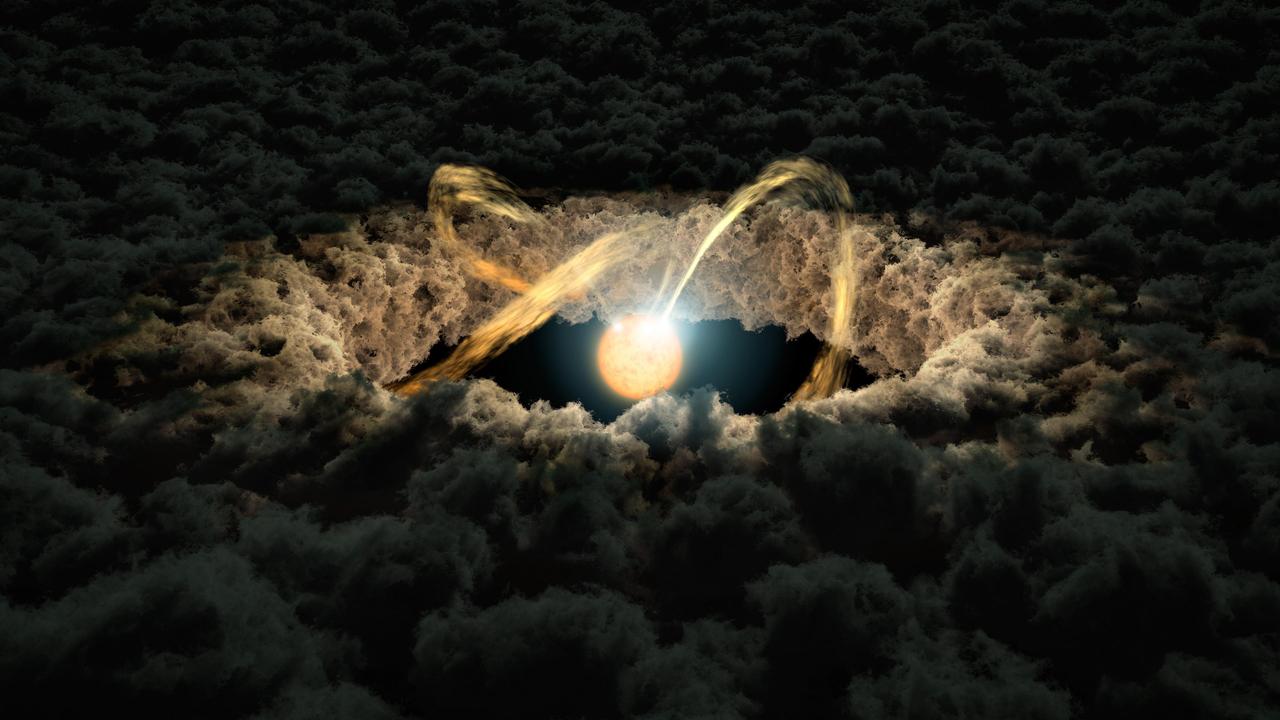
For the past decade, a reliable rule of thumb has run through planet-formation research: if a young star's dusty disk shows a dark gap, look for a planet carving it out. ALMA has photographed many protoplanetary disks with concentric rings and gaps, and the idea that each gap marks a hidden world has been an appealing, if often untested, explanation.
A new study of one of the largest of these disks pushes back on that rule. The disk around V1094 Scorpii holds four narrow ring-gap pairs, and they do not all have the same cause. As the team puts it, "the origin appears to differ from place to place."
A big disk, seen more sharply
V1094 Sco is a young T Tauri star in the Lupus star-forming region, about 500 light-years away. A 2018 paper from a survey of Lupus disks first identified it as a giant, multi-ringed system. That earlier work traced dust out to about 300 au and found gaps at roughly 100 and 170 au, with bright rings at about 130 and 220 au.
The new analysis, led by Masayuki Yamaguchi, a postdoctoral researcher at Kyushu University, with Masahiro Machida and colleagues, and published in The Astrophysical Journal, did not need new telescope time. The researchers went back to existing ALMA observations: Band 6 continuum data plus the 12CO and 13CO J=2-1 emission lines. They combined these with scattered-light images from the SPHERE instrument on the European Southern Observatory's Very Large Telescope.
The gain came from processing. Radio interferometers like ALMA sample a target only partially, so an image has to be reconstructed from the measurements. Rather than the long-standard CLEAN algorithm, the team used PRIISM, an open-source imaging technique based on sparse modeling, to recover finer structure from the same data. The resulting picture shows a dust disk extending to about 380 au, roughly 13 times the distance between the Sun and Neptune, with four narrow rings and gaps concentrated between about 100 and 230 au.
The gas reaches much farther. Carbon monoxide emission traces a disk out to about 760 au in Keplerian rotation, orbiting the star the way planets orbit the Sun. The star itself is estimated at about 0.88 solar masses.
A quiet disk
One of the key measurements concerns turbulence. Astronomers describe how much a disk churns with a dimensionless parameter, alpha. For V1094 Sco, the team finds alpha at or below about 10-3, and possibly at or below 10-4. In other words, the disk, and its outer regions in particular, is calm.
That matters because turbulence controls how dust spreads and how sharp the edges of rings and gaps can be. In a quiet disk, the shapes of the gaps carry cleaner information about what made them. That makes it possible to test specific formation scenarios against the observed widths and depths.
Why one planet per gap fails
When the researchers compared the gaps with the simplest planet model, in which each gap is opened by its own planet, the numbers did not fit. The widths and depths of the gaps across the disk are inconsistent with a one-planet-per-gap arrangement.
What they found instead is a split.
Inner region, near 100 au: The sharper images resolve what looks like a double gap at about 100 au. That structure fits a single low-mass companion of about 55 Earth masses, with an uncertainty of plus or minus 35. That would put the companion between Neptune (about 17 Earth masses) and Saturn (about 95) in mass. It is far short of a Jupiter, yet apparently enough to sculpt two gaps in a calm disk instead of one.
Outer region, 170 to 230 au: The rings here behave differently. They are regularly spaced, and they have no counterpart in the SPHERE scattered-light images, which trace small grains in the disk's upper layers. According to the authors, this pattern is compatible with secular gravitational instability, a process in which the disk's own gravity, rather than a planet, gathers dust into rings.
The result is a hybrid. A low-mass companion plausibly shapes the inner structure, while the outer rings may need no planet at all.
Why It Matters
Ring-and-gap disks have often been used as indirect evidence of young planets, and planet masses and positions have been inferred from gap shapes across many systems. V1094 Sco is a clear example of how that inference can go wrong. If some rings come from self-gravity in the dust and gas, then counting gaps to count planets will overstate how many large bodies these disks contain, at least in their outer reaches.
The study does not argue that planets are irrelevant. The inner double gap still points to a companion of tens of Earth masses at about 100 au. The point is narrower and more useful: different mechanisms can work in different parts of the same disk, and telling them apart takes multiple lines of evidence. Here those were gap morphology, ring spacing, turbulence limits from the widths of the dust rings, and whether a structure also appears in scattered light.
There is also a methods lesson. Everything in this analysis came from archival data. Reprocessing existing ALMA observations with a sparse-modeling imager produced enough detail to resolve a double gap and to test competing models. Many other disks sit in the archive with images made the conventional way, and some of their tidy, planet-carved explanations may deserve a second look.
The 55-Earth-mass companion remains an inference, not a detection. Its stated uncertainty is wide, and confirming it will take more direct evidence. For now, V1094 Sco serves as a caution for the field: a gap in a disk is a clue about what happened there, not proof that a planet made it.
