
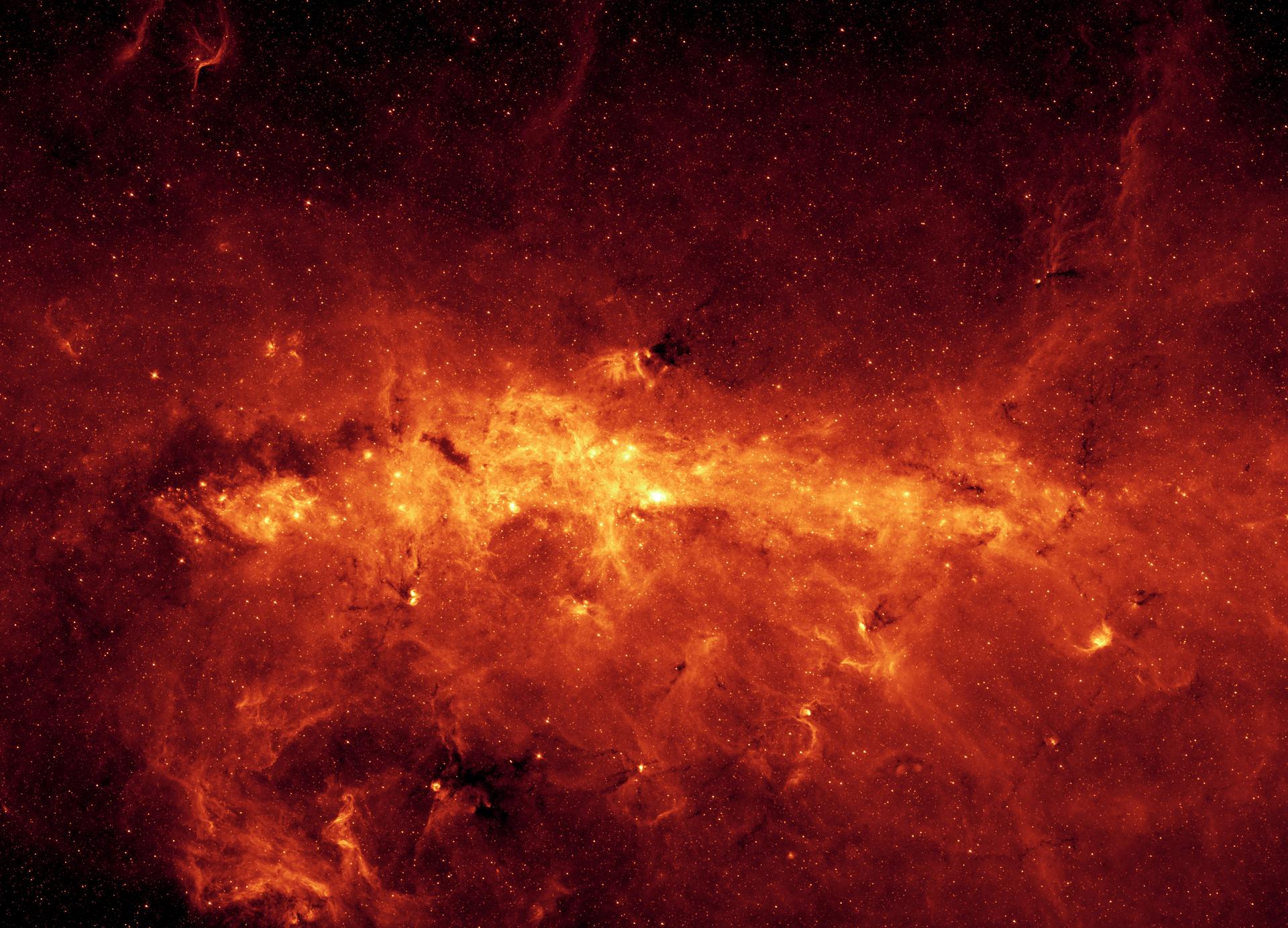
Computer models of the Milky Way have always had to blur the details. Even the best galaxy simulations could not afford to track individual stars, so each of their smallest particles stood in for a clump of roughly 100 Suns. A team led by researchers at RIKEN and the University of Tokyo now says it has removed that limit. In work presented at the SC26 supercomputing conference, the group simulated the entire galaxy at a resolution of about one solar mass per particle. That is fine enough to resolve individual stars.
Their largest run used 5.4 trillion particles. "Our highest-resolution Milky Way simulation used 5.4 trillion particles, ~10,000x those in the state-of-the-art simulations," the authors write, as reported by Universe Today. Two things made it possible. The first was raw hardware: three exascale-class machines, Aurora, Frontier and JUPITER. The second was a machine-learning model that lets the code skip the most expensive part of the physics.
The supernova bottleneck
The project is called PHEASANT, and the University of Tokyo's Nov. 19 press release describes what it was up against. Galaxies hold hundreds of billions of stars, along with gas and other material, all interacting under gravity and other forces. Some of that gas is periodically blown apart by supernovae.
Those explosions are the problem. When a star goes supernova, it heats and pushes the surrounding gas outward, and simulating that in detail normally requires very small time steps, around 100 years each according to the researchers. When the goal is to follow a galaxy over vast stretches of time, steps that short dominate the cost. As Professor Michiko Fujii of the University of Tokyo put it, small regions where the gas is dense and changing rapidly demand much shorter steps, "which greatly increases the amount of calculation required."
The team's answer was not to calculate those explosions step by step. Keiya Hirashima, a postdoctoral researcher at RIKEN, built an AI model that predicts how the gas around a supernova will be distributed 100,000 years after the explosion. Rather than grinding through roughly a thousand 100-year steps to cover that span, the simulation asks the model where the gas ends up and continues from there, which lets the whole-galaxy simulation use a much longer time step. According to the researchers, this makes the run around 20 times faster than calculating the same process directly.
A surrogate, not a replacement
The term for this kind of component is "surrogate model," and the details matter. The AI does not simulate the galaxy. The main simulation is still an N-body/hydrodynamics code. The machine-learning piece covers only the gas surrounding supernova explosions, which would otherwise set the pace for everything else.
The approach first appeared in an earlier preprint, "The First Star-by-star N-body/Hydrodynamics Simulation of Our Galaxy Coupling with a Surrogate Model" by Hirashima and colleagues. In that paper the authors describe the ML surrogate as a way to bypass the short supernova timesteps. They call the result the first star-by-star simulation of the Milky Way. The preprint reached 300 billion particles using 148,900 nodes, equivalent to 7,147,200 CPU cores. It also reported that performance scales beyond 10,000 CPU cores, using A64FX and x86-64 processors and NVIDIA CUDA GPUs.
Going from 300 billion particles to 5.4 trillion is roughly an eighteen-fold increase, and the new work ran on three exascale systems rather than the preprint's configurations.
Three machines, three architectures
Running one simulation across several supercomputers is harder than it sounds. According to the University of Tokyo, the team adapted its software to work efficiently on three different supercomputer systems that use a mixture of CPUs and GPUs from different makers. Hirashima said each system uses AMD, Intel or NVIDIA hardware and that good performance across all three "required some specific optimizations." The university called the combination of three machines with different hardware a world first. The team's SC26 paper is titled "Architecture-Agnostic Exascale Star-by-Star Simulation of Our Galaxy."
Universe Today notes that the results come from an SC26 paper (Hirashima et al. 2026), the supercomputing conference's proceedings. The title alone shows how much of the effort went into making one code run well on varied hardware, alongside the astrophysics.
What "star by star" actually means
The resolution change is easy to understate. Until now, the smallest particles in galaxy simulations were clusters of stars with the mass of about 100 Suns, as Universe Today describes, and the behavior of individual stars was averaged out. In PHEASANT, particles have about one solar mass. Universe Today adds a caveat worth keeping: a one-solar-mass particle is still a proxy for the population of stars, not a literal catalog of every star in the galaxy.
This matters most for the processes that link stars to their surroundings. Massive stars form in groups, heat the gas around them, and eventually explode. When several explosions occur close together, the university explains, they can create enormous bubbles of hot gas that trigger further star formation and drive material out of the galactic disk. A simulation without enough detail can miss these connections between individual stellar events and paint a different picture of how the galaxy evolves.
Why It Matters
Fujii says the simulation lets the team investigate how individual supernovae affect the number of stars that form, the size of the giant gas bubbles, and the material that flows out of the galaxy. Hirashima points to how material circulates between the disk and the surrounding halo, and to the relationship between spiral arms and the formation of molecular clouds. Following these processes could help explain how the galaxy becomes enriched with different elements over time.
The method may end up mattering as much as the galaxy. Many simulations are held back by a small region of fast physics that sets the time step for the whole run. The PHEASANT approach handles that region with a trained surrogate. The roughly 20-fold speedup reported here is a concrete figure for what the trade is worth. The paper's authors also write that the surrogate modeling approach can be generalized beyond astrophysics, with climate modeling, space forecasting and low-temperature plasma among the applications they name.
Some caution is warranted. Any surrogate is only as good as its training, and the central question for this approach is how well the AI's predicted gas distributions match what a full calculation would produce across the conditions found in a real galaxy. The university reports that the team has confirmed the model produces a star formation rate similar to the one estimated from observations of the real Milky Way, which it presents as evidence of reliability. Hirashima also notes that the team has not yet simulated the full process through which a galaxy like ours forms. Still, a simulation of the whole Milky Way at roughly one solar mass per particle is a result that the researchers say was not previously achieved.
Sources
- Milky Way simulation pushes technical boundaries (University of Tokyo press release, Nov. 19, 2026)
- AI Helps Three Powerful Supercomputers Simulate The Milky Way In Extraordinary Detail (Universe Today)
- The First Star-by-star N-body/Hydrodynamics Simulation of Our Galaxy Coupling with a Surrogate Model (Hirashima et al., arXiv)
