
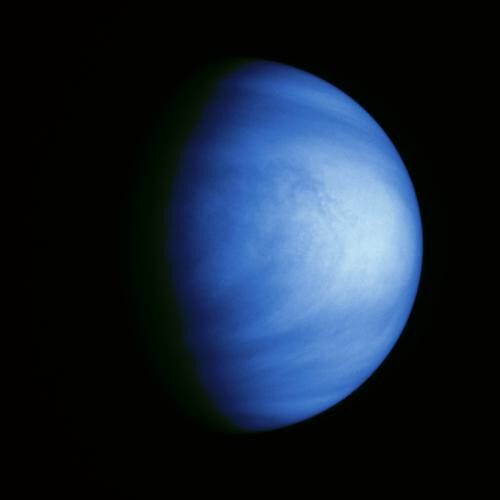
For decades the standard description of Venus's clouds has been short: droplets of concentrated sulfuric acid. A preprint posted to arXiv on Nov. 25 argues the description leaves out a large share of what is in them. Rakesh Mogul, Mikhail Zolotov, Michael Way and Sanjay Limaye report mass-spectral evidence that the cloud aerosols hold a lot of iron sulfate. Their data are not new. They were recorded in 1978 by an instrument that fell through the Venusian atmosphere.
The paper, titled "Mass Spectral Evidence for Iron Sulfate in Venus' Cloud Aerosol," follows an earlier re-analysis of the Pioneer Venus Large Probe's Neutral Mass Spectrometer, known as the LNMS. It is listed on arXiv as "in review," meaning it has not yet been through peer review.
A probe, an inlet, and a slow-motion experiment
The Pioneer Venus Multiprobe mission sent one Large Probe and three Small Probes to Venus on a carrier bus. According to NASA's NSSDCA catalog, the bus weighed 875 kg at launch, and 585 kg of that was the probes. All four instrumented probes descended through the atmosphere, and the bus went in after them. Its sister spacecraft, the Pioneer Venus Orbiter, was placed in orbit around Venus five days before the probes entered the atmosphere. The mission's goals included working out the nature and composition of the clouds and the structure of the atmosphere.
The new analysis depends on something the LNMS did by accident. According to the authors, aerosol particles were inadvertently collected into the spectrometer's inlets at roughly 48 to 51 km altitude, within the cloud deck. The probe kept falling into the hot lower atmosphere, and below the clouds that trapped material broke down thermally. The breakdown products were released into the mass spectrometer, so the instrument ended up measuring the clouds' contents well after it had left them.
At 23 km and below, the authors report signals from several iron-bearing ions: 54Fe+, 56FeO+, 54FeO+, 56Fe2O+ and 56Fe2O2+. Because the signals include two iron isotopes and both single-iron and double-iron oxide fragments, the case for iron rests on more than one mass peak.
What the numbers say
The team measured an iron-to-sulfate mole ratio of 2.0 ± 1.1, which they say aligns with hydronium jarosite, an iron sulfate mineral. They write that the jarosite likely formed within the inlets after the aerosol was captured, dehydrated and lost sulfuric acid. From the thermal release profiles they estimate the makeup of the cloud aerosol:
- Bulk iron: 0.8 ± 0.4 mg/m³
- Hydronium jarosite: 2.2 ± 1.2 mg/m³, or 30 ± 17 percent by weight
- Water: 3.7 ± 0.4 mg/m³, or 50 ± 10 percent by weight
- Sulfuric acid: 1.5 ± 0.2 mg/m³, or 20 ± 5 percent by weight
The error bars matter. The jarosite estimate in particular has an uncertainty more than half the size of the value. Still, the overall result is that sulfuric acid makes up about a fifth of the aerosol mass in this accounting, and water and an iron sulfate phase make up most of the rest.
The authors also say what the data cannot tell them. The speciation of the ferric sulfates in the native aerosols, meaning the exact chemical forms present, such as whether they sit in solution or in particles, remains unconstrained. Jarosite fits the stoichiometry. The instrument saw fragments, though, and the parent compounds have to be inferred.
Picking up a 2025 thread
The preprint follows an earlier paper. In September 2025, Cal Poly Pomona announced a re-analysis led by Mogul and published in the Journal of Geophysical Research: Planets. That work concluded the aerosols contain iron sulfates and sulfuric acid at about 20 percent by mass each, with about 60 percent water by mass. The university said the result significantly updated the perception that the clouds are highly concentrated sulfuric acid, and challenged the notion that Venus's atmosphere is dry.
Cal Poly Pomona also described where the data had been. The Large Probe's mass spectrometer records were archived by NASA on microfilm and mostly forgotten by the Venus community over the following decades. Mogul and Limaye, a senior Venus scientist at the University of Wisconsin, Madison, hatched a plan in 2021 to take a fresh look at them.
The new numbers differ from the 2025 ones: about 30 percent hydronium jarosite and 50 percent water by weight, compared with roughly 20 percent iron sulfate and 60 percent water. Both studies give a similar overall picture, with sulfuric acid a minority component and water the largest. The newer paper focuses on the iron itself, identifying specific iron ions in the spectra and tying them to a mineral phase.
Where would the iron come from?
The obvious first guess is the planet's surface. The authors judge, however, that surface sourcing of the cloud iron is likely minor. Instead, they suggest that cosmic dust influx, the steady arrival of material from space, could deliver iron to the clouds in a geologically short time, which they put at 2.4 ± 1.5 million years. In the 2025 release, Mogul likewise said the iron may arise from the input of cosmic materials.
If that holds up, iron in Venus's clouds would be a product of material arriving from space and being processed in the planet's atmosphere, rather than a record of surface geology.
Why It Matters
The authors note that Venus's cloud aerosols play pivotal roles in the thermal, chemical and optical properties of the atmosphere, so their composition bears on many other questions about the planet. Concentrated sulfuric acid is a famously harsh chemical environment, and that picture has framed discussions of cloud chemistry and habitability. Mogul has said the aerosol composition his team found, which was not previously known, presents new considerations for cloud chemistry models and cloud habitability discussions. Clouds that are about half water by weight, with a large mineral fraction, would be a different system chemically.
The result also shows that old mission archives can still be useful. The Pioneer Venus Large Probe's descent produced the data behind these papers, and those data sat on microfilm for decades before anyone took a close look at the iron signals. The authors are careful to say what they cannot pin down, including the native chemical forms in the droplets and the large uncertainties on several quantities. Until those questions are settled, a spectrometer from 1978 is giving planetary scientists reason to revisit the textbook description of Venus's clouds.
