
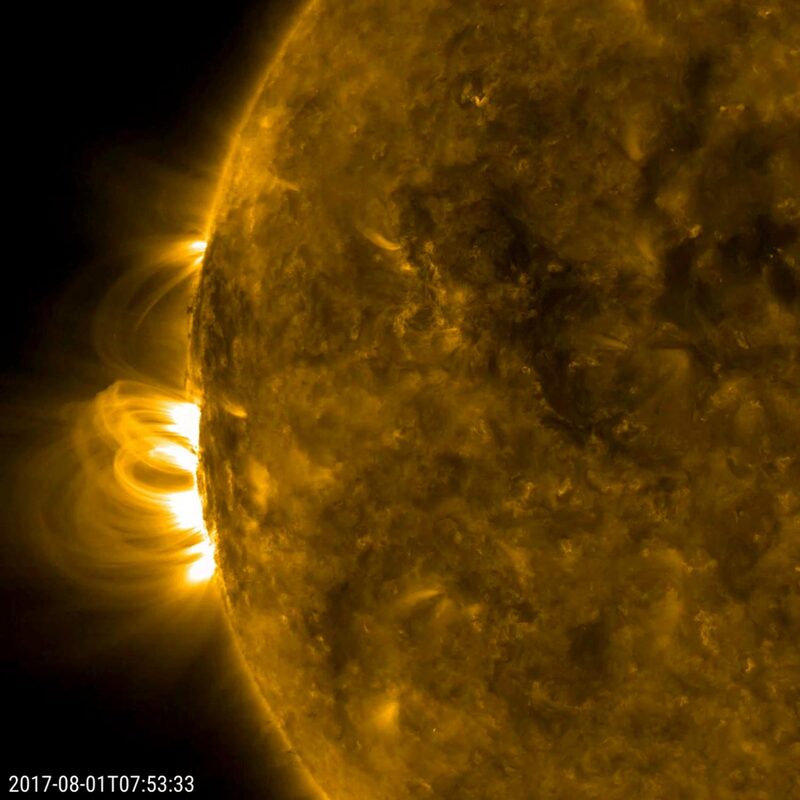
Space weather doesn't always make news, and this weekend is one of those times. NOAA's Space Weather Prediction Center (SWPC) issued its forecast at 0030 UTC on Nov. 28, 2026, and it describes a Sun with little going on. Solar activity is low, no coronal mass ejections are headed for Earth, and the strongest geomagnetic activity expected through Nov. 30 is a short spell of unsettled conditions. There are still two things worth watching: a newly numbered sunspot group on the Sun's eastern edge, and a stream of fast solar wind arriving from a coronal hole.
Here is what happened over the past day, what the forecasters expect next, and why a 293-year-old compass experiment is still the reason we measure all this.
The newcomer: Region 4584
The most active spot on the Sun right now is one that only just came into view. SWPC's forecast discussion says the new Region 4584, at S10E68, produced all three C-class flares of the reporting period. The coordinates put it in the southern hemisphere, 68 degrees east of the center of the Sun's disk, near the eastern limb where regions rotate into sight. The largest of the three flares was a C3.9 at 1849 UTC on Nov. 27.
SWPC classifies the region as Cro/beta. The beta label means its magnetic field has both positive and negative polarities. That is a step more complex than the simplest single-polarity groups, but it is not the tangled arrangement forecasters link to major eruptions. A second group, Region 4583 (N05E33, Cao/beta), produced only low-level B-class enhancements.
Spaceweather.com's live data, read at 0550 UT on Nov. 28, agrees with this picture. It listed a 24-hour X-ray maximum of C3 at 1849 UT on Nov. 27, matching SWPC's C3.9 event, and a newer C2 flare at 0428 UT on Nov. 28 as the six-hour maximum. The site put the sunspot number at 30 (updated Nov. 27) and said the visible sunspots have stable magnetic fields that pose no threat of strong flares.
The day before was quieter still. EarthSky's Nov. 27 roundup counted nine B-class flares and no C-class flares, with activity rated very low. It noted a flaring newcomer in the southeast that had not yet been numbered because it had not fully rotated into view. That is the likely precursor to Region 4584, though the sources do not say so directly.
The wind: a coronal-hole stream arrives
Flares are the dramatic part of space weather. The solar wind, the steady outflow of charged particles from the Sun, is what drives most of the geomagnetic activity felt at Earth. Coronal holes are regions where the Sun's magnetic field opens into space, and they release faster streams of that wind.
According to SWPC, solar wind speed rose from about 280 km/s to about 375 km/s during the reporting period. The total interplanetary magnetic field reached 15 nT. The spacecraft readings showed the effects of a positive-polarity coronal-hole high-speed stream. Spaceweather.com's later reading had the wind at about 384.9 km/s with a density of 5.3 protons per cubic centimeter.
The key number for Earth's response is the north-south component of that magnetic field, called Bz. When Bz points south, it connects more easily with Earth's magnetic field and lets energy into the magnetosphere. When it points north, it mostly doesn't. SWPC reported that Bz was mainly northward and dipped only briefly to -6 nT. That is why a 15 nT field did not produce a storm: SWPC rated the geomagnetic field quiet over the same period.
What to expect, day by day
SWPC's 3-day forecast gives the most detail. The greatest observed 3-hour Kp index over the past 24 hours was 2. Kp is a 0-to-9 measure of global geomagnetic disturbance. The forecast peak is Kp 4.00, expected in the 00-06 UT blocks on Nov. 28. That level is below NOAA's storm-scale levels. Spaceweather.com showed Kp at 4.00, which it labels "unsettled," when it was read on the morning of Nov. 28, so the forecast peak arrived on time.
- Nov. 28: Quiet to active geomagnetic conditions, peaking at Kp 4 early in the UTC day. Solar wind stays weakly enhanced.
- Nov. 29: Quiet to unsettled, with forecast Kp values between about 1.7 and 3. Wind still weakly enhanced.
- Nov. 30: Quiet, with forecast Kp values between about 0.7 and 2 and solar wind back at background levels.
SWPC expects no G1 or greater geomagnetic storms during the forecast period. The chance of an S1 or greater solar radiation storm is 1 percent on each day. The chances of R1-R2 radio blackouts and of R3 or greater blackouts are each listed at 1 percent. SWPC forecasts very low solar activity overall, with a chance of more C-class flares from Nov. 28 through Nov. 30.
The two sources differ slightly on aurora. EarthSky's Nov. 27 update said fast coronal-hole wind reaching Earth could produce G1-level aurora at far northern latitudes. SWPC's later forecast, issued after the stream arrived and showed a mostly northward Bz, does not expect G1 conditions. Skywatchers at high latitudes may still see a faint display around the Kp 4 peak. People at mid-latitudes should not plan an aurora night around this event.
One more detail matters mainly to satellite operators. SWPC expects the flux of electrons above 2 MeV to be at normal to moderate levels on Nov. 28 and likely high on Nov. 29-30. That is mainly of interest to satellite operators.
A compass in Uppsala
The connection between solar wind, magnetic fields and aurora looks obvious today, but someone had to work it out first. EarthSky's Nov. 27 column credits part of that work to Anders Celsius, born in 1701 and best known for his temperature scale. Early in his career Celsius studied the northern lights. Working in Uppsala with his assistant Olof Hiorter, he watched a compass needle and saw that it swung more during strong auroral displays. In 1733 he published the idea that aurora is linked to Earth's magnetism.
That observation is an early example of the idea behind today's geomagnetic indices: a strong aurora goes with a disturbed magnetic field, and a disturbed field moves the needle. The Kp value in the forecast measures global geomagnetic disturbance, a far more refined version of that link.
Why It Matters
Quiet forecasts are useful in their own right. For power grid operators, HF radio users, GPS-dependent industries and satellite teams, knowing that no Earth-directed CMEs are on the way and that storm odds are low is real planning information. The 1 percent radiation and blackout probabilities are close to as calm as the Sun gets.
This weekend also shows a point that dramatic events can hide: the arrangement of the magnetic field matters as much as its strength. A 15 nT field would usually draw attention. Because Bz pointed mostly north, the observed Kp stayed at 2, with the forecast peak at only Kp 4. The forecasters now have a new beta-class region on the eastern limb to watch as it rotates toward the center of the disk, where any eruption would be aimed more directly at Earth. The current readings rate the Sun's visible spots as stable and unlikely to produce strong flares. Region 4584 has been the most productive of them so far, and its next few days will show whether that holds.
