
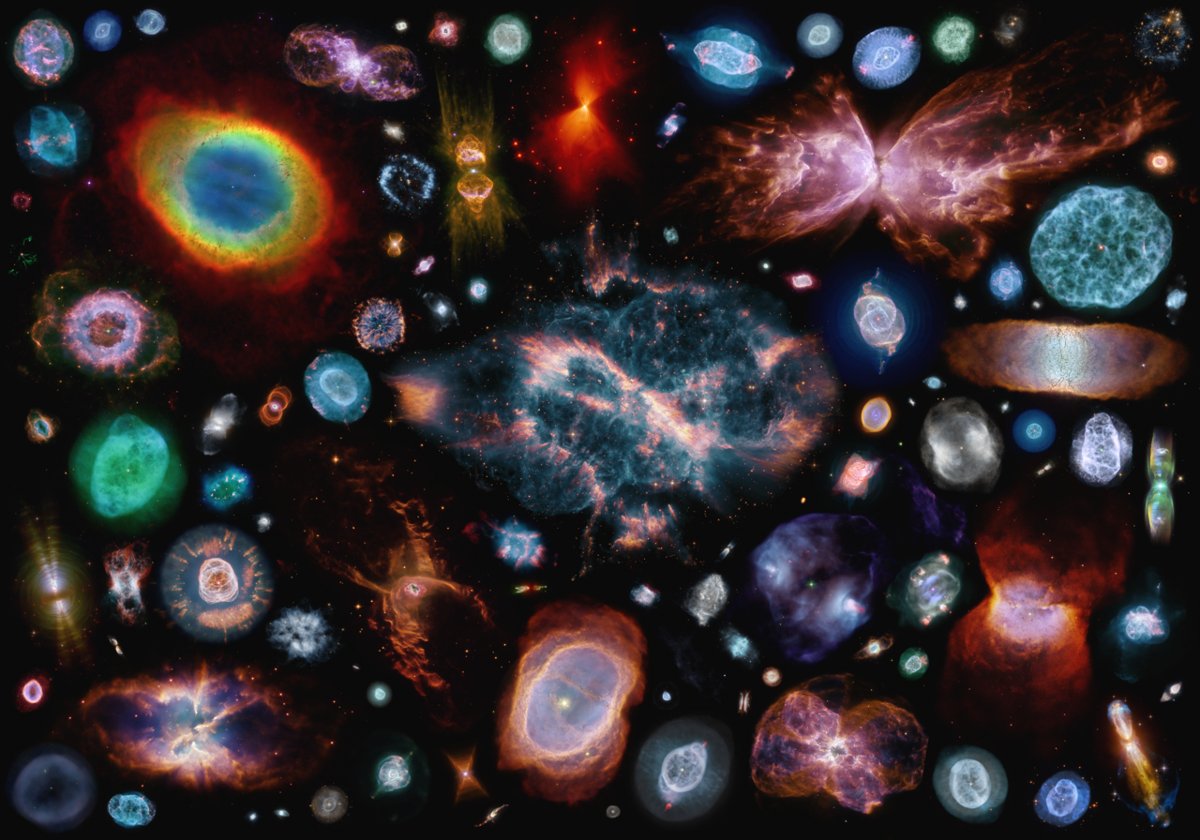
The name is a historical accident. When William Herschel trained his large reflecting telescope on these fuzzy, circular objects in the late 18th century, they reminded him of the disk-like appearance of Uranus as seen through his eyepiece — a round, greenish smudge rather than a point of light. He called them planetary nebulae, and the name stuck, even though they have nothing to do with planets. They are, in fact, among the most violent and beautiful endpoints a star can reach.
A planetary nebula forms when a star with roughly the mass of our Sun exhausts the hydrogen in its core. The star expands into a red giant, then sheds its outer layers in a slow, dense stellar wind that drifts outward over thousands of years. What remains at the center is the stellar core: a white dwarf, typically about the size of Earth but with a temperature exceeding 100,000 kelvin. That white dwarf floods its surroundings with ultraviolet radiation, ionizing the expelled gas and causing it to glow. The result is a shell of luminous gas — sometimes spherical, sometimes bipolar, sometimes hourglass-shaped, often with intricate filamentary structure — surrounding a faint hot star.
Finding the Ring Nebula (M57)
The Ring Nebula in Lyra is the canonical entry point for anyone getting started with planetary nebulae. M57 sits almost exactly on the line connecting the two southern stars of the small parallelogram that forms Lyra's main asterism, about 40% of the way from Sheliak (Beta Lyrae) to Sulafat (Gamma Lyrae). In a finder chart, this geometry is obvious and the star field is unambiguous. Even in a 60mm refractor, M57 appears as a noticeably non-stellar fuzzy disk. With a 4-inch or larger aperture, the ring structure becomes clear: a slightly oval annulus of glowing gas with a darker center.
What you cannot easily see in a small telescope is the central white dwarf. It glows at about magnitude 14.8, well below the threshold for typical amateur equipment, though it has been glimpsed in 12-inch and larger telescopes under exceptional conditions. What you are seeing when you look at the ring is mostly ionized oxygen, which emits at a characteristic wavelength of 500.7 nanometers — a blue-green color that explains why planetary nebulae often appear greenish-blue at the eyepiece. M57 is roughly 2,300 light-years away and about one light-year in diameter, its shell of gas expanding at about 20 to 30 kilometers per second.
The Dumbbell (M27): the best planetary for small instruments
Observers with small telescopes should start here, not with M57. The Dumbbell Nebula in Vulpecula is the largest and brightest planetary nebula in the northern sky, measuring about 8 arcminutes by 5.7 arcminutes at its widest extent — nearly a quarter of the Moon's apparent diameter. At magnitude 7.4, it is visible through 10×50 binoculars from a dark site as a small but clearly non-stellar object. In a 3-inch or 4-inch telescope at low to medium power, the characteristic dumbbell or apple-core shape is unmistakable: two bright lobes with a thinner waist between them.
M27 sits about 1,360 light-years away, making it the nearest bright planetary nebula, and its apparent size is a direct consequence of that proximity. The Dumbbell is estimated to be about 9,800 years old, young enough in nebular terms that its structure is still relatively coherent and well-defined.
The Blinking Planetary (NGC 6826)
This one is a party trick. NGC 6826 in Cygnus has a central star bright enough to see directly at the eyepiece — around magnitude 10.4 — and it plays an unusual visual game. When you look directly at the nebula, the bright central star dominates and the surrounding shell becomes invisible. When you use averted vision, looking slightly to one side so the image falls on the rod-rich periphery of your retina rather than the cone-dense fovea, the nebula suddenly pops into view surrounding the star. Alternate between direct and averted vision and the nebula blinks in and out — a demonstration of rod versus cone sensitivity you will remember.
NGC 6826 is a relatively small planetary at about 27 arcseconds in diameter, requiring medium to high magnification to resolve well. It sits about 2,200 light-years away. The blue-green color is pronounced through most telescopes.
Filters that change everything
Planetary nebulae respond dramatically to narrowband filters. An oxygen-III (OIII) filter, which passes only the 495.9 and 500.7 nanometer emission lines, will make the nebula brighter relative to the background star field and often reveal structure invisible in white light. This seems counterintuitive — a filter that blocks most light should make things harder to see — but for emission objects, blocking background light while passing only the specific wavelengths the nebula emits dramatically increases contrast. The Dumbbell and Ring nebulae both benefit strongly from OIII filtration.
The Helix Nebula (NGC 7293) in Aquarius is the largest planetary nebula in the sky by apparent size but its low surface brightness makes it challenging without a filter. With an OIII filter from a dark site, it becomes one of the most rewarding objects in the autumn sky.
These objects are worth understanding beyond their visual appeal. The Sun will become a planetary nebula in roughly five billion years. The gas expanding from its surface will ionize, glow, and drift outward for about 10,000 years before dispersing into the interstellar medium, seeding the next generation of stars with heavier elements forged in the Sun's core. When you look at M57 in Lyra, you are looking at a Sun-like star in one of its final acts.
