
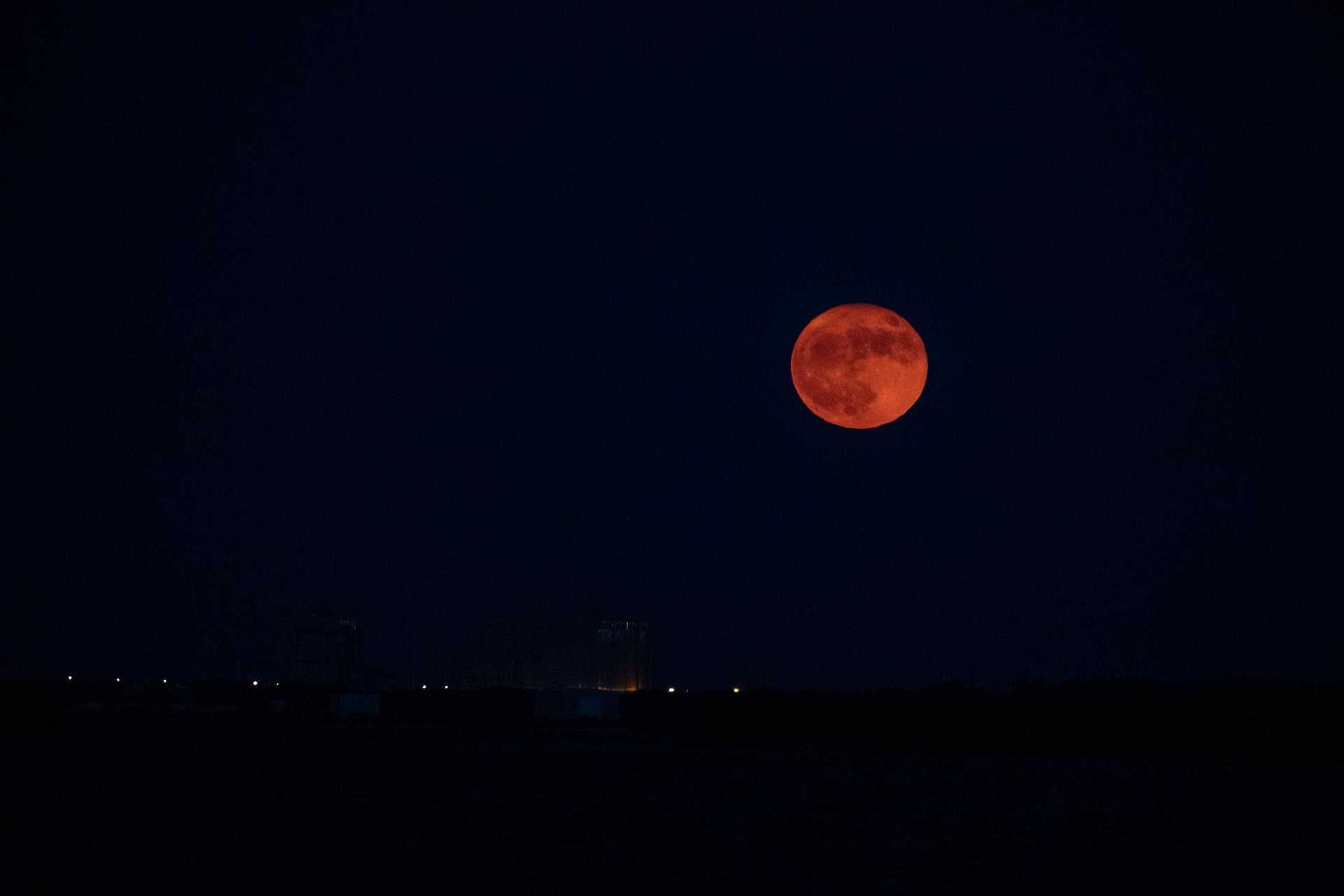
The final stretch of July 2026 is a study in timing. The Moon does most of the talking, brightening night after night from a tidy half-lit disc into a glaring full orb, and in doing so it sets the terms for everything else in the sky. A meteor shower is trying to peak. A ringed planet is showing off a rare geometry. Venus is anchoring the evening west. Whether you catch any of it well depends on where the Moon is and how bright it has become — so let us start there.
The Moon calls the shots
The Moon reaches First Quarter on 21 July, according to NASA's monthly skywatching roundup, with Star Walk pinning the moment at 11:06 GMT. A First Quarter Moon is the observer's friend: half the disc is lit, it sits high in the evening sky, and the low sunlight raking across the lunar terminator throws craters and mountain ranges into sharp relief. Point even a modest telescope or a decent pair of binoculars along that shadow line and the Moon stops being a flat white coin and becomes a world with topography.
Enjoy that view while it lasts, because over the following week the Moon fattens steadily toward full. The Full Buck Moon arrives on 29 July at 14:36 GMT — the name is a traditional label for July's full Moon. By the time it is riding high each night in the days on either side of that date, it is effectively a floodlight, and a floodlight changes what else you can hope to see.
Saturn, tilted nearly on its side
If you own a telescope, Saturn is the target to prioritize this month, and for a specific reason. NASA highlights the planet as a rewarding sight with its rings appearing "unusually thin" — tilted to a shallow, nearly edge-on angle from our line of sight. Saturn's ring plane slowly seesaws over the years as the planet orbits the Sun, and right now we are viewing it close to edge-on, so the famous rings show up as a taut, narrow line slicing across the disc rather than the broad open ellipse most people picture.
It is an oddly austere look, and a temporary one — the geometry will open back up over the coming years — which makes this a genuine "see it now" observation rather than a perennial one. Star Walk lists Saturn at magnitude 0.6, sitting in the constellation Pisces and best placed in the morning sky. That timing matters: to catch Saturn well you are looking in the pre-dawn hours, when the planet has climbed clear of the horizon murk.
Where are the other planets?
Venus owns the evening. It hangs in the western sky after sunset, brilliant enough to be the first "star" out, and around 22 July it forms a triangle with two stars of Leo — Regulus, the constellation's bright heart, and Denebola, marking the lion's tail. A bright planet framed by named stars is one of the easier naked-eye compositions to find and a satisfying one to sketch or photograph.
Mars works the opposite end of the night, low in the morning sky. Around 22 July it passes near Aldebaran, the orange eye of Taurus, and Elnath, the star marking one of the bull's horns. Aldebaran's own ruddy color makes for a nice contrast-and-compare with Mars — a good exercise in training your eye to read planetary hues.
Jupiter is essentially leaving the stage. It reaches conjunction with the Sun on 29 July, meaning it sits on the far side of the Sun from our vantage point and is lost in the solar glare — not an observing target this month, just a note for anyone wondering where the sky's other heavyweight has gone.
Mercury is a long shot. Star Walk notes it sitting very low before sunrise after its retrograde motion ends on 23 July, which puts it deep in the twilight and difficult to pull out of the brightening dawn.
The Delta Aquariids, versus the Moon
Now the frustrating part. The Southern Delta Aquariids, a meteor shower that favors observers under darker southern skies, build toward a peak on the night of 30–31 July. At their best the shower delivers roughly 25 meteors per hour — a respectable, if not spectacular, rate.
The catch is that peak lands within days of the Full Buck Moon. Star Walk puts the Moon at about 97 percent illuminated during the shower's maximum, which is very nearly as bright as it gets. That much moonlight washes out the fainter meteors and leaves only the brightest streaks visible, so the practical count you can expect is well below the theoretical 25 per hour.
Is it worth trying anyway? Yes, with adjusted expectations. The Delta Aquariids produce a slow trickle of activity for several nights around the peak rather than a sharp one-night spike, so you are not locked into the single moonlit worst-case evening. Position yourself so the Moon is blocked — behind a building, a hill, a tree line — face a darker patch of sky, give your eyes twenty minutes to adapt, and settle in. The meteors that do punch through the moonlight will be the bright ones worth seeing.
A word on the Milky Way
NASA also flags the summer Milky Way, which appears as a pale band arching across the sky from genuinely dark sites. This is not a late-July target so much as a late-July-and-a-dark-sky target — and with the Moon dominating the back half of the month, your realistic window is earlier, before the Moon fills out, and far from city lights. If you can get out to a dark site during the darker nights around and before First Quarter, the band is there for the looking.
Why It Matters
Skywatching guides can read like a list of dates to memorize, but the useful skill is understanding how the pieces interact — and late July 2026 is a clean lesson in exactly that. The same bright Moon that makes for gorgeous terminator views through a telescope on 21 July is the reason the Delta Aquariids will disappoint eight nights later. Planning around the sky means reading those trade-offs: chase the Moon and Saturn's rare edge-on rings when the Moon is your ally, and accept that the meteor shower and the Milky Way are working against a hard light source you cannot switch off. Saturn's nearly edge-on tilt is the standout here precisely because it is fleeting — a configuration that rewards observers who look this year rather than assuming the rings will always be wide open. None of this requires expensive gear. A pair of binoculars, a clear horizon, and an awareness of where the Moon sits will get you most of the way.
