
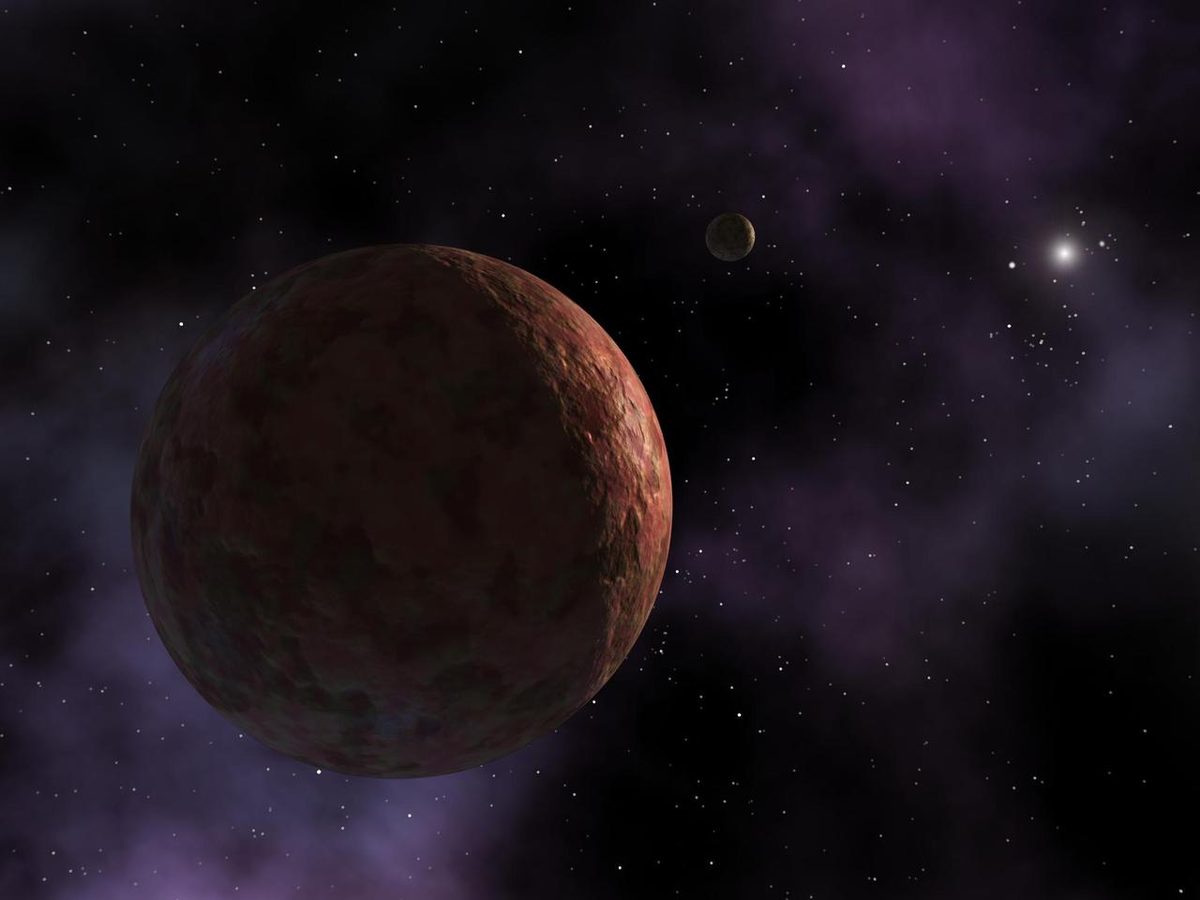
There is a region of the solar system so remote that light from the Sun arrives as little more than a bright star, and where a full orbit around that star takes thousands of years. Most astronomers had assumed this outer dark was a statistical fog — objects flung there by ancient gravitational upheavals, orbiting in the cold without pattern or purpose. Then Mike Brown and Konstantin Batygin sat down with the orbital data and noticed something that wouldn't go away: the most distant trans-Neptunian objects aren't scattered randomly. They're clustered. And the clustering points, probabilistically, at something massive lurking beyond the reach of any telescope we've yet trained on that part of the sky.
That was 2016. In the years since, the hypothesis has survived sustained scrutiny, attracted serious institutional telescope time, and generated a genuine observational campaign unlike anything the outer solar system has seen before. Planet Nine has not been found. But the parameters around where it must be, and what it must look like, have tightened considerably — which in astronomy is a meaningful kind of progress.
What the orbits are actually saying
The argument for Planet Nine is fundamentally statistical, but the statistics have teeth. The objects at issue are a subset of the trans-Neptunian population known as extreme TNOs — bodies with semi-major axes beyond 250 astronomical units, far enough out that Neptune's gravity is essentially irrelevant to their long-term dynamics. When Batygin and Brown first flagged six of these objects in 2016, their orbital planes and their closest approaches to the Sun were clustered in physical space in a way that had roughly a one-in-14,000 chance of arising by chance. Subsequent observational campaigns have added more extreme TNOs to the catalog, and the clustering has persisted.
The proposed explanation is gravitational shepherding by a planet with a mass somewhere between five and ten times that of Earth — a super-Earth, or perhaps a scaled-down version of Neptune — in a highly elliptical orbit inclined about 15 to 25 degrees relative to the ecliptic, with a semi-major axis somewhere in the range of 400 to 800 AU. At that distance, Planet Nine would complete a single orbit in roughly 10,000 to 20,000 years. Its orbital period is longer than the entirety of recorded human history.
Critics have raised two serious objections. The first is observational bias: we find TNOs when they're closest to us and brightest, and the survey footprints for most TNO-discovery programs aren't uniform across the sky. If the clustering of detections reflects clustering of survey coverage rather than clustering of actual orbits, the whole argument evaporates. Batygin and colleagues have spent considerable effort modeling this bias explicitly, and their most recent analyses — incorporating bias-corrected survey data from projects like OSSOS and the Dark Energy Survey — still find excess clustering beyond what observation geometry alone can explain. The signal is attenuated somewhat by bias corrections, but it doesn't disappear. The second objection is that simulations of the early solar system can sometimes produce TNO clustering through purely stochastic mechanisms. These alternative models exist and are not trivially dismissed. They are also not obviously more parsimonious than the Planet Nine hypothesis.
The Vera Rubin Observatory changes the game
For most of the debate's history, the observational campaign has been opportunistic — researchers catching extreme TNOs as a byproduct of surveys designed for other purposes, then feeding the orbital data back into the clustering analysis. That is changing. The Vera C. Rubin Observatory in Chile, now in commissioning with its Legacy Survey of Space and Time (LSST) ramping toward full operations, is purpose-built for exactly the kind of deep, wide, repeated sky coverage that a systematic Planet Nine search requires.
LSST will image the entire accessible southern sky every few nights to a depth that existing surveys can't approach. Over its ten-year baseline, it's expected to discover tens of thousands of new TNOs — a tenfold or greater increase over the current catalog. The statistical power this brings to the clustering debate is enormous. If the clustering is real, Rubin will make it undeniable. If it's an artifact of patchy historical coverage, that will become clear too. Either outcome resolves a decade of productive uncertainty.
But Rubin's contribution may not stop at TNOs. A sufficiently bright Planet Nine — one that reflects enough sunlight, or that happens to be near perihelion and thus closer to us than its average distance — could appear directly in the LSST data. Brown estimates that if Planet Nine is at the near end of its predicted orbital range, say 400 to 500 AU, its reflected light might push it into Rubin's detection window. If it's sitting near aphelion at 800-plus AU, it will be too faint. The outcome is genuinely uncertain, which is part of what makes this era of the search interesting.
Narrowing the haystack
Even before Rubin reaches full cadence, other programs have been pressing the search. The Subaru Telescope's Hyper Suprime-Cam has surveyed large swaths of the sky at high sensitivity. WISE and its successor NEOWISE scanned the entire sky in infrared, relevant because a cold, dark Planet Nine might be more conspicuous in thermal emission than in reflected visible light — though re-analyses of WISE data have so far turned up no convincing candidates. The upcoming SPHEREx mission and, further out, proposed infrared space telescopes could extend this search.
The current best-fit orbital solution for Planet Nine places it somewhere in a broad arc of the sky in the direction of the constellations Orion and Taurus, or alternatively in the general direction of the constellation Cetus. These aren't small patches, but they're finite. Follow-up work from Batygin's group and independent analyses by researchers including Scott Sheppard and Chad Trujillo — who co-discovered several of the key extreme TNOs — have continued to refine the positional constraints. The most recent analyses favor the hypothesis that Planet Nine is somewhere between 500 and 700 AU away, on the fainter and colder end of what current instruments can reach.
One underappreciated element of the Planet Nine hypothesis is what it implies about how the planet got there. A super-Earth in the outer solar system doesn't fit neatly into standard models of solar system formation. The leading explanation is that Planet Nine formed closer in, where there was enough material, and was then ejected outward by gravitational interactions with Jupiter or Saturn during the chaotic early period of planetary migration — the same episode that is thought to have scattered much of the primordial Kuiper Belt. This makes Planet Nine a relic of a process we know happened, which lends the hypothesis a physical plausibility that goes beyond the clustering statistics alone.
There is also the intriguing possibility that Planet Nine is not a native. Some researchers have proposed that the Sun captured a free-floating planet — a rogue planet ejected from another stellar system — early in its history when the Sun was still part of a dense stellar nursery. Free-floating planets are now known to exist in substantial numbers; JWST has identified them in young star clusters. Whether the Sun was in the right environment at the right time to capture one is debatable, but the mechanism is physically sound.
The honest assessment, ten years after the original hypothesis, is that Planet Nine remains unconfirmed but not implausible, and that the observational machinery now being brought to bear on the question is qualitatively different from what existed in 2016. Rubin alone will generate more useful TNO data in its first two years than all prior surveys combined. If the planet is there and findable with current technology, the search is no longer a matter of years — it's a matter of the survey completing enough sky coverage to close the case. If nothing emerges from that data, the clustering hypothesis will need to be revisited from scratch. Either way, the outer solar system is about to get a great deal less mysterious.
