
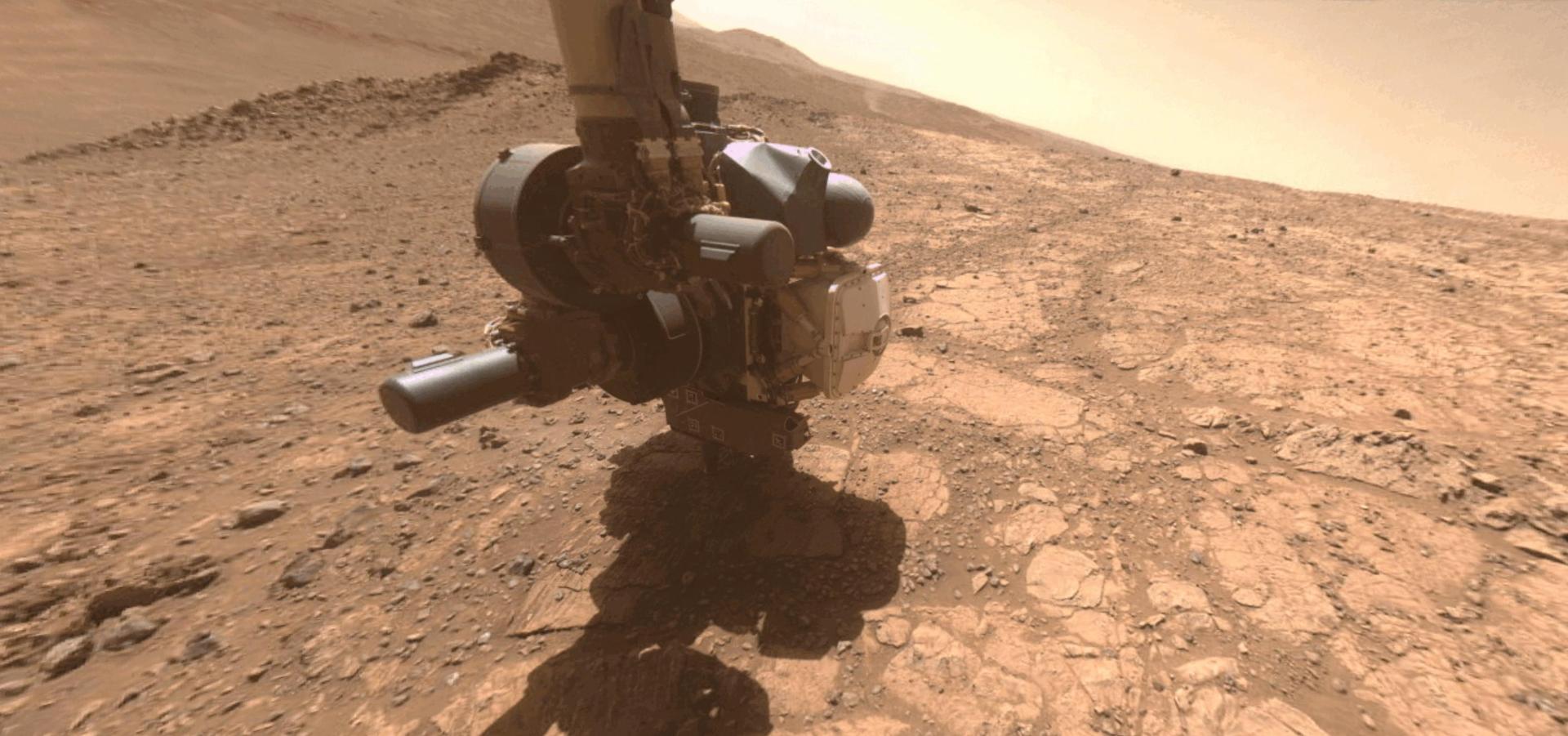
On October 24, 2026, the 2,018th Martian day of its mission, Perseverance's Mastcam-Z camera looked into the rover's coring bit and saw a fresh cylinder of rock. The sample, named "Singita," is the rover's first in more than a year. Mission scientists think it may be among the oldest rocks exposed on the surface of Mars.
The timing is a little awkward. On November 9, two weeks after the core was drilled, NASA's Science blog described the new sample. The same day, the agency's Mars program announced another study of how, or whether, any of these samples will reach Earth.
A hard rock, then a better one
Singita took some work. The team first tried a target called "Badger Peak," and NASA says its hardness was too high to core. The team still felt strongly that it was worth adding a gabbro, an igneous rock made mostly of calcium-rich plagioclase feldspar and pyroxene crystals, to the sample collection. The Planetary Society reported that the team's first attempt to drill a core failed and that the rover had to switch to a different, less-used drill bit before it succeeded. Rather than keep working on the stubborn rock, the rover drove about 100 meters (330 feet) to a different patch of light-toned rocks, where visual and chemical data showed a composition similar to that of Badger Peak.
The second site, in the Lac de Charmes region, was an improvement on both counts. NASA says the team chose a neighboring rock with a flatter surface, better oriented for the drill stabilizers to press against, and used a coring bit with less wear. On October 17 (sol 2011), Perseverance abraded a patch called "Pumbe" to expose fresh material for its instruments. A week later it drilled about 3.1 centimeters (1.2 inches) into the rock and collected the core. NASA's latest mission status report lists the spacecraft status as nominal.
Dug up from a kilometer down
The likely culprit is impacts. NASA's blog says textures in the rock suggest Singita likely formed deep in the Martian crust and was later modified and excavated by at least one, and possibly several, large impact events. Katie Stack Morgan, Perseverance's project scientist, announced the sample at the American Astronomical Society's Division for Planetary Sciences conference. According to The Planetary Society, she said the rock was likely buried about a kilometer (0.6 miles) deep in the crust before being thrown to the surface by an asteroid or comet impact, or by multiple impacts over time.
"It could be among the oldest rocks exposed on the surface of Mars," Stack Morgan said.
That claim depends on a comparison. Singita is the first crystalline igneous rock the rover has sampled outside Jezero crater. Jezero formed in a giant impact about 3.9 billion years ago, give or take, so scientists did not expect to find older rocks inside the crater. Researchers think Singita is likely at least as old as Jezero, and it could be several hundred million years older. If so, it records a stretch of Martian history that is older than the crater where the rover began its mission.
"Could be" is carrying a lot in that sentence. The Planetary Society notes there is no way to know the rock's exact age without bringing the sample back to Earth. The same report says Stack Morgan expects the rover to stay in the region and attempt two more samples, including one from a different, younger crystalline igneous rock.
And so, another rethink
That brings back the long-running question of Mars Sample Return. On November 9, Tiffany Morgan, director of NASA's Mars Exploration Program, described a new effort called the Perseverance Sample Retrieval Architecture, or PSRA, during a virtual meeting of the Mars Exploration Program Analysis Group (MEPAG), Space.com reported. Its aim is to develop impartial recommendations for retrieving the samples Perseverance has collected and delivering them to Earth, by assessing mission requirements, reviewing lessons learned and evaluating current capabilities and acquisition options.
The schedule is slow. The PSRA strategy team kicks off in January 2027, and its final report is due in winter 2027-2028. That means roughly a year of study before any new plan is settled, let alone funded or built.
The program has been here before. Space.com notes that one earlier price tag, about $11 billion with samples returned in 2040, was judged by NASA itself as too costly and not doable in an acceptable time frame. Another appraisal group found it feasible to return samples as early as 2035 for about $8 billion. How PSRA will deal with cost and other concerns, Space.com says, is still to be determined.
Not everyone thinks the wait is harmless. Bruce Jakosky, speaking at the same MEPAG meeting, flagged the importance of returning samples before human missions to Mars. He pointed to hazards that have already been identified, including perchlorates and chloromethanes in the soil and breathable dust that could also affect hardware wear, which he argued would be better understood with material in hand before astronauts are exposed to them.
Why It Matters
Singita shows how Perseverance's sample collection keeps gaining value. A rock that may be several hundred million years older than Jezero is the kind of material that could help anchor a timeline of early Mars, but its exact age cannot be known without bringing it back to Earth. That will not happen while it sits in a sealed tube on another planet.
The competition is also getting closer. China's Tianwen-3 mission appears on track to launch around 2028 on two Long March 5 rockets, according to Space.com. Per the China National Space Administration, it will have a lander, an ascender, a service capsule, an orbiter and an Earth reentry module, and it aims to return roughly 500 grams of Martian material in 2031. NASA's PSRA final report is due in the winter of 2027-28, close to that launch date. If both schedules hold, China could be launching its sample-return hardware around the time NASA finishes deciding how it will retrieve the samples it has already collected.
None of that takes away from the engineering behind Singita. The team passed over a rock that was too hard, drove about 100 meters, swapped to a less-worn bit and came back with a core. But what the sample can tell scientists depends on decisions made far from Lac de Charmes, and for now those decisions are scheduled to take about another year.
