
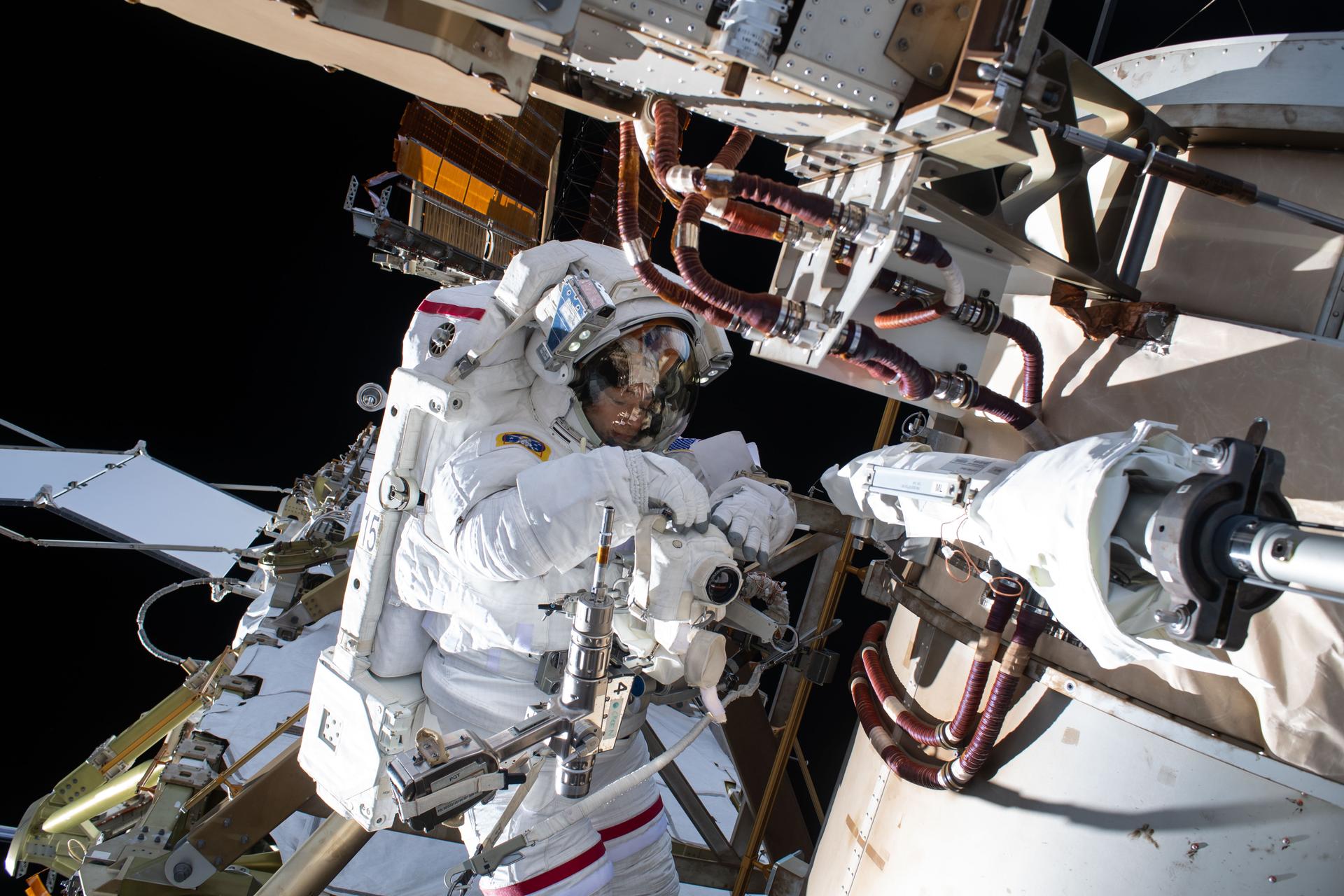
The International Space Station's power upgrade is finished. On Thursday, Nov. 5, NASA astronaut Anil Menon and Canadian Space Agency astronaut Joshua Kutryk installed and deployed the eighth and final ISS Roll-Out Solar Array, or IROSA, on the station's 3B power channel. According to NASA's Space Station blog, the pair wrapped up at 3:35 p.m. EST after 6 hours and 59 minutes outside, bringing the station's generating capacity from 160 kilowatts to roughly 215 kilowatts.
It was the second spacewalk in a week for the same two crew members, and in many ways a mirror image of the first. On Oct. 29, Menon and Kutryk put up the seventh array. Last week's job left exactly one array to go; this week's closed out the set.
A Rerun on the Opposite Side
Mission managers gave the Expedition 75 crew the go on Nov. 4 for a spacewalk planned to last about seven hours, with a scheduled start of 8:30 a.m. The choreography, as NASA described it the day before, repeated the Oct. 29 tasks on the other side of the station: Kutryk would translate along the starboard truss while Menon rode the end of Canadarm2 carrying the rolled-up array. The two would hand the hardware off between them, then install it on the far end of the starboard truss.
That arrangement is a sensible division of labor for an awkward payload. The array delivered on the previous excursion weighed 340 kilograms, according to SpaceQ. Mass doesn't disappear in orbit just because weight does, so a payload that size calls for the robotic arm to do the long-distance hauling. Per NASA's plan, that leaves the astronaut on the truss free to meet the arm and receive the package.
Thursday's outing was designated U.S. spacewalk 101. It was Menon's fifth spacewalk and Kutryk's second, and NASA counts it as the 286th spacewalk in support of station assembly, maintenance and upgrades.
The Warm-Up Act: Spacewalk 100
The Oct. 29 spacewalk carried its own milestones. FOX 13 described it as the 285th ISS spacewalk and the 100th conducted from the Quest airlock without a space shuttle present. It ran 7 hours and 11 minutes; SpaceQ reports the crew switched their suits to battery power at 7:57 a.m. EDT and were back inside at 3:08 p.m. EDT. Beyond installing the seventh array, the pair completed get-ahead tasks intended to smooth the way for the Nov. 5 work.
It was also Kutryk's first spacewalk, which made him the fifth Canadian to walk in space and the first since David Saint-Jacques in 2019. The Canadian flavor extended past the crew: CSA astronaut Jenni Gibbons served as CAPCOM, the voice relaying instructions from the ground, and the robotic arm doing the heavy lifting was Canadarm2, flown from inside the station by Watkins and Delaney.
Kutryk framed the day as more than a hardware swap. "Today was a step forward [for] the future of space station," he said, according to SpaceQ, calling it a step toward spacewalks on the Moon as well.
Canadarm2's Comeback
That the arm was available for either job is worth noting. SpaceQ reports that a Canadarm2 wrist joint failed in May and was replaced during a June 30 spacewalk; the failed unit is scheduled to return to Earth aboard a cargo Dragon in November. Two back-to-back array installations that both depended on the arm suggest the repair has held up under real operational load.
What Is an IROSA, and Why Eight?
The roll-out arrays don't replace the station's original solar wings; they augment them, each one installed on a specific power channel. The work required considerable groundwork. NASA's Nov. 5 post says astronauts completed 18 spacewalks to prepare the power channels and install the eight arrays. With 3B now outfitted, NASA says the power augmentation upgrades are complete.
Exactly when the campaign started depends on which NASA post you read. The Nov. 5 blog entry says the work began in February 2021, while the Nov. 4 entry dates it to June 2021. Either way, it has been a multi-year effort spread across many crews and expeditions.
Why It Matters
Power is the station's fundamental budget. Every experiment, every life-support system and every piece of hardware aboard draws from the same supply. Taking the station's capacity from 160 kW to about 215 kW is an increase of roughly 34%, by our arithmetic; FOX 13 rounds it to 30%. SpaceQ reports the agency says the extra power will support critical station operations, including a safe, controlled descent from orbit at the end of the station's life.
The final installation also closes out a long, well-rehearsed sequence of spacewalks without drama, which is its own kind of achievement. The Oct. 29 and Nov. 5 excursions were nearly identical in plan and duration, and both ran roughly seven hours. For a program that will increasingly lean on spacewalks, robotic arms and modular hardware beyond low Earth orbit, a routine executed this cleanly is a useful data point. Kutryk's own framing, connecting station work to future lunar EVAs, points to exactly that.
With the eighth array deployed, the ISS power upgrade moves from active project to finished infrastructure, and the station's crews can get back to spending that electricity rather than installing the hardware that makes it.
Sources
- Spacewalkers Install Final Roll-Out Solar Array (NASA Space Station blog, Nov. 5, 2026)
- Astronauts Are Go for Final Power Upgrade Spacewalk (NASA Space Station blog, Nov. 4, 2026)
- Weekly ISS update: One solar array to go after Kutryk's spacewalk (SpaceQ)
- Mission accomplished: Astronauts complete historic spacewalk on Space Station (FOX 13)
