
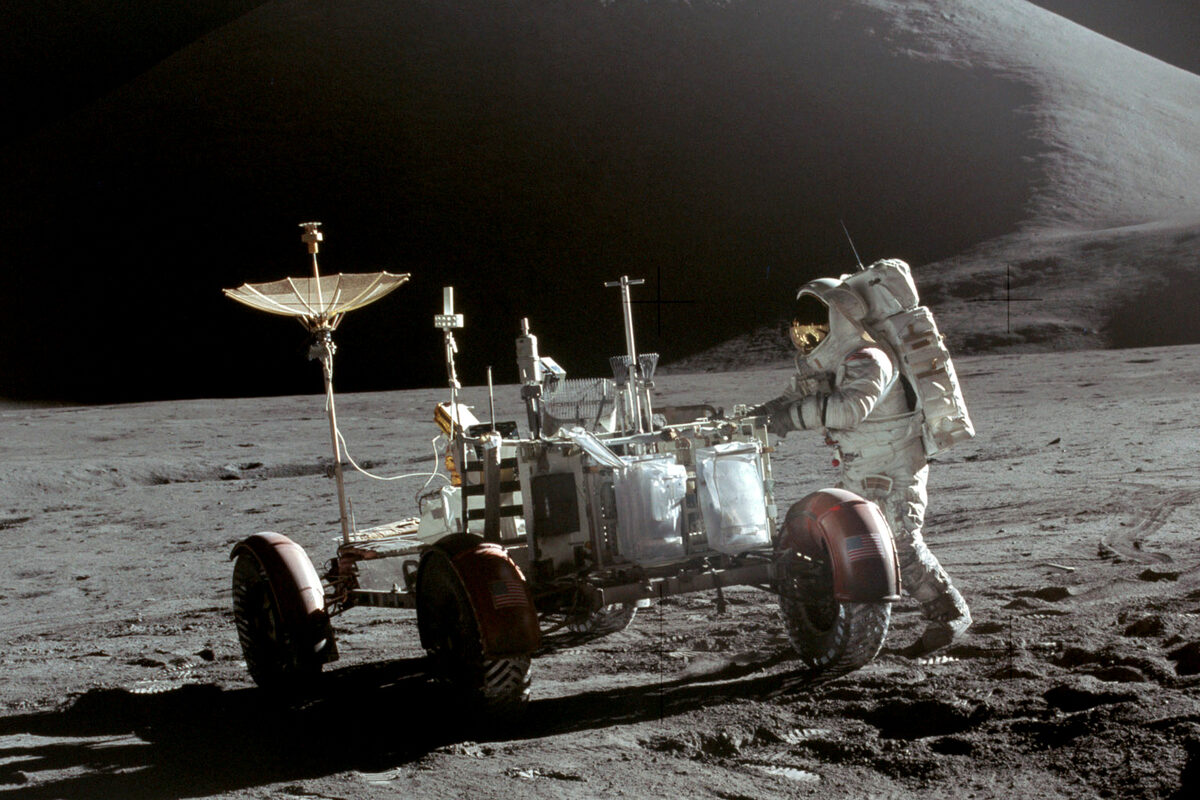
NASA has a new way to get to the Moon's south pole: reuse its Mars hardware. On Nov. 7 the agency confirmed it is moving forward with PROMISE, short for the Polar Rover for Observation, Mapping, and In-Situ Exploration. The six-wheeled, nuclear-powered rover will be managed by NASA's Jet Propulsion Laboratory. It is being built from spare flight components and engineering test models made for the Curiosity and Perseverance Mars rovers.
Blue Origin will deliver it. The company gets a $94 million base contract, with an option worth $140 million more, to carry PROMISE to the lunar surface on its Blue Moon Mark 1 lander. NASA is targeting a launch in late 2028 and an 18-month mission on the surface.
A Mars rover's sibling, sent somewhere colder
NASA says JPL has more than three decades of experience building and operating Mars rovers, and the hardware left over from those programs is the core of PROMISE. Spacecraft programs routinely build spare flight parts and full test vehicles, which engineers use on the ground to rehearse drives and work through problems before sending commands to the real rover. NASA's plan puts some of that hardware to work on a new world.
When the proposal was still under review in July, SpaceQ described it as an engineering test version of the Perseverance and Curiosity rovers. NASA's Nov. 7 announcement is more specific: spare flight components plus engineering test models from both Mars programs. The practical appeal is easy to see. Designs that have already flown, and parts that have already been qualified, can shorten a schedule that would otherwise mean building a new rover from scratch for a late-2028 launch.
Why nuclear power
The power source is the most important design choice. The Moon's south pole is hard on solar-powered machines. A lunar night lasts about two weeks, and the region holds permanently shadowed craters that sunlight never reaches. According to SpaceQ's July coverage of the proposal, PROMISE would carry a plutonium nuclear battery so it can keep working through those long nights and drive into the dark.
"Having a nuclear battery on it allows us to go anywhere we want, regardless of the illumination," said Carlos Garcia-Galan, NASA's Moon Base program manager, at a briefing SpaceQ covered in July.
NASA's announcement describes the rover as powered to survive lunar nights. That matters for a mission planned to last 18 months. A solar-only vehicle at the pole would have to plan its work around light and shadow. A nuclear-powered one can plan around its science targets instead.
What it will carry
According to NASA, PROMISE's science payload includes:
- A drill that can reach about 3 feet (1 meter) below the surface
- Spectrometers to analyze the composition of the material it encounters
- Temperature and radiation sensors to characterize the environment
- Visible-light cameras
The rover will also demonstrate NASA's High Performance Spaceflight Computing technology, so it doubles as a test bed for onboard processing on future missions.
The 1-meter drill is one of the most consequential instruments. Sampling the surface tells you what is lying on top. A meter of depth tells you how the material is layered, and that is what matters when you want to know what is actually in the polar ground and how it got there.
The Blue Origin piece
The delivery contract expands an existing relationship. NASA says the PROMISE award builds on a May 2026 task order to Blue Origin for two lunar terrain vehicles. The rover will ride Blue Origin's Mark 1 lander, with a $94 million base value and a $140 million option.
The award arrives alongside a broader set of robotic deliveries. NASA announced a round of Commercial Lunar Payload Services awards on June 30, and SpaceQ reported them on July 2. The awards, tied to NASA's Moon Base plans, went as follows: $297.9 million to Astrobotic for two missions, $144.2 million to Firefly and $148.3 million to Intuitive Machines. Interesting Engineering, covering the same awards on June 30, described four robotic Moon Base missions meant to reach the surface by late 2028, the same period NASA now gives for the PROMISE launch.
Why It Matters
PROMISE matters for three reasons.
The first is access. The lunar south pole, and especially its permanently shadowed craters, is where a solar-powered lander or rover struggles most. A nuclear power source removes that constraint. In Garcia-Galan's words, the rover can go anywhere "regardless of the illumination." If it works, it opens terrain that light-dependent missions have to approach carefully or avoid.
The second is reuse. Building a lunar rover from Mars spares and test models is a bet that proven hardware can be repurposed faster and with less risk than a new design. A late-2028 launch puts that bet on a tight schedule. Whether it pays off will be a useful lesson for future missions that want to get more out of existing programs.
The third is duration and depth. An 18-month mission with a drill that reaches a meter down is a long, ground-level look at the region NASA has chosen for its Moon Base ambitions. Characterizing the subsurface, its temperature and its radiation environment is the groundwork any longer-term presence there would need.
Plenty is still to be proven. The rover has to be assembled, tested and integrated with a lander, and the launch is two years out. But with the Nov. 7 decision, PROMISE now has a delivery contract and a target date.
Sources
- NASA Awards Moon Base Transportation, Technology, Science Projects (NASA news release, Nov. 7, 2026)
- PROMISE (NASA mission page)
- New lunar missions and nuclear rover to pave the way for NASA Moon Base (SpaceQ, July 2, 2026)
- NASA expands Moon Base with four lunar missions (Interesting Engineering, June 30, 2026)
