
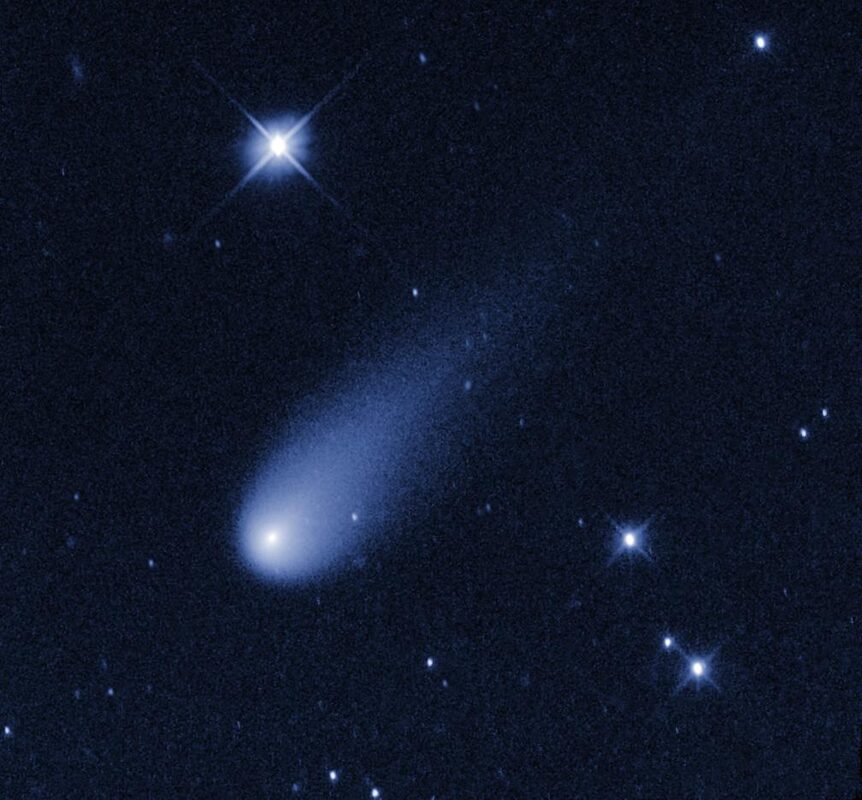
When an object from another star system passes through our neighborhood, astronomers get one chance to study it. It arrives, swings past, and leaves for good. For 3I/ATLAS, the third interstellar object ever identified, Webb's observing program was designed in advance to be ready for exactly this. A new study using the James Webb Space Telescope now offers a close look at what the comet is made of, and the answer is less exotic than you might expect.
The study was led by Silvia Protopapa of the Southwest Research Institute (SwRI) and published in The Astrophysical Journal Letters. It finds that the ice in the comet's coma is dirty: the water-ice grains are mixed with a lot of dust and other refractory material. That mixture looks more like the surfaces of some trans-Neptunian objects, the icy bodies orbiting past Neptune, than like the cleaner ice usually seen around solar system comets.
A telescope waiting for a visitor
3I/ATLAS was discovered in summer 2025. It follows 1I/'Oumuamua, found in 2017, and 2I/Borisov, found in 2019. Space.com notes that the comet possibly formed as long as 10 to 12 billion years ago, which would make it more than twice the age of the solar system.
Webb was ready for it because of a deliberate plan. According to SwRI's announcement, the observing program is led by Martin Cordiner of NASA Goddard and the Catholic University of America, and was designed to be ready the moment an active interstellar comet was found and to follow it over time. Interstellar objects are found with little warning and don't stay long, so having that program ready was valuable.
The team took three observations with Webb's NIRSpec instrument in its low-resolution PRISM mode. The first was on August 6, 2025, when the comet was 3.3 astronomical units (au) from the Sun. The second came on December 22, 2025, at 2.4 au, and the third on April 1, 2026, at 5.7 au. Observing at three distances lets researchers see how the coma changes over time, so the result doesn't rest on a single snapshot.
What the spectrum shows
Water ice has a recognizable pattern in the near-infrared. It absorbs light in several bands, including a strong one near 3 microns and weaker ones near 1.5 and 2.0 microns. Measuring how strong each band is, and what shape it has, tells researchers about the size and composition of the ice grains.
According to the team's paper, 3I/ATLAS shows a broad absorption band at 3 microns, along with emission from water vapor, carbon dioxide and carbon monoxide gas. The 1.5 and 2.0 micron bands, however, are weak or missing. That mismatch is the main clue. In small, dusty grains, light travels only a short distance through the ice, which weakens the shorter-wavelength bands while leaving the 3-micron band prominent.
The model that fits best uses aggregates of water ice ranging from submicron to micron size, mixed with refractory material. In other words, the grains are dusty clumps rather than clean ice crystals. Space.com describes them as dirty, dust-rich water ice, in contrast to the much cleaner, nearly pure ice of the solar system's own comets. SwRI's release adds that the grains are about the same size as those in our comets; what sets them apart is how much dust is mixed in.
The April 2026 data, taken at 5.7 au, were harder to explain. The researchers found that the spectrum favored a second, larger population of micron-sized, ice-rich aggregates. It also shows a subtle feature near 3.1 microns that is consistent with crystalline water ice. The paper doesn't settle why the coma changed in this way. SwRI's release quotes co-author Michael Kelley saying the cause could be the Sun heating the grains differently at each observation, or new material exposed as the comet's surface eroded near the Sun, and that telling them apart is an open question.
Neither a typical comet nor an alien oddity
The paper's central claim is about where 3I/ATLAS fits. The authors say its spectral properties bridge those of water-ice-bearing solar system comae and several spectral classes of mid-sized trans-Neptunian objects. It isn't an exact match for the comets we know, and it isn't so strange that it has no counterpart here. It lands somewhere along the same range, toward the refractory-rich end.
The team reads this as suggesting that the icy building blocks formed in different protoplanetary disks may span a continuum, from pure ice grains to water-ice aggregates with varying amounts of refractory material. SwRI's release says Protopapa described the grains as holding clues to the conditions where the comet was born. SwRI also notes the resemblance to trans-Neptunian objects lies in the shape of the water-ice band, and that the idea remains something to be confirmed.
A reasonable caution: this is one object, measured mostly in its coma, which is the cloud of gas and dust the nucleus gives off. The coma doesn't directly show the comet's interior. Grain-size models also involve choices about which materials to include and how to mix them. The fit is good, and the three observations make it stronger, but it remains a model of a single visitor.
Why It Matters
Interstellar comets are rare samples of material that formed around other stars, and 3I/ATLAS lets researchers compare that material with ice in our own solar system using Webb spectra of both. That is a direct comparison that is hard to make any other way.
The comparison suggests the raw materials of planet formation may share a common range of properties. If an object that may be billions of years older than the Sun carries ice resembling that of some bodies beyond Neptune, then the processes that built our outer solar system may not be unusual. The finding also shows the value of the approach behind the observations. Because Cordiner's program was designed to be ready for an active interstellar comet, Webb could follow 3I/ATLAS over eight months instead of only catching it briefly.
Future interstellar visitors will be a test of this idea. SwRI says future Webb observations of solar system comets and newly discovered interstellar visitors will help test these interpretations and determine whether 3I/ATLAS is typical. If another visitor also sits along the same range between comets and trans-Neptunian objects, the case for shared building blocks gets stronger. If it doesn't, 3I/ATLAS may turn out to be just one example from a wider variety than we expected.
Sources
- JWST Reveals Refractory-Rich Water Ice in Interstellar Comet 3I/ATLAS (Protopapa, Kelley, Cordiner et al., arXiv)
- SwRI-led study uses Webb to compare interstellar comet 3I/ATLAS with icy bodies in our solar system (SwRI, Oct 26, 2026)
- James Webb Space Telescope uncovers new clues about the origins of 'interstellar invader' comet 3I/ATLAS (Space.com, Nov 2, 2026)
