
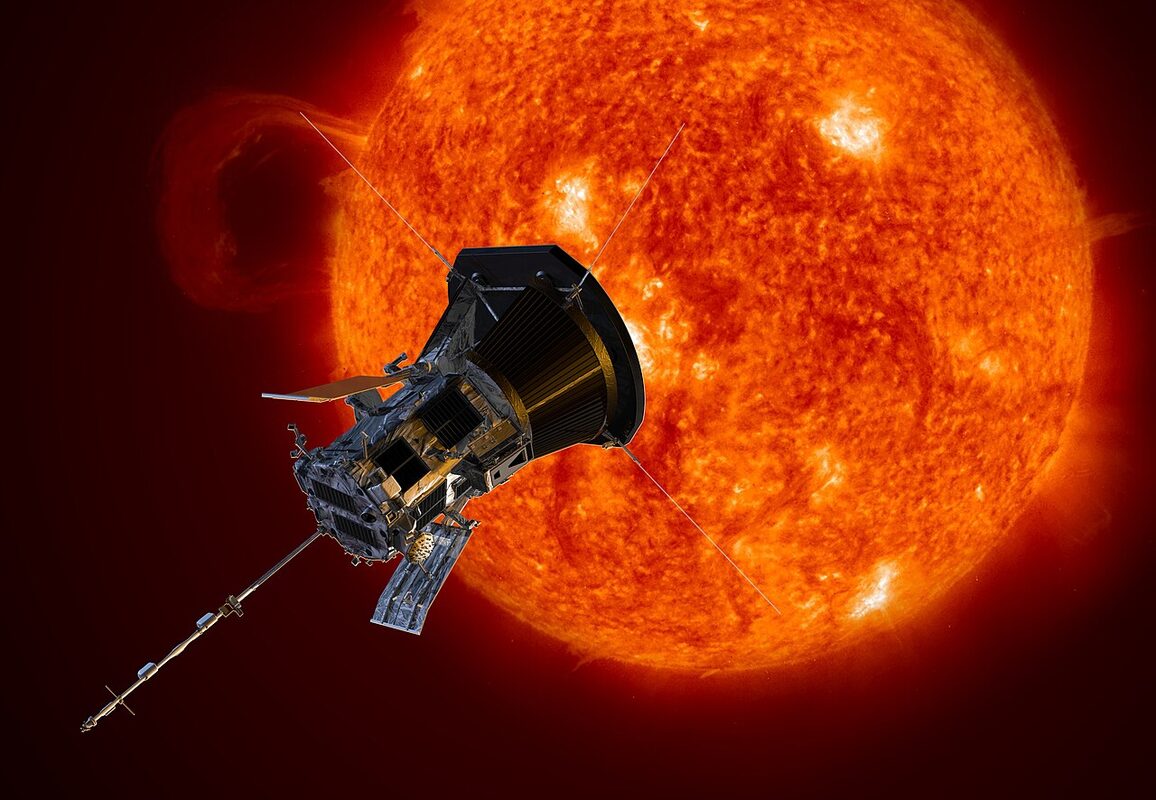
On Christmas Eve 2024, a spacecraft the size of a small car flew closer to the Sun than anything humans have ever sent, passing just 3.8 million miles above the solar surface while moving at roughly 430,000 miles per hour. At that speed you could cross the United States in under thirty seconds. NASA's Parker Solar Probe survived, phoned home, and has since repeated the feat again and again — most recently on its 27th close approach in March 2026, once more matching that record distance. It remains the fastest object ever made, and the only one that routinely flies through the atmosphere of a star.
Why fly into the Sun at all
The Sun poses a paradox that has puzzled physicists for decades. Its visible surface, the photosphere, simmers at about 5,500 degrees Celsius. Yet the corona — the wispy outer atmosphere visible during a total eclipse — is hundreds of times hotter, reaching millions of degrees. Heat is not supposed to flow from a cooler thing to a hotter one, so something in the corona must be actively dumping energy into it, and for seventy years no one could say for certain what. The second mystery is the solar wind: the Sun continuously blows a stream of charged particles out across the solar system, and how that wind gets accelerated to such speeds was, until recently, inferred only from a distance. The only way to answer either question definitively was to stop observing the corona from afar and fly a spacecraft straight through it.
How it survives
The engineering is the headline. Parker is shielded by a carbon-composite heat shield about 11.5 centimetres thick, which faces the Sun and reaches some 1,370 degrees Celsius at closest approach — while the instruments tucked in its shadow stay near room temperature. The trick is that the corona, despite its staggering temperature, is so thin that it transfers relatively little actual heat to a passing object; temperature and heat are not the same thing. The spacecraft also has to be ferociously autonomous, because at closest approach it is moving too fast and is too close to the Sun to take commands in real time. It flies the gauntlet alone, on instructions loaded in advance, and only days later does it turn its antenna back toward Earth to confirm it lived and to dump its data.
To reach the Sun, Parker had to do something counterintuitive: shed enormous orbital energy. A spacecraft launched from Earth inherits Earth's sideways motion around the Sun, and simply falls into a wide orbit. To get close, Parker has flown repeated gravity-assist passes by Venus, each one bleeding off speed and tightening its loop, until it could dive deep into the corona and swing back out. Each of those Venus encounters lowered the floor of its orbit a little further.
What it has found
The science has been worth the difficulty. By sampling the corona directly, Parker has gathered evidence pointing to small, jet-like magnetic eruptions — and to abrupt, S-shaped kinks in the magnetic field nicknamed "switchbacks" — as part of the machinery that heats the corona and flings the solar wind outward. It has flown through structures that, from Earth, are only smudges of light, measuring the particles and fields inside them where they form rather than where they arrive. That matters beyond pure curiosity: the same processes drive space weather, the storms that can disrupt satellites, power grids, and communications, and understanding them at the source is the foundation for forecasting them.
The probe carries a fitting name. It honors Eugene Parker, the astrophysicist who in 1958 predicted the existence of the solar wind against the skepticism of his peers — the first time NASA named a mission for a living person, and Parker lived to see his spacecraft launch. The mission's baseline goals are now met, and what comes next is formally under NASA review, but the spacecraft is healthy and still threading the corona on each pass. For the first time, the study of our star is not a matter of squinting at it from 93 million miles away. We have an instrument inside its atmosphere, reporting back from a place we could once only theorize about.
