
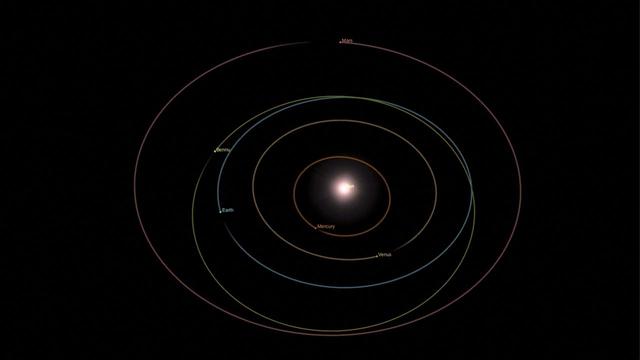
In the spring of 2029, a 370-meter-wide rock called 99942 Apophis will pass close enough to Earth that people with dark skies and sharp eyes will be able to watch it move across the constellations without a telescope. It will cross within 32,000 kilometers of the surface — well inside the belt of geostationary satellites that carry our television signals and weather data. No asteroid this large has come this close in recorded human history. And when it does, it will not be alone.
NASA's OSIRIS-APEX spacecraft is currently en route, already past its Earth gravity assist and closing the gap. The plan is to arrive at Apophis months before the historic flyby, settle into orbit, and watch from just a few kilometers' altitude as Earth's gravity does something to this asteroid that no scientist has ever been close enough to observe: stress it, shake it, and reshape it in real time. What the mission captures could rewrite how planetary scientists think about the internal structure of small rocky bodies — and, more urgently, how to predict what they do when strong gravitational forces act on them.
From Bennu to Apophis: a spacecraft repurposed at the edge of its operational life
OSIRIS-APEX began its life as OSIRIS-REx — Origins, Spectral Interpretation, Resource Identification, Security-Regolith Explorer — the mission that spent two years in close orbit around the near-Earth asteroid Bennu, touched down in 2020 to snatch a sample of its surface, and then began the long flight home. The sample capsule landed in Utah's West Desert in September 2023, delivering 121 grams of pristine carbonaceous material to waiting scientists. The spacecraft, still functional and carrying remaining fuel, had nowhere obvious to go. NASA decided to send it somewhere extraordinary instead.
Renaming it OSIRIS-APEX (Apophis Explorer), the agency redirected the probe on an extended mission to intercept Apophis ahead of the 2029 flyby. The spacecraft executed an Earth gravity assist in September 2025, using a close swingby of its home planet to bend its trajectory and build the velocity needed to rendezvous with Apophis. As of mid-2026 it is in cruise, on track for an April 2029 arrival — months before the asteroid's closest approach to Earth. That lead time is not incidental: the entire point is to observe Apophis before, during, and after the tidal stress event that the Earth encounter will impose on it. The mission does face some uncertainty; NASA's proposed budget cuts have put several extended missions under review, and OSIRIS-APEX has not been fully shielded from that pressure. Scientists and advocates have been pushing hard to protect the mission through 2029.
What a close pass actually does to an asteroid
The physics of what happens to Apophis during its 2029 flyby is well understood in broad strokes but poorly constrained in the details that matter most. As the asteroid swings through Earth's gravity well, differential gravitational forces — tidal forces, the same mechanism that stretches ocean tides — will act across its body. Because Apophis is not a solid homogeneous sphere but almost certainly a rubble pile, a loosely gravitationally bound aggregate of fragments left over from an ancient collision, those tidal forces will do real work on its interior.
Models predict that the encounter will trigger surface mass movement: material sliding, boulders shifting, small landslides resurfacing patches of ground that have been locked in place for billions of years. The asteroid's rotation rate is expected to change — Apophis currently rotates once every 30.6 hours, and the flyby's torques will alter that, possibly substantially. Its spin axis orientation may also shift. These are not minor perturbations. For a body already near the boundary between gravitational coherence and dispersal, even modest tidal stress is a significant event.
OSIRIS-APEX will be positioned to measure all of it. The spacecraft carries the same instrument suite it used at Bennu: a camera system, a thermal emission spectrometer, an X-ray spectrometer, and a laser altimeter. Together they can build detailed surface maps at centimeter-scale resolution, track the movement of individual boulders over time, characterize the thermal properties of freshly exposed material, and measure the mass distribution of the body through precise tracking of the spacecraft's own orbital perturbations. The combination amounts to a controlled geophysical experiment on a planetary body, something that cannot be replicated in any Earth laboratory.
The 2004 discovery that made Apophis famous for the wrong reasons
Apophis earned its place in public consciousness the hard way. When it was discovered in June 2004 by Roy Tucker, David Tholen, and Fabrizio Bernardi using the Kitt Peak National Observatory, preliminary orbital calculations produced a result that shook planetary defense researchers: a roughly 2.7 percent probability of Earth impact on April 13, 2029. That figure briefly made Apophis the most dangerous known asteroid on record, a distinction it held for several weeks before additional observations and refined orbital mechanics reduced the probability to zero. The 2029 close approach is guaranteed to be a miss. A subsequent concern about a 2036 impact resonance was similarly ruled out by the mid-2010s.
What those early scares cemented, however, was scientific and institutional attention on Apophis as a case study in near-Earth object dynamics. The asteroid sits in a peculiar orbital neighborhood, crossing Earth's path repeatedly. It is also large enough that a genuine impact would be a regional catastrophe — not an extinction-level event, but comparable in destructive potential to an airburst far larger than Tunguska. The 2029 flyby is thus not merely a spectacle but a chance to understand a class of object we have strong practical reasons to characterize well.
One of the subtler questions OSIRIS-APEX will address is whether the Yarkovsky effect — the gentle but relentless radiation pressure that can push small bodies onto unexpected trajectories over decades — behaves differently for Apophis after the flyby redistributes surface material. Dark fresh regolith absorbs more solar radiation than weathered material; if landslides expose large patches of it, the thermal recoil force on the asteroid could change measurably, complicating long-term orbital predictions. Planetary defense is, at bottom, a problem of trajectory forecasting, and trajectory forecasting is only as good as the physical models underpinning it.
April 13, 2029: the window the mission was built around
The date of closest approach carries a certain dark irony — it is a Friday the 13th — though the asteroid's nominal track will carry it harmlessly past. At peak proximity, Apophis will be moving at roughly 7.4 kilometers per second relative to Earth, traversing the sky faster than most satellites. Ground-based observatories worldwide will be pointed at it. Radar facilities including the Goldstone planetary radar will ping it continuously, mapping its surface topography with unprecedented resolution. Amateur astronomers with modest telescopes will watch it in real time.
OSIRIS-APEX will be in orbit throughout, a companion watching from a few kilometers' altitude as the Earth's gravity field swells to fill the asteroid's sky. The spacecraft is not designed to land during the encounter — the tidal and rotational environment will be far too chaotic for controlled surface contact — but it will descend close enough to disturb the surface with thruster plumes, a technique tested at Bennu to excavate and expose subsurface material. Those TAG-adjacent maneuvers, planned for the quieter pre-approach months, will give scientists a window into the layers below the immediate surface before tidal stress reshuffles everything above.
What the mission hopes to assemble will be the most detailed portrait ever made of a rubble-pile asteroid under geophysical duress. Whether that portrait reveals a body more rigid than expected, or more fragile, or structured in some way the models do not yet anticipate, the data will anchor a generation of planetary science. Apophis in 2029 is not just a close call receding into history — it is an experiment that the solar system has been setting up for four and a half billion years, and if OSIRIS-APEX makes it there, it will be humanity's instrument for running it.
