
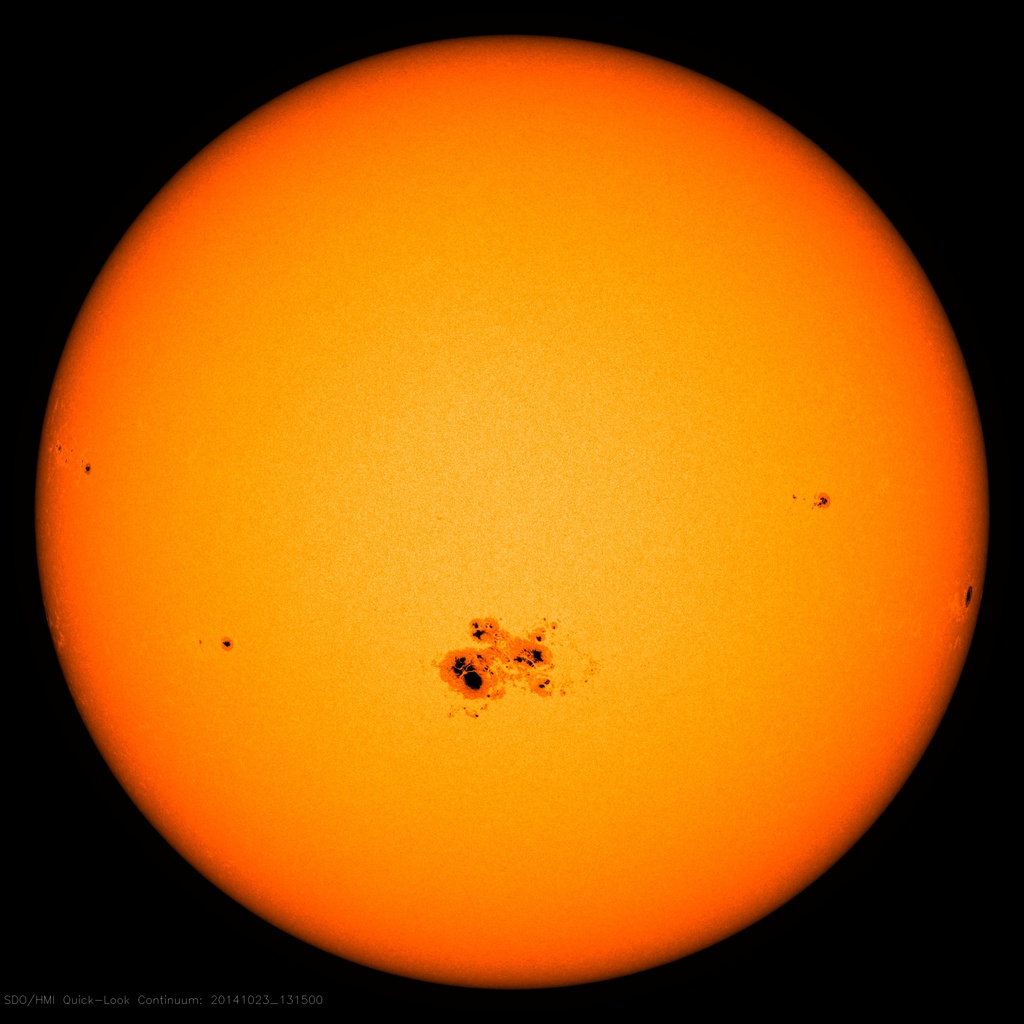
There are two things to watch in the sky this week, and they are close to opposites. On the Sun, one big and magnetically tangled sunspot keeps producing flares, but none of them has been aimed at Earth. At night, the Orionid meteor shower builds toward its peak on the night of October 21-22, and the main obstacle is a bright waxing gibbous moon. Here is what is going on and how to plan for it.
AR4551: Big, Busy, and Facing the Wrong Way for Aurora
EarthSky describes Active Region 4551 as a monster sunspot group as wide as two to three Earths. It has been the most productive flare source on the Sun this week. At 15:42 UTC on October 16 it fired an impulsive M-class flare. EarthSky lists it as M1.4, and NOAA's Space Weather Prediction Center (SWPC) lists it as M1.3 in its October 17 forecast discussion. Either way, it was a moderate flare, and both sources say it caused an R1 (minor) radio blackout on the sunlit side of Earth.
It was not a one-off. EarthSky counted 20 flares across the Sun in 24 hours: one M-class, 15 C-class and four B-class. AR4551 produced 13 of them. SWPC classifies the region's magnetic layout as beta-gamma-delta, which EarthSky calls the most complex configuration possible. EarthSky says that gives the region potential for stronger flares. SpaceWeather.com lists the spot as beta-gamma and says it harbors enough energy for M-class flares. The two sources differ on the classification, a reminder that these labels can change as a spot evolves.
SpaceWeather.com put the daily sunspot number at 81 on October 17.
So why no aurora alert?
Flares are flashes of radiation. They can cause radio blackouts within minutes, but they don't produce aurora on their own. Aurora needs a coronal mass ejection (CME) or a fast solar wind stream to hit Earth's magnetic field. So far, nothing like that is heading our way. EarthSky reports no Earth-bound CMEs in available coronagraph imagery. SWPC says a CME first seen at about 02:36 UTC on October 17 came from a prominence eruption on or behind the Sun's eastern limb and is not Earth-directed.
Current conditions are quiet. SpaceWeather.com reported a planetary K-index of 0.67, close to the bottom of the 0-9 scale, with a 24-hour maximum of 3.67. That is nowhere near the levels needed for aurora at mid-latitudes.
SWPC expects solar activity to stay low through October 19 and gives a 20% chance of M-class flares, due mainly to the flare potential of Region 4551. That leaves room for AR4551 to surprise. SWPC does not expect any S1 solar radiation storms through October 19.
The wildcard: a coronal hole
The one thing that could change this picture is not a sunspot. EarthSky reports that a large coronal hole in the Sun's southeast quadrant is now facing Earth. Coronal holes are regions where the Sun's magnetic field opens out into space and lets fast solar wind escape. EarthSky says that wind may start reaching Earth within the next couple of days, and its forecast for October 19 allows for unsettled to active conditions. SpaceWeather.com says wind from a southern coronal hole will reach Earth on October 20. Whether this stream stirs up much geomagnetic activity depends on its speed and on the orientation of its embedded magnetic field, which cannot be known until it arrives. EarthSky advises aurora watchers at high latitudes to stay alert, and everyone else should keep expectations modest.
The Orionids: Halley's Comet, Returned in Pieces
Space.com says the Orionid meteor shower peaks overnight October 21-22. The meteors are debris from Halley's Comet. Each year Earth passes through the stream of debris the comet has left behind. Space.com says particles hit the atmosphere at 147,600 miles per hour and vaporize, producing the streaks of light we see as shooting stars.
The radiant, the point in the sky where the meteors seem to come from, lies close to the red giant star Betelgeuse in Orion, which Space.com says sits above the southeastern horizon for U.S. stargazers in the early hours of October 22. You don't need to stare at the radiant. Space.com recommends looking 40 to 90 degrees away from it, where the glowing trains left by the fast-moving meteors are longest.
The moon problem, and the workaround
This year the Moon is the main obstacle. Space.com reports a 74%-lit waxing gibbous moon on peak night. Its glare will hide fainter shooting stars for much of the night, and faint meteors make up most of any shower. The good news is the timing. Space.com says the Moon sets a few hours after midnight, leaving a window of dark sky before dawn, and that the best viewing is between midnight and dawn on October 22. Space.com suggests checking a site such as Time and Date for the exact moonset time at your location.
Set realistic expectations. Space.com estimates 10 to 20 meteors per hour under ideal dark skies. Light pollution, haze, or a partly moonlit sky will cut that number down. This is not a shower that puts on a constant display. It rewards a patient hour in a reclining chair.
Practical viewing checklist
- When: Between midnight and dawn on October 22, ideally after moonset.
- Where to look: Look at a wide stretch of dark sky, roughly 40 to 90 degrees away from the radiant near Betelgeuse, not straight at Orion.
- Dark adaptation: Head away from artificial lights and allow 20 to 30 minutes for your eyes to adapt to the dark.
Why It Matters
This week shows how loosely the Sun's behavior connects to what we see from the ground. A spot two to three Earths wide with a complex delta-class magnetic field sounds like an aurora maker. But flares alone don't make aurora, and so far AR4551's eruptions have not been Earth-directed. Meanwhile, a coronal hole, which appears as a dark patch because the escaping plasma is cooler and less dense, may end up having more effect on Earth's magnetic field over the next few days. That is useful context the next time a headline about a "monster sunspot" shows up without a CME forecast to go with it.
The Orionids are a dependable annual event, and they are a reminder that Halley's Comet is part of the sky every October even though the comet itself is far away. Each meteor is a grain left behind by the comet on an earlier passage. You don't need dark-sky travel or equipment to see one, just a clear sky after moonset and some patience.
