
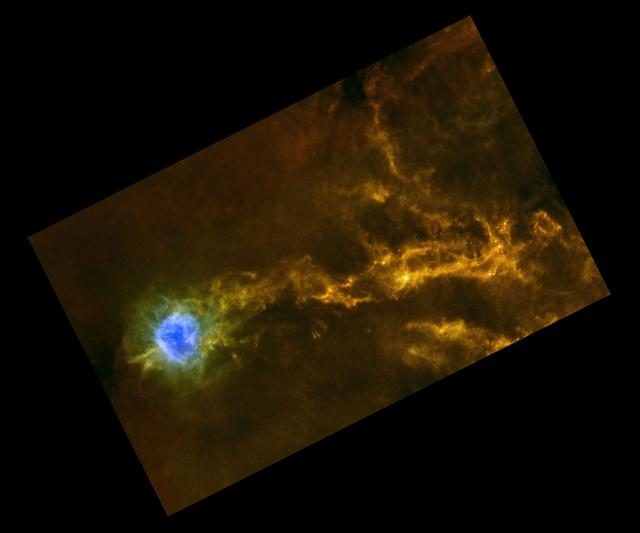
At a distance of roughly 1,344 light-years, the Orion Molecular Cloud complex is close enough that astronomers can resolve individual protostars and study the mechanics of star formation in real time. It is, in the most literal sense, a factory floor — and JWST has given us a resolution and sensitivity at which we can watch the machines working.
The complex spans roughly 300 by 200 light-years and contains three main cloud components: Orion A, Orion B, and the Lambda Orionis ring. The famous Orion Nebula (M42) is just the ionized face of Orion A — the bright surface layer where ultraviolet radiation from the young Trapezium cluster has eaten away the molecular cloud behind it. Everything visible to the naked eye is a thin skin. The real action is buried inside, in cold, dense filaments where gas is collapsing under gravity faster than thermal pressure and magnetic fields can resist.
From Filament to Protostar
Modern star formation theory begins with the filamentary structure of molecular clouds. Infrared surveys with Herschel revealed that essentially all star-forming regions are threaded with dense filaments — long, thin structures with characteristic widths near 0.1 parsecs (roughly a third of a light-year). These filaments form along the intersections of supersonic turbulent flows, compressed by the collision of gas streams that are themselves driven by supernovae, galactic shear, and magnetic forces.
When a filament's linear mass density exceeds a critical threshold — roughly 15 solar masses per parsec — it becomes gravitationally unstable and begins fragmenting into cores. Each core, over a timescale of 100,000 to 500,000 years, contracts toward a central protostar. As the core collapses, conservation of angular momentum spins up the gas, flattening it into a disk. The inner disk accretes onto the protostar; the outer disk is the raw material of a future planetary system.
In Orion, this process is complicated by the environment. The Trapezium cluster — four massive O-type stars within a volume roughly a light-year across — floods the surrounding nebula with extreme ultraviolet radiation. This radiation photoevaporates the outer envelopes of nearby protostars, truncating their disks and potentially limiting the mass available to form planets. These irradiated protostellar systems are called proplyds (protoplanetary disks), and over 250 have been catalogued in M42 alone.
What JWST Showed
The 2022 release of JWST's Orion Nebula mosaic, assembled from NIRCam observations, was more than a pretty picture. At infrared wavelengths, the telescope cuts through dust that blocks optical light and resolves structures at the scale of individual planetary systems. The image revealed jet-driven bowshocks in extraordinary detail — curved shock waves where supersonic outflows from embedded protostars plow into surrounding gas, marking their positions even when the stars themselves are invisible.
These jets, and their visible manifestation as Herbig-Haro objects, are a signpost of active accretion. When material falls onto a protostar, a fraction of the infalling mass is redirected into bipolar outflows — collimated jets that punch outward along the rotation axis of the disk. The jets carry away angular momentum, allowing continued accretion, and heat and stir the surrounding cloud, influencing the efficiency of star formation across the complex.
JWST also resolved an unexpected population of Jupiter-mass binary objects — pairs of free-floating objects between the masses of planets and brown dwarfs, moving together through the nebula with no parent star. How these objects formed remains contested. They may be the lowest-mass products of the normal star formation process, fragments that collapsed from molecular cloud cores but were never massive enough to sustain hydrogen fusion. Alternatively, they may have been ejected from forming multiple-star systems during dynamical interactions in the cluster's early history.
Orion as a Calibration Point
Because Orion is so close and well-studied, it functions as a reference point for interpreting star formation across the galaxy. The initial mass function — the statistical distribution of stellar masses that emerge from a cloud — was first characterized in Orion, and it has proven remarkably universal across environments very different from the solar neighborhood.
The disk fraction (the percentage of young stars that still retain detectable circumstellar disks) declines with cluster age and with proximity to massive stars. In Orion, disk fractions vary from roughly 80% in the youngest embedded clusters to under 20% near the Trapezium, where photoevaporation has stripped disks on million-year timescales. This gradient is a direct measurement of the hostile effect massive stars have on planetary system formation around their lower-mass neighbors — a relevant consideration when asking whether solar systems like ours are typical or require unusual circumstances.
The next observational frontier is spectroscopic characterization of disk chemistry. JWST's MIRI spectrograph is mapping the molecular composition of Orion protoplanetary disks — detecting water ice, simple organics, and silicate features that trace the building blocks available to emerging planets. If the chemical inventory of Orion disks resembles that of our own early solar system, as current data tentatively suggests, then the ingredients for rocky, water-bearing planets may be a standard output of the star formation process rather than a special condition we need to explain.
