
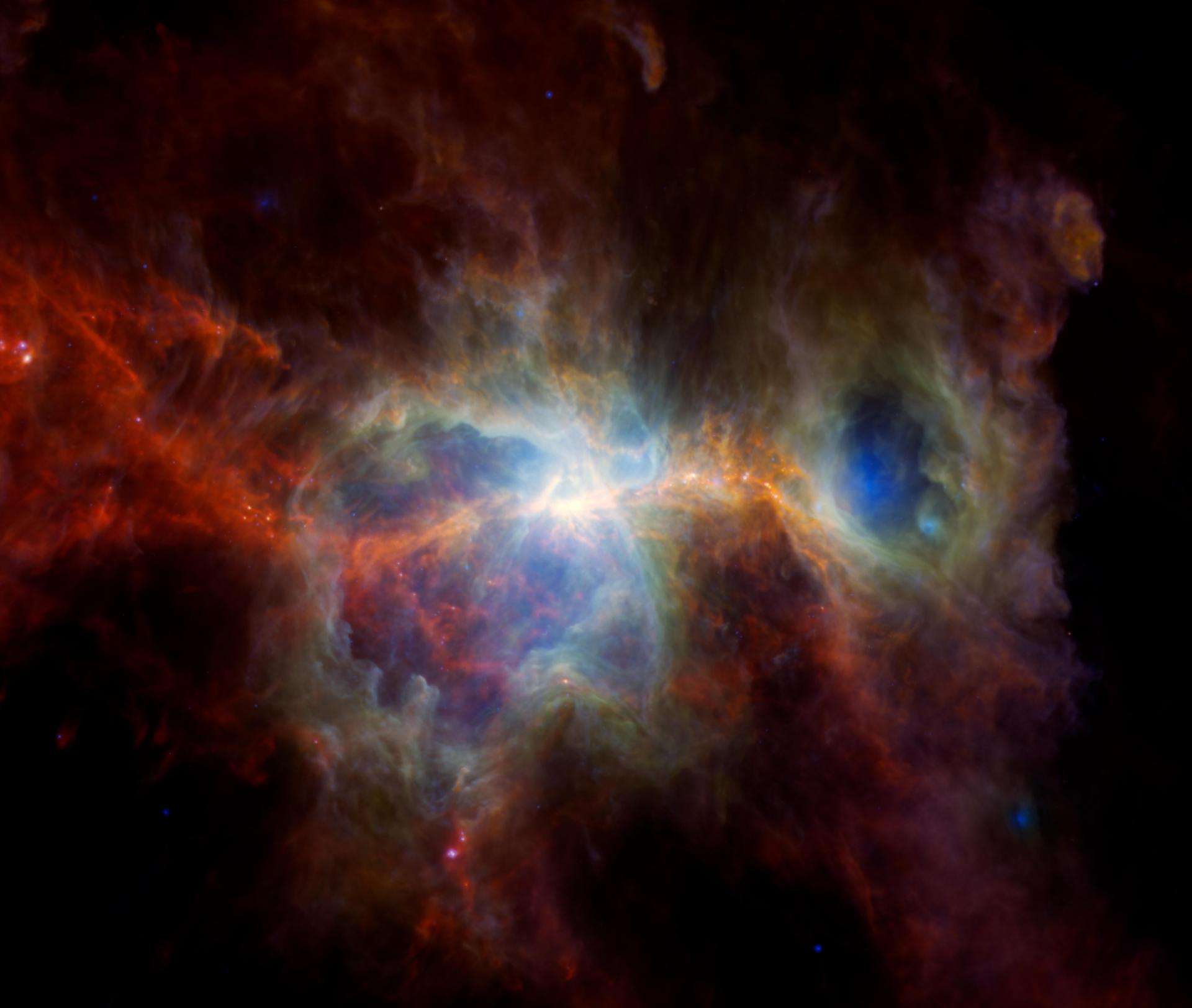
The Orion Bar is about 1,350 light-years away and appears nearly edge-on from Earth. That makes it one of the best places to study what happens when starlight hits the gas clouds where new stars form. Better telescopes have made one problem harder to ignore, though. What ALMA and JWST observe in the Bar does not match the layered picture that standard models of such a region assume.
A new study published in Astronomy and Astrophysics takes a direct approach to that problem. Dr. Brandt Gaches of the University of Duisburg-Essen led an international team that built what the authors describe as the first fully three-dimensional, high-resolution model of an Orion Bar analogue that resolves the photochemical fronts inside it. The result is simple to state: the shape of the gas matters a great deal. Uneven cloud structure casts shadows, and those shadows change both the chemistry and the infrared light that JWST detects.
"The three-dimensional structure of the gas makes a crucial difference," Gaches said in the university's announcement.
The problem with layers
The Orion Bar is a photodissociation region, or PDR. In a PDR, ultraviolet light from nearby stars breaks molecules apart and changes the chemical makeup of the surrounding gas. Two boundaries matter here. One is the H2 dissociation front, where hydrogen changes between its atomic and molecular forms. The other is the C+ recombination front, where ionized carbon recombines into neutral carbon.
The standard way to model a PDR is in one dimension. The cloud is treated as a stack of layers, and the chemical zones follow each other in order with distance from the light source. Until now, PDR models of the Orion Bar have generally represented it this way, according to the university.
ALMA and JWST observations of the Orion Bar show something else: the H2 photodissociation front overlaps the C+ recombination front. Universe Today's coverage notes that this overlap does not fit models built on stratified layers. The authors say existing approaches based on simplified geometrical assumptions have difficulty reproducing the spatial emission structure.
What the team built
The group of Gaches, Thomas Bisbas, Lothar Brendel, and Zhengping Zhu used an upgraded version of the steady-state 3D-PDR code. According to the team's preprint on arXiv, the upgrade allows the gas to be lit by plane irradiation, and it solves for the non-LTE rovibrational levels of H2. In practical terms, the model follows in detail how molecular hydrogen, the most abundant molecule in the Universe, behaves under intense stellar radiation.
The radiation transport depends on a ray-tracing algorithm developed by Zhu, of Zhejiang Lab in China. Calculating how radiation travels through a complex 3D structure is computationally demanding, and Zhu said the new algorithm overcame that bottleneck and allowed the Orion Bar to be modeled in 3D at unprecedented spatial resolution. Dense regions block part of the incoming radiation, creating shadows and shielded pockets in which the chemistry develops differently than it would in a smooth slab.
What the model shows
In the simulation, the H2 dissociation front is not a clean plane. The paper describes it as a complex surface, and that surface overlaps the C+ recombination front. This matches what the observations show.
The model also reproduces the look of the region. The authors report that it reproduces the complex morphology of H2 emission seen in observations, in particular the arc- and filament-like features. They attribute the overlapping fronts and the emission morphology to the three-dimensional gas distribution, which produces shadowing and shielding by dense substructures.
According to the university release, the model can also produce realistic images of how such a region should appear to JWST. That lets researchers compare a simulation with what the telescope actually sees, and study how the three-dimensional structure of stellar nurseries shapes their chemistry in ways that simpler one-dimensional models cannot capture.
Why It Matters
Photodissociation regions are the boundary zones of clouds where massive young stars shine on the surrounding gas. Their light gives astronomers clues about how stars form and how gas is recycled to make future generations of stars and planets, both in our own galaxy and in studies of star formation across cosmological history. How that gas is heated, broken apart, and chemically changed affects what astronomers can learn from the light it gives off. If a model assumes smooth layers that real clouds do not have, interpretations drawn from it may be off in ways that are hard to detect.
The Orion Bar has long served as a test case because it is close and seen almost edge-on. The new work suggests that even in this favorable view, a one-dimensional description leaves out the shadows that shape the region. A model that can create synthetic JWST-style images of a clumpy, partly shadowed cloud gives observers a way to test their interpretations directly against the data.
The study has limits. It models an analogue of the Orion Bar, and the code computes a steady state, not a cloud changing over time. The authors also note that their main objective was not an optimized fit to the Orion Bar. Their claim is narrower: when the gas is allowed to be three-dimensional and clumpy, the overlap of chemical fronts and the filament-like H2 structures can be explained. They add that future work can examine gas morphologies produced by different physical mechanisms and their photochemistry and emission in three dimensions.
Gaches leads an Emmy Noether Research Group at the University of Duisburg-Essen. The preprint was first submitted to arXiv in August 2026. The university announced the publication on Oct. 16, and Universe Today covered the study on Oct. 19.
Sources
- Resolving dense photodissociation regions: The structure of photochemical fronts in three-dimensional gas distributions (arXiv:2608.04116)
- The Chemistry in Stellar Nurseries is Complex, and a New 3D Model Highlights It (Universe Today)
- New 3D model reveals how shadows reshape chemistry in stellar nurseries (University of Duisburg-Essen press release, via mirror)
