
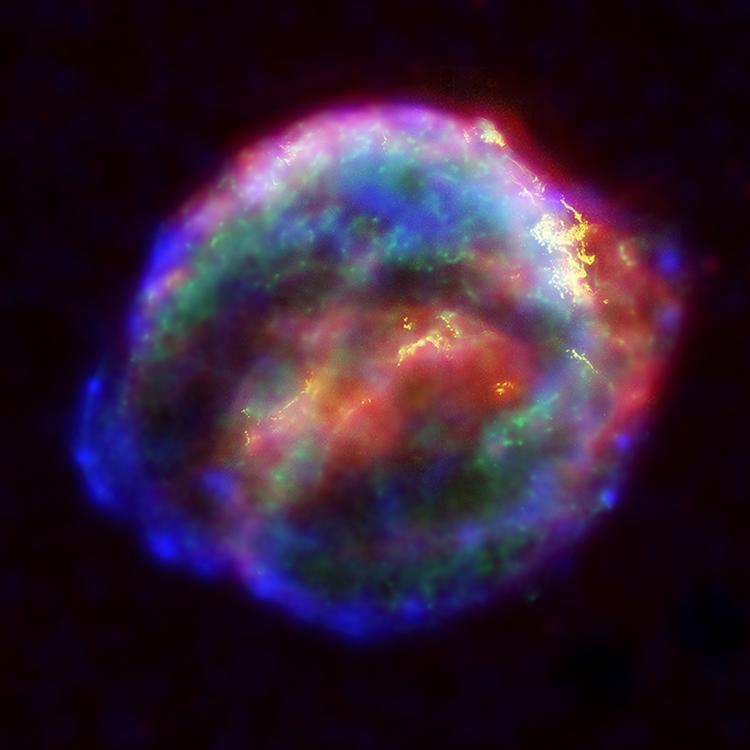
When a massive star runs out of fuel and its core collapses, it can end in one of two very different ways. It can blow itself apart in a core-collapse supernova, or it can fail to explode and collapse into a black hole. Deciding which stars end which way is one of the harder problems in stellar astrophysics. A new peer-reviewed study suggests that the answer depends heavily on a particle physics effect that many collapse models leave out: neutrinos changing flavor.
The work, by Mariam Gogilashvili and Irene Tamborra of the Niels Bohr International Academy, was published as a Letter in Physical Review D (Phys. Rev. D 114, L061304). The authors simulated stellar collapse for 195 progenitor stars between 9 and 120 solar masses and added a schematic treatment of neutrino flavor conversion. Their conclusion is in the paper's title: flavor conversion "shapes the rate of failed core-collapse supernovae."
What the simulations did
According to the preprint on arXiv, the team ran the same large set of progenitors under different assumptions about how much flavor transformation takes place. As Universe Today reported on October 16, the researchers assumed several different levels of flavor change across the 195 simulations and then compared which stars exploded and which did not.
The treatment is schematic, meaning the conversion is parameterized and not computed from first principles inside each simulation. That limits how literally the individual outcomes should be read. Its strength is that it lets the authors run a population-scale experiment: across nearly two hundred stars, they can ask how sensitive the overall explosion pattern is to this one ingredient.
By their account, it is very sensitive. Universe Today summarizes the central result this way: even a small amount of flavor change can flip a star's outcome between exploding and collapsing.
The 16 to 30 solar-mass window
The effect is not spread evenly across stellar masses. The paper reports that flavor transformation reshapes "explodability" most strongly in the range of roughly 16 to 30 solar masses.
Universe Today's description of the mass dependence goes like this. Stars in the 16 to 30 solar-mass band mostly collapse directly into black holes. The smaller stars in the sample and the very largest ones become supernovae unless flavor change is strong. So the middle of the mass range, where failed explosions are already common, is where small changes to the neutrino physics matter most, and the results depend on how much conversion is assumed.
The study also looks at what each star leaves behind. According to the arXiv abstract, flavor conversion modifies the mass distribution of compact remnants, the neutron stars and black holes left after collapse. If the boundary between "explodes" and "collapses" moves, the population of objects at the end of stellar evolution changes with it.
Why It Matters
The authors connect their results to three long-standing tensions between models and observations.
The first is the supernova-rate problem. Universe Today notes that astronomers observe fewer supernovae than star formation rates would predict. If more massive stars quietly collapse into black holes without a visible explosion, that gap would plausibly get smaller. The abstract says the result naturally eases this problem.
The second is the red-supergiant problem, which the abstract lists alongside the supernova-rate problem as another tension that including flavor conversion eases.
The third is about neutron stars. The abstract says the results reconcile theoretical expectations with the low-mass tail of the observed neutron star mass distribution. Flavor conversion changes the remnant mass distribution in the simulations, which is the lever behind that match.
The broader point is methodological. If the explode-or-collapse outcome can flip with only a modest amount of flavor change, then population predictions from models without neutrino flavor physics may be off. That bears on how many supernovae should occur, how many black holes should form directly, and what neutron star masses should look like. The authors call neutrino flavor conversion a fundamental ingredient in predicting neutron star and black hole populations. The study does not settle exactly how much conversion happens inside real collapsing stars. It shows that the amount is a parameter models cannot safely ignore.
Caveats worth keeping in mind
The schematic approach is the main limitation. The paper shows that outcomes are highly sensitive to flavor conversion, but it does so by assuming levels of conversion and not by deriving them. As Universe Today's summary makes clear, the predicted fate of stars outside the 16 to 30 solar-mass window depends on whether flavor change is weak or strong. Narrowing that down is a separate problem; Universe Today suggests observing more supernova progenitors as large sky surveys come online.
Still, the work has been through peer review. The paper was first posted on May 15, 2026, revised through a third version on August 18, and has since appeared in Physical Review D Letters, published September 22. For a field that has long struggled to make collapse simulations match the supernovae and remnants astronomers actually see, the result points to a specific ingredient worth getting right.
Sources
- Neutrino Flavor Conversion Shapes the Rate of Failed Core-collapse Supernovae (arXiv:2605.16504, Gogilashvili & Tamborra)
- Neutrino flavor conversion shapes the rate of failed core-collapse supernovae (Physical Review D)
- The Flavor of Neutrinos Could Determine How a Large Star Dies (Universe Today, Oct 16, 2026)
