
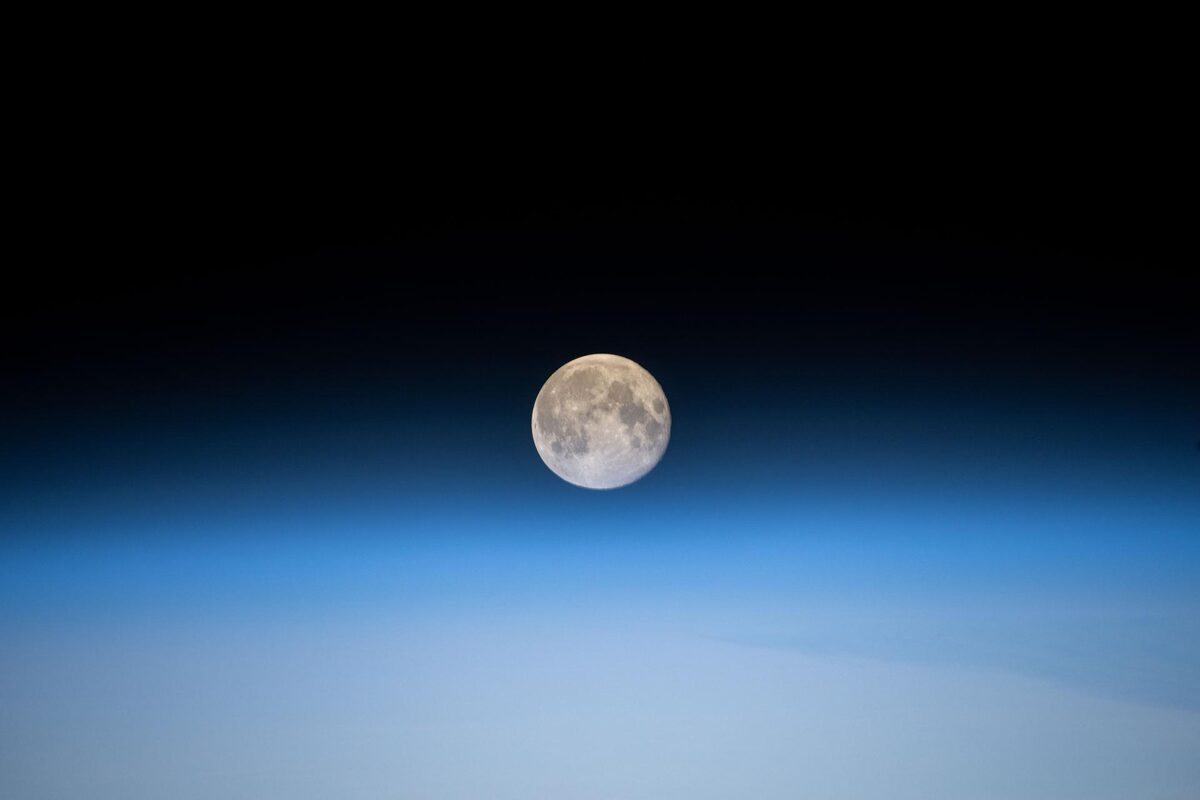
Researchers have known for years that the Moon is getting smaller. A new paper says by how much. The Moon's radius has shrunk by roughly 45 meters over the last 400 to 800 million years, and the evidence is written across its surface in more than 10,000 young cracks.
The study, "Thrust Faulting and the Late-Stage Contraction of the Moon," was published Oct. 14 in The Planetary Science Journal. Thomas R. Watters of the Smithsonian National Air and Space Museum led it, working with Maria Banks, Cole Nypaver and Mark Robinson. The team built its fault inventory from images taken by the Lunar Reconnaissance Orbiter Camera (LROC).
"The number of these young faults revealed in LROC images is much greater than I ever imagined," Watters said, as quoted by Universe Today.
A cooling body, slowly creasing
The basic physics is simple. The Moon formed from a giant impact about 4.5 billion years ago, and as its interior cools it slowly contracts. A brittle crust sitting on a shrinking interior has to give somewhere. On the Moon it gives way through thrust faults, where one block of crust is pushed up and over another. From orbit they show up as small, sharp, cliff-like scarps.
Earth gets rid of that kind of stress differently. It has many moving tectonic plates whose boundaries take up most of the deformation. The Moon is a single-plate body, so there are no plate boundaries to concentrate the strain. The Smithsonian release spells out what follows: moonquakes can occur anywhere.
The faults are not spread evenly. The team found that the regions with the thickest crust have the fewest faults, which suggests crustal structure controls where the contraction shows up.
The numbers
Earlier lunar fault studies were mostly about showing that contraction is happening. This paper tries to measure it. Adding up the fault population, Watters and colleagues estimate that the Moon's radius has decreased by about 45 meters (148 feet) over the past 400 to 800 million years.
If the rate of radius decrease has stayed constant over that span, the Moon has been shrinking about 6 to 11 centimeters per million years, or roughly 0.1 micrometers per year. For scale, the Smithsonian compares this with Earth's tectonic plates, which move about 1.5 cm per year. The Moon's shrinkage would not show up on any human timescale. Over geologic time it adds up to an enormous amount of crust that has been pushed together and stacked.
Why "young" is the important word
These scarps are geologically young. Universe Today's coverage puts them at roughly 300 to 400 million years old. That is recent for a 4.5-billion-year-old world, and it means the contraction did not end in the distant past. The study's framing as "late-stage" contraction reflects this.
That raises a thermal puzzle. The Smithsonian release says the paper suggests widespread faulting did not occur early in lunar history because a heavily fractured, thick, porous crust insulated the interior, inhibiting cooling and contraction until relatively recently. In other words, the Moon did not simply shrink at a steady pace from the start, and the fault record could help constrain models of the lunar interior as well as describe the surface.
Why It Matters
If the faults were only ancient relics, this would be a study about lunar history. Because they are young and the contraction is expected to continue, it is also about hazards.
The clearest example is landslides. According to Universe Today, the spatial correlation between very recent landslides and young thrust faults suggests that seismic shaking from those faults set them off. Slopes near a scarp are exactly the kind of terrain where shaking can cause slope failure.
Two facts from the study are relevant to anyone planning long-duration surface operations. First, the Moon has no plate boundaries to confine seismic activity, so moonquakes can occur anywhere. Second, more than 10,000 young faults is far more than Watters expected, which makes it harder to assume a given site is far from one.
The Lunar Reconnaissance Orbiter has been orbiting the Moon for 17 years, long enough to map scarps and landslides from orbit. The authors argue that the possibility of active faulting provides strong justification for a Lunar Geophysical Network to characterize the sources of seismic events and their potential hazards.
What we know, and what we don't
The study gives a well-defined estimate for a process that used to be described mostly in qualitative terms: roughly 45 m of radial contraction over 400 to 800 million years, at about 6 to 11 cm per million years if the rate was constant, spread across a single-plate world that can quake anywhere. The sources reviewed here do not say which of the 10,000-plus faults are active today, how often they slip, or exactly why the Moon's late cooling followed the path it did. Those are the questions that surface instruments such as a geophysical network would be meant to address.
