
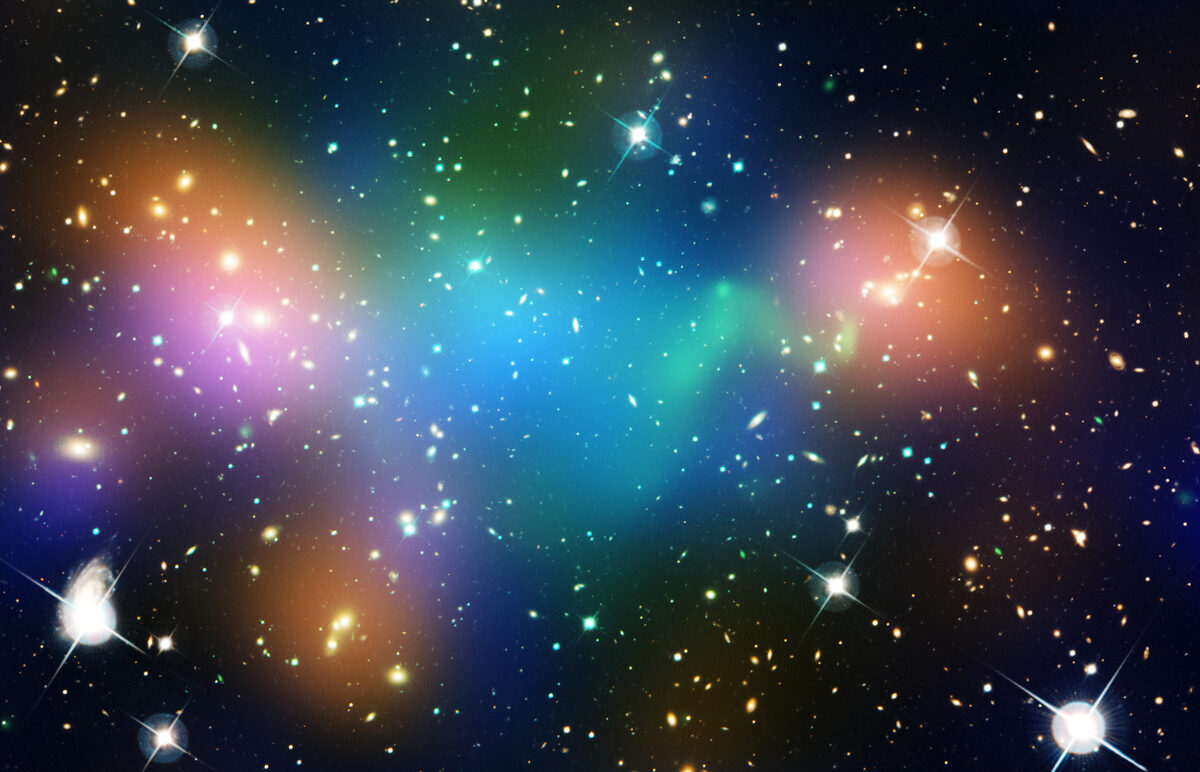
Some objects in the sky are hard to explain because they are faint or strange. El Gordo is hard to explain because it is so large. The galaxy cluster sits about 7 billion light-years away. It is really two massive regions in the middle of a collision, and together they hold more than two quadrillion solar masses, according to Universe Today. An object that heavy, seen that far back in time, is hard to fit into standard cosmology built on cold dark matter.
A new study by R. Valdarnini, posted to arXiv on Aug. 22, 2026, suggests a way out. Dark matter may not be the inert, collisionless substance of the standard picture. It may interact with itself, and those interactions may come in two kinds. Valdarnini ran a large suite of N-body and hydrodynamical simulations of the merger. The study reports that El Gordo's properties are "well reproduced" in a two-state self-interacting dark matter (SIDM) scenario. The study's own caveats are also important, and we cover them below.
A cluster built like the Bullet Cluster, only heavier
El Gordo has been known as an outlier for more than a decade. In 2012, NASA's Chandra X-ray Observatory team described it as the most massive, hottest and most X-ray-luminous cluster known at that distance or beyond. Chandra's X-ray data, combined with optical images from the Very Large Telescope and infrared data from Spitzer, showed two clusters colliding at several million miles per hour.
The Chandra team also compared it to the Bullet Cluster, and the comparison holds up. In both systems the hot gas in each cluster was slowed by the collision, while the dark matter was not. That split between gas and mass is what makes merging clusters useful for testing dark matter. Gas shows up in X-rays. Dark matter shows up only through its gravity, which astronomers map with weak gravitational lensing, the slight distortion of background galaxies by mass in the foreground. A model of what dark matter is has to reproduce both the X-ray picture and the lensing maps of a collision like this.
What "two-state" dark matter means
In the simplest self-interacting models, dark matter particles can bounce off one another the way billiard balls do. These collisions are elastic: the particles change direction, but no kinetic energy is lost. Valdarnini's simulations include that channel. They also include a second one.
In the two-state picture, each dark matter particle has a ground state and an excited state. Universe Today's summary puts it this way: most collisions are ordinary elastic bounces, but with the right energy a collision can kick one of the particles into the excited state, removing kinetic energy from the collision. The paper calls this an inelastic, endothermic "up-scattering" channel. In effect it lets dark matter cool down while it clusters, which addresses a problem with purely elastic SIDM models, where frequent collisions tend to keep dark matter warm.
The key point is that the energy loss is tied to collision energy rather than happening in every collision. The paper gives a threshold velocity of roughly 1,200 to 1,600 km/s for the up-scattering channel. A merger of two enormous clusters is the kind of high-speed event where a threshold like that could matter.
The numbers that make it work
The study reports the parameter ranges that best reproduce El Gordo. Interaction strengths in SIDM are usually given as a cross-section per unit mass, which measures how readily particles scatter off one another:
- Elastic cross-section: about 4 to 5 cm2/g
- Inelastic (up-scattering) cross-section: about 2 to 4 cm2/g
- Threshold velocity for the inelastic channel: about 1,200 to 1,600 km/s
The abstract states that elastic scattering alone is not enough. Valdarnini writes that the inelastic, endothermic channel is "essential" for matching the weak-lensing profiles of the two colliding clusters. Universe Today's description of the result agrees: in the simulations, the two-state model fits better than either non-interacting dark matter or dark matter that only scatters elastically.
The catch: everything rides on the mass
This is not a detection of self-interacting dark matter, and the paper does not claim one. Valdarnini says the conclusions depend critically on current uncertainties in two quantities. The first is the mass of the primary cluster. The second is the projected separation between the two dark matter concentrations, written dDM.
The abstract spells out the failure case. If future weak-lensing measurements with smaller error estimates show a low primary mass (below roughly 1015 solar masses) and a larger projected separation (above roughly 740 kpc), the paper says it would be difficult to reconcile the proposed self-interacting scenario with the observational constraints. Universe Today makes a similar point: because the mass of El Gordo and the speed of the collision are still uncertain, a mass at the low end of the range would mean the two-state model does not fit the data.
That dependence matters more than it might seem. The tension with standard cosmology is greatest when El Gordo is heavy, so a lower mass estimate would also shrink the problem the model was built to solve.
The fairest summary is the one Universe Today gives: this is a possible solution, not a definite one. It is a set of dark matter parameters that can reproduce one unusual object, given the current range of mass and separation estimates.
Why It Matters
Dark matter makes up most of the mass in galaxy clusters, but its particle nature is still unknown. Whether dark matter can interact strongly with itself is one of the key open questions. Colliding clusters are natural test cases for any theory in which dark matter particles interact, because the collision drives the dark matter of one cluster through that of the other at very high speeds.
Valdarnini's result is notable for its specificity. It does not just say that "dark matter might interact." It names a two-channel model with cross-sections and a velocity threshold, and it ties those numbers to observables already in hand: the weak-lensing profiles of El Gordo's two components. That makes the idea testable. The paper itself suggests that future lensing surveys of massive, high-velocity merging clusters could be decisive in testing the proposed scenario.
The study also shows how a single extreme object can drive a field. If El Gordo's mass and separation estimates shift in the wrong direction, this particular model would be hard to sustain. If El Gordo's high mass holds up, cold, collisionless dark matter will keep facing questions, and models like this one will be among those tested against it.
Sources
- Hydrodynamical simulations of the merging cluster El Gordo in a two-state self-interacting dark matter scenario (R. Valdarnini, arXiv:2608.21844)
- A Distant Supercluster of Galaxies Points To Self-Interacting Dark Matter (Universe Today, Oct. 16, 2026)
- El Gordo: NASA's Chandra Finds Largest Galaxy Cluster in Early Universe (Chandra X-ray Observatory, 2012)
