
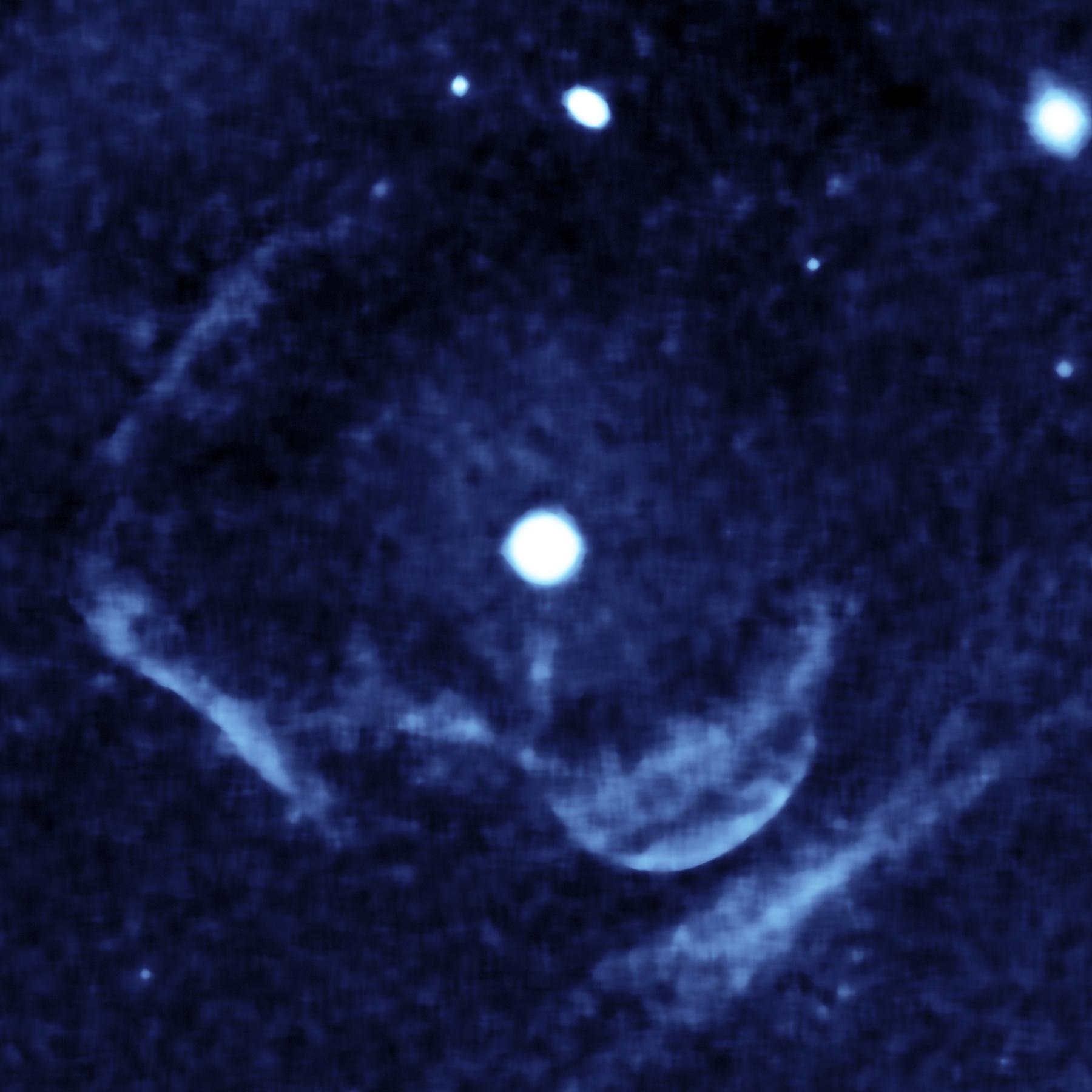
If you've got a pair of binoculars and a clear view of the summer sky, point them toward the small constellation Sagitta over the next several nights. A star that had no business being there a week ago is now sitting at magnitude 7.42 — well within reach of ordinary 15x70 binoculars, and creeping toward the edge of naked-eye visibility under dark skies. It's a nova, and the astronomical community has moved fast to confirm what it is and where it came from.
The object was picked up on August 25, 2026, by the NMW-TexasTech survey, one of several automated sky-patrol programs that scan wide swaths of sky night after night looking for exactly this kind of change. Within the same day, amateur astronomer K. Yoshimoto in Yamaguchi, Japan, logged a magnitude of 7.42 — a striking brightness for an object that, by all indications, wasn't visible at all before the eruption. The discovery was formalized through the Central Bureau for Astronomical Telegrams (CBAT), the Harvard-hosted clearinghouse astronomers have relied on for over a century to rapidly circulate news of transient objects. CBAT assigned it the provisional designation PNV J19450648+1822422, pinning its position at RA 19h45m06.48s, Dec +18°22'42.2".
Provisional designations don't last long once a spectrum comes in. Follow-up spectroscopy revealed the signature astronomers were watching for: clear P Cygni profiles in the hydrogen-alpha and hydrogen-beta lines, with expansion velocities around 1,500 kilometers per second. That combination — a blueshifted absorption trough sitting next to an emission peak, produced by material blasting outward from the star faster than the speed of a jet engine's exhaust by a factor of thousands — is close to a textbook confirmation of a classical nova. The object has since been given its permanent variable-star name: Nova Sagittae 2026, or V488 Sge.
What Actually Exploded
A nova isn't a star dying, and it isn't the same phenomenon as a supernova, despite the similar name. It's a thermonuclear event on the surface of a white dwarf — the dense, burnt-out core left behind after a sun-like star exhausts its fuel — that's siphoning hydrogen off a companion star in a tight binary system. Gas pulled from the companion piles up on the white dwarf's surface until pressure and temperature at the base of that layer cross a threshold, igniting a runaway fusion reaction across the whole surface. The result is a flash of light bright enough to outshine the entire system by tens of thousands of times, expelling the accreted material into space at exactly the kind of velocities now showing up in V488 Sge's spectrum. Unlike a supernova, the white dwarf survives intact, and the whole accretion-eruption cycle can repeat over centuries or millennia.
What makes this particular eruption easier to pin down than most is that the underlying system was already known. Before it flared, the progenitor was cataloged as a candidate eclipsing binary with a 9.9011-day orbital period — meaning astronomers had years of baseline photometry on this system before it did anything dramatic. That's a useful head start for characterizing the eruption, since researchers already have a sense of the binary's orbital geometry and can watch for how the eclipses behave as the nova's ejecta expands and clears.
Gaia parallax measurements place the system at a distance of roughly 6,255 parsecs, or about 20,400 light-years — within the Milky Way, far enough that the light reaching binocular users this week left the star system when human ancestors were living through the last glacial period. The eruption itself likely happened millennia ago, and we're only now watching the news arrive.
An Unusually Crowded Nova Season
V488 Sge isn't erupting in isolation. Observers tracking the discovery have noted that it's one of at least four novae simultaneously bright enough to observe: alongside Sagittae, there are active novae currently visible in Sagittarius, Aquila, and Taurus. Having four novae observable at once is an uncommon coincidence — these events are individually rare enough that a single bright nova is newsworthy on its own, and a cluster of them sharing the sky is the kind of thing that gets circulated fast among variable-star observers.
Amateur observers are already tracking the eruption closely — multiple independent magnitude estimates came in within hours of the discovery announcement, exactly the kind of rapid, distributed monitoring that turns a single discovery into a full light curve: the brightness-versus-time record that lets astronomers classify how fast a nova fades and, from there, infer things like the mass and composition of the ejected material. Organizations like the American Association of Variable Star Observers (AAVSO) coordinate much of this kind of amateur photometry for events like this one.
Why It Matters
Bright novae are genuinely rare events, and ones with a known, well-characterized progenitor binary are rarer still. Because V488 Sge's candidate eclipsing binary was already cataloged with a precise 9.9-day period, researchers have a pre-eruption baseline to compare against as the system evolves — a chance to watch how mass ejected at 1,500 km/s reshapes the orbital signature of a system whose geometry was already mapped. That's valuable for testing models of nova ejecta and how it interacts with a close companion star.
There's also a practical, participatory dimension. Classical novae fade on timescales of weeks to months, and the earliest days of that decline carry the most diagnostic information about the eruption. Because this one is bright enough for backyard binoculars and modest telescopes, it's squarely in range for the amateur observing networks — like AAVSO's — that supply much of the day-to-day photometric data professional astronomers rely on for these events. A four-nova sky is also simply a rare treat for observers: most people who take up a pair of binoculars on a clear August night won't get another chance to catch this many stellar eruptions in one sitting.
