
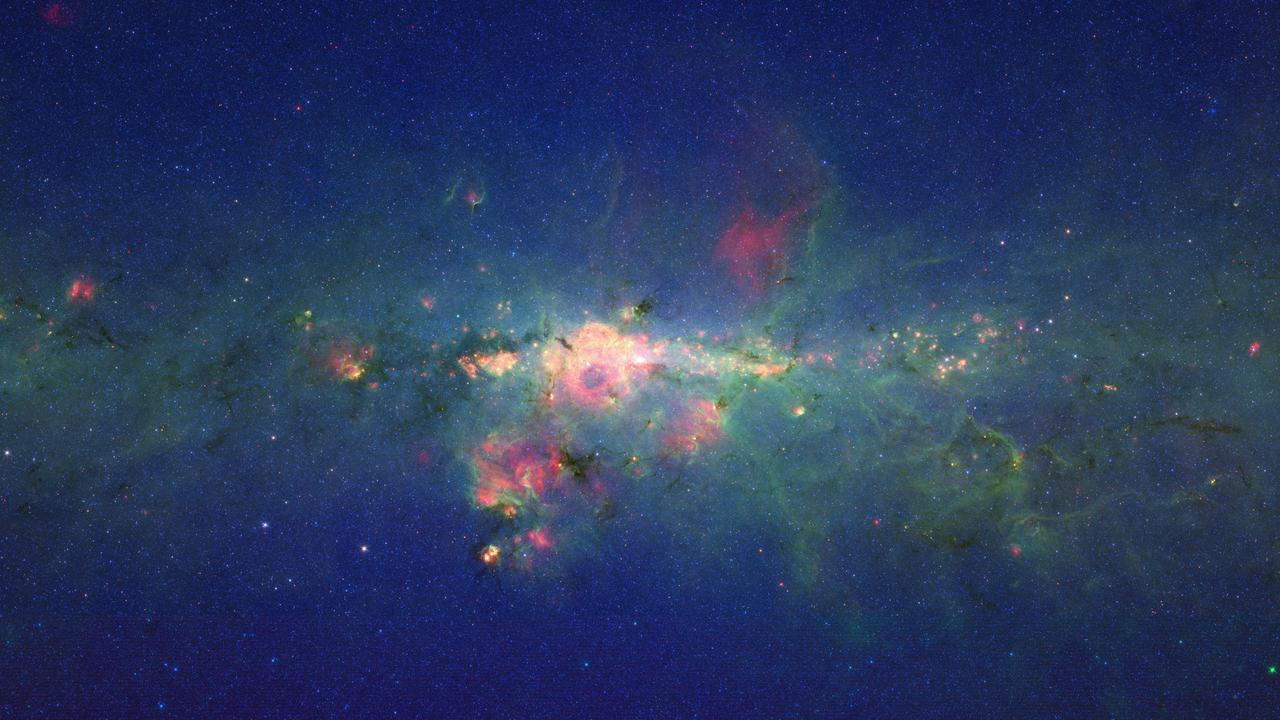
Astronomers have a hard time mapping the Milky Way because we sit inside it. Every structure we assign to our galaxy, whether a spiral arm, a ring or the central bar, has to be inferred from objects seen edge-on through dust, with distances that are often uncertain. A new study published online in Nature Astronomy on November 20 argues that one of the best-known features on that map has been misread.
The paper, led by Hillary Davis of the University of Sydney with co-authors including Joss Bland-Hawthorn, Thor Tepper-Garcia and Oscar Agertz, says that at least some of what astronomers call the Norma arm is not a spiral arm. In their reading, it is the star-forming leading edge of the Galactic bar.
Davis told Universe Today that "at least part of the so-called Norma arm may not be a spiral arm at all, but a region of star formation along the leading edge of the Galactic bar."
What the Study Actually Did
The team's evidence comes from masers. These compact, bright sources mark very young star-forming regions, far younger than a million years. Because they are so young, they show where stars are forming right now, not where gas and stars have drifted since. Many of these masers had been treated as tracers of the Norma spiral arm.
The researchers ran new N-body hydrodynamic simulations. These model both the gravity of the galaxy's stars and the behavior of its gas. They then compared the simulated gas flows with where the masers actually sit. According to the paper's abstract, the million-year-old masers line up with the bar's shock front in the first Galactic quadrant, or equivalently its dust lane. This is the region where gas flowing through the bar piles up. If the masers sit in that lane, the dust lane itself must be forming stars.
This is a reinterpretation of known objects, not the discovery of new ones. The masers are where they always were. The claim is about what structure they belong to. Assigning them to the bar instead of a spiral arm changes both the map and what that part of the galaxy is doing.
A Bigger, Slower Bar
Matching the simulations to the maser data also pins down the bar's geometry. The paper gives:
- Semi-major axis: about 4.3 ± 0.2 kiloparsecs
- Semi-minor axis: about 2.3 ± 0.2 kiloparsecs
- Inclination: 20 degrees (+5/−2) to our line of sight
- Pattern speed: no faster than roughly 40 km/s per kiloparsec
In more familiar units, Universe Today reports that this makes the bar about 28,000 light-years from end to end and about 15,000 light-years wide. It turns once roughly every 154 million years. Earlier estimates covered a remarkably wide range: bar lengths from about 3,000 to 16,000 light-years, and rotation periods from 102 to 246 million years.
That spread shows how poorly the bar has been constrained. The authors sum up their conclusion in one line: the Galactic bar is "long, slow and star-forming."
Why a Star-Forming Shock Front Is Unusual
The odd part is the "star-forming" part. In nearby barred galaxies, which astronomers can view from outside, star formation along a bar's shock front is uncommon, according to Universe Today. The paper notes that star formation is often suppressed along the dust lanes of local bars, in part because bar-driven shocks and shear inhibit the growth of gravitational instabilities. It also notes that the suppression is not universal, since some nearby barred galaxies do show notable star formation along their dust lanes.
If the Milky Way's bar really does form stars along its leading edge, then either our galaxy is unusual or the conditions in its dust lane differ in some way from those in many of its neighbors. It does mean the Milky Way can't simply be assumed to behave like the barred spirals seen in telescope images.
Why It Matters
A galaxy's bar is more than a feature on the map. A bar's length and rotation speed shape how it moves gas and stars through the inner galaxy. Pinning down those numbers matters for anyone modeling the Milky Way's structure, and the old range of estimates was very broad. A bar about 28,000 light-years long that turns once every 154 million years is a specific, testable target.
The result also highlights a weak point in how we map our own galaxy. Spiral arms are often traced by lining up tracers like masers and assuming they belong to a coherent arm. If a group of those tracers can come from a completely different structure, then other assignments may deserve a second look. That is especially true in the crowded, dust-hidden inner galaxy, where it is hard to tell the bar's edge from the start of an arm.
Davis's own wording is careful: "at least part" of the Norma arm. The study does not claim the arm doesn't exist. It argues that some of the evidence for it has been attributed to the wrong structure. The real test will be whether the bar parameters derived from the simulations agree with other independent measurements of the bar.
The Fine Print
The conclusions rest on simulations. The pattern speed is given only as an upper limit (no faster than about 40 km/s per kiloparsec), not as a precise value. The inclination uncertainty is also lopsided, +5 degrees against −2. These are the usual caveats for a model-based reinterpretation, and they leave room for follow-up work to tighten or challenge the numbers.
A preprint of the paper was posted to arXiv on October 28, ahead of the journal publication, so other researchers have had access to the full argument for several weeks.
