
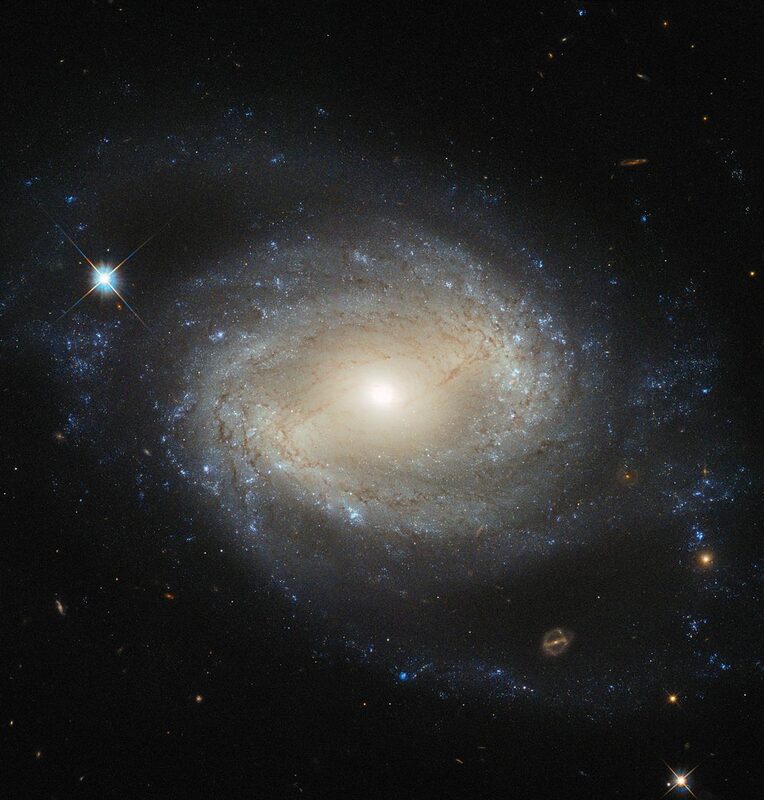
Some galaxies get a single Hubble portrait. NGC 4394 has now had two. On November 24, 2026, NASA published a new view of the barred spiral. It merges observations taken about a decade ago with fresh data from a program built to answer one question: what happens to a galaxy's star formation when the galaxy lives in a crowded cluster?
The result is a crisp face-on look at a galaxy that ESA/Hubble has called an archetypal barred spiral. There is a bright central bar, spiral arms curling off its ends, and a center that may share a feature with the core of our own galaxy.
A galaxy in a crowd
NGC 4394 sits about 55 million light-years away. On the sky it falls within the constellation Coma Berenices, but physically it belongs to the Virgo Cluster, a group of more than 1,000 galaxies, according to NASA. Distance estimates differ a little by source. Earlier coverage from Sci.News cited 53.8 million light-years. NASA and ESA/Hubble both give about 55 million, and the small gap is a reminder that extragalactic distances carry real uncertainty.
The object isn't a recent find. William Herschel discovered it in 1784, ESA/Hubble notes. Sci.News lists other catalog names, including LEDA 40614 and UGC 7523.
Two programs, one picture
The new image is a composite, and the history of the data explains why the galaxy is back in the news.
The earlier Hubble view, released by ESA/Hubble in 2016, came from observing program #10515, led by principal investigator Eric Peng. That program wasn't aimed at NGC 4394. It focused on the neighboring galaxy Messier 85, and while one Hubble instrument examined M85's unusual collection of star clusters, the Advanced Camera for Surveys captured a parallel area of sky that contained NGC 4394.
The new data come from program #18103, led by David Thilker and taken with Hubble's Wide Field Camera 3. This program is dedicated to understanding how star formation comes to an end in galaxies in dense cluster environments, and how that differs from more isolated galaxies in the field. Researchers used the camera's sensitivity to a broad range of wavelengths to determine the ages of individual star clusters, and NGC 4394 is one of 40 galaxies studied this way. NASA credits the image to ESA/Hubble & NASA, E. Peng, D. Thilker, and the MAUVE-HST Team.
A target captured by chance for one science goal can be revisited years later for a completely different one, and the two datasets together feed a single image.
Why the bar matters
The most noticeable feature of NGC 4394 is its bar, the elongated band of stars running through its center. Bars are not unusual. NASA says astronomers estimate 65 percent of nearby spiral galaxies have one.
NASA's release uses NGC 4394 as a way into the question of how galactic bars form and how they can later decay. NASA explains that bars are thought to form when a galaxy's disk of stars becomes unstable, and that as bars grow more massive they can themselves become unstable, so a bar is not necessarily permanent. NASA also notes that bars are more common today than several billion years ago, and says NGC 4394 closely resembles what astronomers think the Milky Way would look like seen face-on. ESA/Hubble's 2016 description called NGC 4394 the archetypal barred spiral galaxy.
A core like ours?
The other point of interest is at the very center. NASA says NGC 4394 and the Milky Way might both contain a LINER, or low-ionization nuclear emission-line region, an area near a galaxy's center whose spectra show certain ionized or neutral elements. ESA/Hubble's 2016 description was more definite, saying the center of NGC 4394 is a LINER, and noted that gravitational interaction with a nearby neighbor has likely driven gas toward the center.
NASA's wording for the Milky Way is careful: it says the galaxy might contain one. NASA adds that researchers do not yet know exactly how LINERs form, though hungry supermassive black holes or intense star formation likely play a role. A barred spiral that resembles our galaxy in these ways is a useful comparison object, since we can't step outside the Milky Way to photograph it.
Why It Matters
The scientific value of this image is in the program behind it more than in the picture itself. The program behind the new data, number 18103, is trying to explain how star formation ends in galaxies in dense clusters and how that differs from galaxies in the field. The Virgo Cluster, with more than 1,000 members, is the galaxy cluster closest to us, according to NASA.
Studying 40 galaxies turns that question into a sample study instead of a collection of individual cases. NGC 4394 is one data point among them, and it looks well suited to the job. It is a familiar, well-documented barred spiral with nearly two and a half centuries of observational history behind it, it already has archival Hubble data for comparison, and it may share a LINER with the Milky Way.
The image also shows how much an old space telescope can still deliver. Observations taken a decade ago to study M85 are now part of a new program with a different aim. The results from the full set of 40 galaxies should say more about how star formation ends in crowded clusters.
