
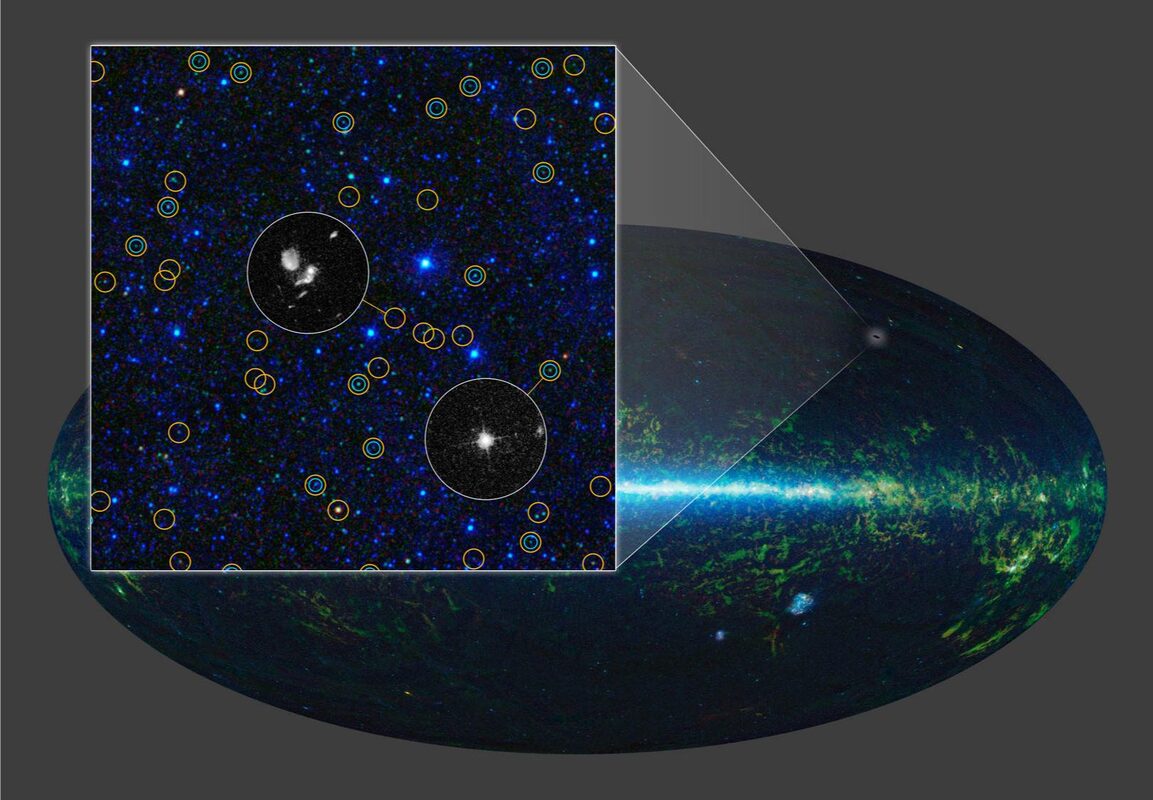
Quasar records usually move slowly. Each new one pushes the edge of the observable quasar population back by a small amount, often after years of searching. ESA's Euclid space telescope has now beaten its own record, and for the first time a quasar has been confirmed past redshift 8.
The object's formal name is EUCL J150452.291+625224.39, shortened to J1504+6252. The discovery team calls it Dun Aonghasa, after the cliff-top fort on Inis Mór, off the west coast of Ireland. Its light left it 630 million years after the Big Bang, about 13.1 billion years ago, when the Universe was roughly 5% of its current age. At its centre is a black hole of around 360 million solar masses, and the mass has been confirmed with the James Webb Space Telescope. The result was announced by ESA on 24 November, alongside a paper by J. Wolf and colleagues in Astronomy & Astrophysics.
A Needle Among Millions
Euclid's main job is not hunting quasars. The mission is studying dark matter and dark energy, and the Euclid Wide Survey photographs huge areas of sky to do it. That same imaging is also very good for finding rare, extremely distant objects, provided someone can pick them out.
Dun Aonghasa was selected from about 18 months of Euclid data that contained millions of objects. Choosing a candidate from imaging is only the first step. The team then followed it up with the Keck Observatory, the Large Binocular Telescope, the Hubble Space Telescope and finally Webb. According to the preprint on arXiv, Webb's NIRSpec spectrograph, using its G395M grating, measured a systemic redshift of z = 8.129 ± 0.005.
The paper says that figure pushes the quasar redshift frontier back by about 39 million years, which is roughly 6% of the age of the Universe at that time. ESA and Space.com round it to 40 million years earlier than the previous record holder. That earlier record also came from Euclid.
Weighing a Black Hole From 13 Billion Light-Years Away
A quasar is a supermassive black hole whose surrounding gas glows brightly as it falls inward. Astronomers can't weigh the black hole directly at this distance. Instead they measure how wide its emission lines are, because fast-moving gas close to the black hole spreads those lines out.
For Dun Aonghasa, the team measured broad-line widths (full width at half maximum) of 3,160 ± 270 km/s in hydrogen-beta and 3,740 km/s in magnesium II. Those widths give a black hole mass of log10(MBH/M☉) = 8.33 to 8.89, depending on which line and calibration is used. That works out to roughly 210 million to 780 million solar masses. ESA's headline figure is about 360 million.
Even the low end of that range is a very large black hole for a time only 630 million years after the Big Bang.
The Slow-Eating Problem
Size alone isn't the whole puzzle. The quasar is also not growing very quickly at the moment.
The team found Eddington ratios of 0.12 to 0.44. The Eddington ratio compares how fast a black hole is actually swallowing matter and shining with the theoretical maximum rate it can sustain. Dun Aonghasa is somewhere between about a tenth and less than half of that maximum. ESA describes it as consuming material at a relatively slow rate.
That makes the timeline harder to explain. A black hole growing this slowly today must have grown much faster before we saw it, or started out unusually large. The authors put it directly: sub-Eddington accretion implies either a massive seed or sustained, highly efficient growth very early on. Space.com notes that theory suggested supermassive black holes need around a billion years of feeding and merging to get this big. Dun Aonghasa is seen only 630 million years after the Big Bang.
ESA says the object puts pressure on models of early black hole formation and growth. A heavy seed, meaning a black hole that begins already very massive, or long periods of rapid feeding early on, are the two routes the authors name.
Why It Matters
One extreme object is interesting. A trend is more useful, and Euclid is producing one. ESA says the mission has announced 31 ancient quasars in about a year and a half, and 12 of them lie beyond redshift 7. Earlier surveys took around 15 years to reach that threshold at all.
That rate matters because single record-breakers say little about populations. To learn how early black holes formed, astronomers need enough of them to measure how common they were, how massive they were and how fast they were growing. Euclid's wide sky coverage and infrared sensitivity, combined with targeted follow-up from Webb, Keck, Hubble and the LBT, is starting to provide that sample.
The paper also includes a notable caveat. The authors suggest that substantially more luminous quasars hosting similarly massive black holes may remain to be discovered, and that previously known quasars from this era may be the rapidly accreting end of a broader population of already massive black holes.
There is also a practical point. ESA calls Euclid a unique quasar-hunting tool, and says that at redshift 8 quasars are so rare that at most a few tens are expected in its entire survey.
What Comes Next
The immediate tasks are clear. Further spectroscopy could tighten the mass estimate, which currently spans almost a factor of four, and the accretion rate. A larger sample of quasars beyond z = 7 will show whether slow-feeding giants like Dun Aonghasa are typical or rare.
The discovery paper, "Euclid: Discovery of a quasar at z = 8.13 hosting a 360-million-solar-mass black hole," was submitted to arXiv on 23 November and published in Astronomy & Astrophysics on 24 November 2026 (DOI 10.1051/0004-6361/202662243).
Sources
- ESA: Euclid breaks own quasar record by 40 million years (24 Nov 2026)
- arXiv:2611.31385 — Euclid: Discovery of a quasar at z = 8.13 hosting a 360-million-solar-mass black hole
- Space.com: Astronomers discover the most distant and ancient supermassive black hole-powered quasar in the universe (25 Nov 2026)
