
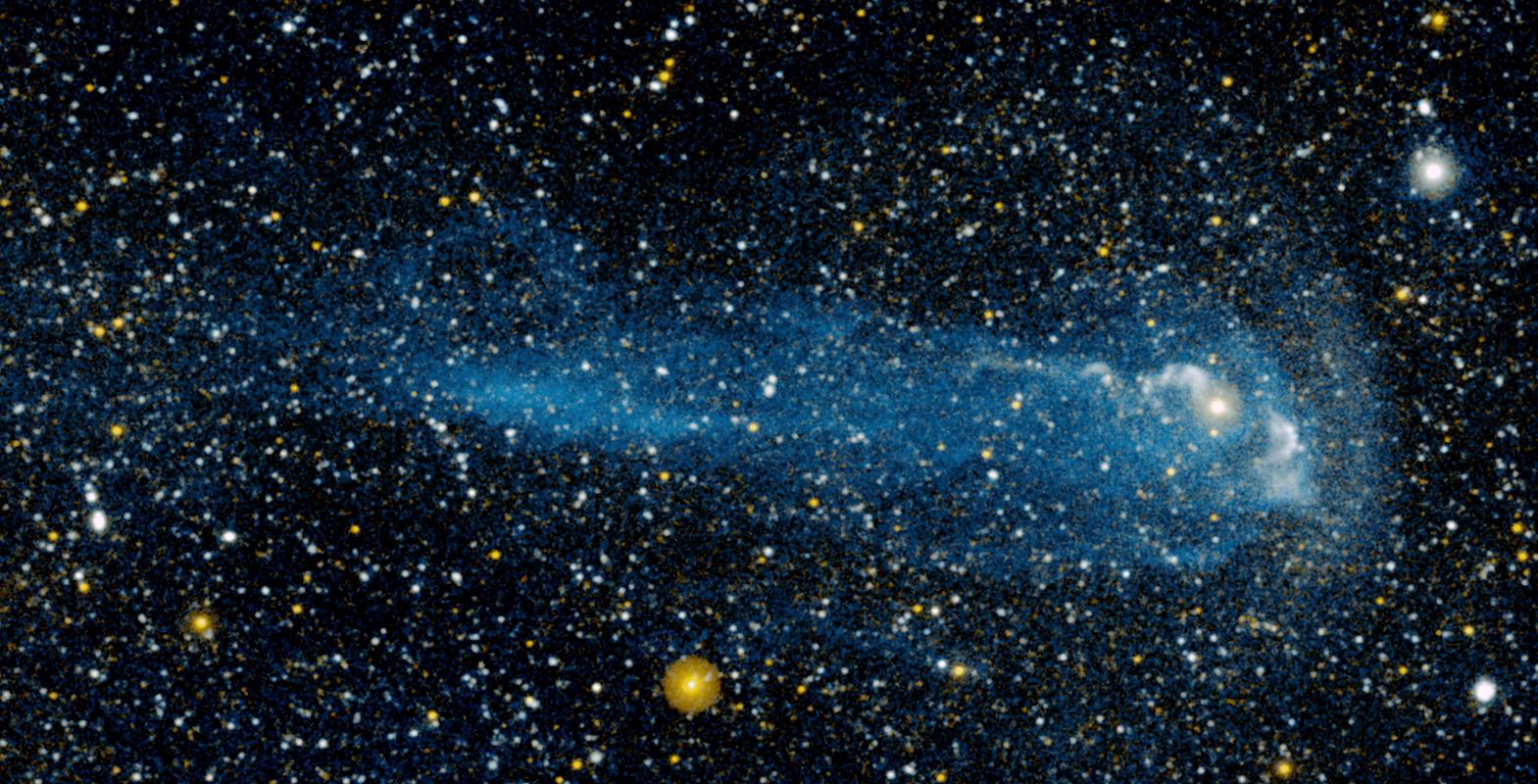
The standard picture of how a dying star loses its outer layers goes like this. A bloated red giant puffs material outward, dust condenses in the cooling gas, and the pressure of the star's own light on that dust pushes the whole thing into interstellar space. Magnetic fields have generally been treated as a minor player, and the paper itself describes their influence as "poorly constrained."
New observations of Mira, a red giant about 330 light years away in the constellation Cetus, argue that this picture leaves something out. Astronomers led by Wouter Vlemmings and Miora Andriantsaralaza of Chalmers University of Technology in Sweden have used the Atacama Large Millimeter/submillimeter Array (ALMA) to image what they describe as a giant magnetic eruption from the star's surroundings. It is a loop of gas, threaded with strong magnetic fields, that the authors say is analogous to a coronal mass ejection from the Sun, only on a vastly larger scale.
The results appear in two papers in Astronomy & Astrophysics, and they draw on ten years of detailed images of the star.
A loop the size of Saturn's orbit
The centrepiece is a structure the team calls a "highly magnetized loop-like mass ejection." According to the paper describing it (arXiv:2608.23695, by Vlemmings, Andriantsaralaza, Bojnordi Arbab and colleagues), the loop extends to approximately eight stellar radii. Behzad Bojnordi Arbab, a doctoral student at Chalmers, puts that in Solar System terms: the loop extends as far out as the distance of Saturn from the Sun. The image showing it was captured in 2025.
Chalmers calls it a "record" eruption. According to the university, a flare appeared on Mira's surface in 2023 and, over the following two years, created a vast, expanding loop of gas around the star. The team estimates that the brightest of Mira's flares are brighter than any flare yet observed from any comparable star. The authors write that the structure's morphology, polarisation pattern, energetics and kinematics all point to the same conclusion, a magnetically driven eruption analogous to a stellar coronal mass ejection. In the Sun, bright flares and magnetic storms lead to such ejections, which send streams of particles outward.
How do you see a magnetic field 330 light years away?
ALMA cannot see magnetic fields directly. It picks them up indirectly, through their polarising effect on radio emission. In the gas around Mira, silicon monoxide (SiO) molecules produce maser emission, the microwave equivalent of laser light. The researchers targeted one specific maser line, the SiO v=1 J=5-4 transition at 215 GHz, and observed it in full polarisation with ALMA at angular resolutions of 1.5 to 2.6 astronomical units.
The polarisation carries the magnetic information. As Universe Today explains, the masers in this case are both linearly and circularly polarised, and the astronomers used those features to map the geometry of Mira's magnetic field. In the loop the masers were strongly polarised, which marks the structure as magnetised rather than just a clump of outflowing gas. The authors also note that the maser emission sits much farther from the star than SiO masers usually do, which they read as tracing an outward-moving shock denser than expected.
Because the work spans a decade of imaging, the team could also see change over time. Andriantsaralaza says the star's surface is constantly changing, with the brightest areas different every time the team looked. The Chalmers release describes recurring magnetic storms around the star, not a single isolated outburst.
What's driving it?
The origin of the magnetic fields is still uncertain. The authors write that several mechanisms have been proposed, and Universe Today names two: a turbulent dynamo deep in Mira's convective envelope, or differential rotation between the star's core and its envelope. Understanding how the fields are generated will matter for understanding how they drive mass loss.
That gap matters, because the mechanism may determine how general the finding is. The sources do not say how common such eruptions are among stars in Mira's evolutionary stage, and which explanation is right could bear on that question.
Why It Matters
Mira is an asymptotic giant branch (AGB) star, a late phase in the life of low- and intermediate-mass stars. Chalmers notes that because Mira is much older than the Sun, it offers a glimpse of the Sun's future: in a few billion years our star will be a cool, windy star like Mira. These stars lose mass at a remarkable rate. Universe Today cites figures of as much as 30 Earth masses of material per year. That material goes on to spread the elements needed for new generations of stars and planets, including carbon, oxygen and nitrogen.
This is the point the Chalmers group stresses. "Strong magnetic fields can also shape and power stellar winds," Vlemmings said in the university's release, adding that this "changes a fundamental part of the origin story of the atoms we ourselves are made of." The authors conclude that magnetic fields must become an integral component of future models of AGB winds, and that magnetic eruptions can dominate mass loss from evolved stars.
The eruptions also help explain how lumpy mass loss can be. Universe Today reports that the authors see such events as able to account for features of AGB mass loss such as clumpiness, asymmetry and variability over time. A smooth, steady wind and a series of magnetically launched loops would spread material in very different ways.
Caveats
The result comes from one star. Whether magnetically driven ejections are a routine part of AGB mass loss or something specific to Mira is not settled by this work. Coverage also gives slightly different distances, with Universe Today using about 300 light years and Chalmers 330. That doesn't change the physics, but readers comparing reports will notice it.
The basic observation holds either way. Around at least one dying star, magnetic fields are strong and organised enough to accompany a loop of gas thrown out to the distance of Saturn's orbit. That makes magnetism a factor that models of stellar winds now have to take into account.
