
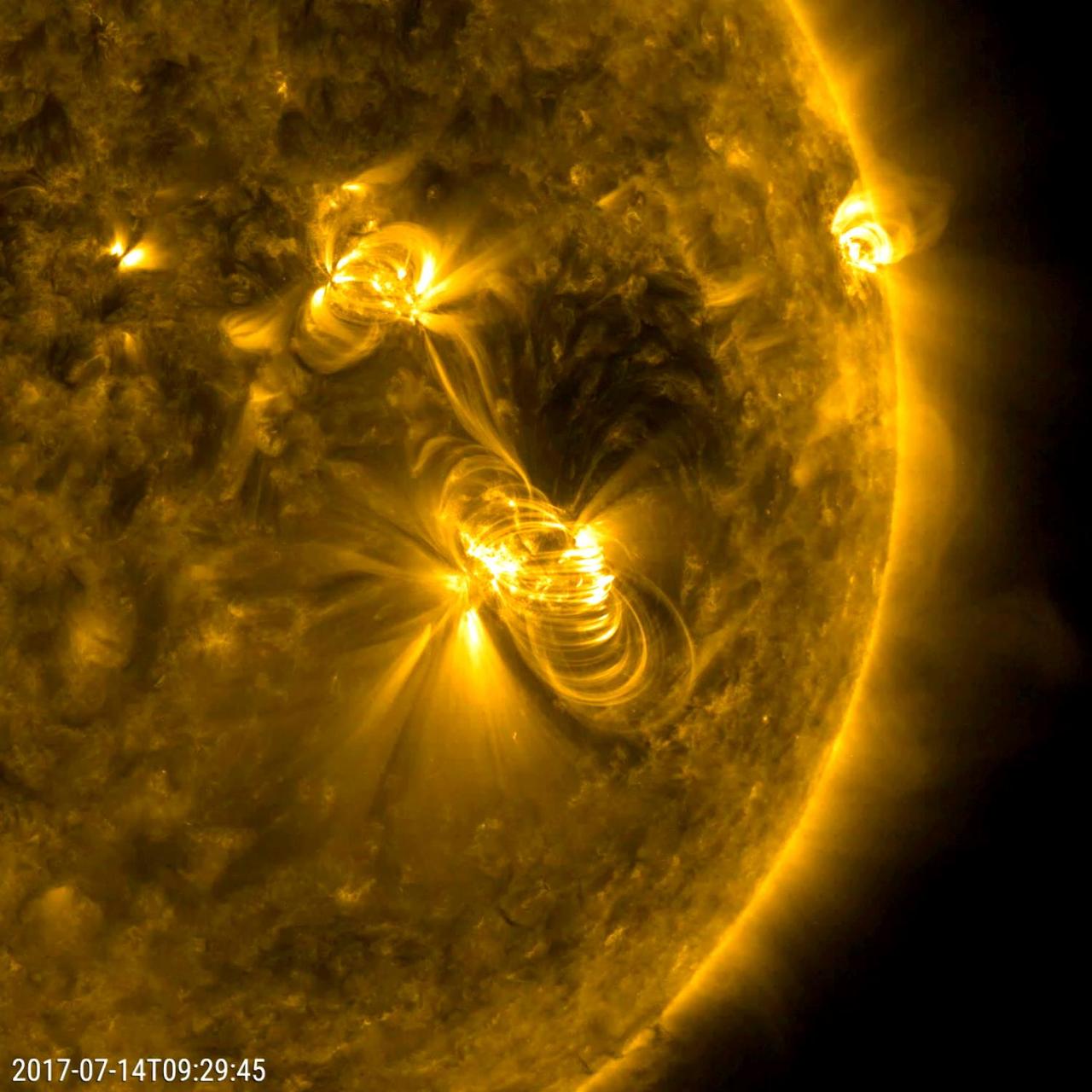
The sun has sent Earth's magnetosphere a heads-up, and NOAA is passing it along. On September 7, 2026, at 16:35 UTC, the agency's Space Weather Prediction Center (SWPC) issued official product WATA20: a watch for a G1-Minor geomagnetic storm, with the elevated activity expected to persist across two consecutive days. The forecast calls for G1 conditions on both September 8 and September 9, dropping back below storm threshold by September 10.
A few hours later, at 20:01 UTC, SWPC followed up with a companion product — WARK05, a K-index warning — forecasting a geomagnetic K-index of 5 in the window between 2000 UTC on September 7 and 0600 UTC on September 8. That's the threshold at which SWPC starts flagging that aurora could become visible at high latitudes, and the agency specifically named northern Michigan and Maine as places where skywatchers might catch a glimpse.
What's actually headed our way
Solar storm forecasting is rarely a single clean signal, and this event is no exception. According to reporting from Watchers.news, published the same day as the NOAA watch, SWPC is tracking the combined arrival of several coronal mass ejections (CMEs) beginning in the early hours of September 8 and continuing into September 9. The setup driving the watch has two separate ingredients converging at roughly the same time: a possible glancing blow from a CME that erupted from the sun on September 2, and the onset of a high-speed solar wind stream flowing out of a coronal hole — a gap in the sun's magnetic field that lets solar wind escape more freely than usual.
Neither ingredient alone would necessarily be remarkable. A glancing CME hit is, by definition, not a direct strike, and coronal-hole streams are a fairly routine feature of the solar wind. But stacked together, they're enough to push NOAA's forecasters to call a watch — and the Watchers.news report notes there's a slight chance conditions could actually reach G2-Moderate if the CMEs arrive on the more energetic end of the forecast range.
EarthSky's running solar-activity log corroborates the broad picture — a glancing CME departing the sun on September 2, layered with a coronal-hole stream — but adds an important caveat that's easy to lose in the excitement: confidence remains low in both the timing and the magnitude of the incoming CME arrivals. That's not a hedge added for legal cover; it reflects a real, persistent limitation in space weather science. CMEs are diffuse clouds of magnetized plasma, and predicting exactly when one will reach Earth, how strong its magnetic field will be oriented, and how hard it will couple with Earth's own magnetosphere is still one of the harder problems in the field.
Where you might actually see something
Coverage from Daily Galaxy corroborates NOAA's G1-Minor forecast for the same window, tracing the activity to a CME that launched from the sun on September 2 and a second eruption on September 4, with sunspot region 4524 identified as the source of the underlying magnetic disturbances. The outlet lists a broader swath of potential viewing territory: Alaska, northern Washington, Idaho, Montana, North Dakota, South Dakota, Minnesota, Wisconsin, Michigan, upper New York, and Maine. Of that list, Montana, North Dakota, and Minnesota are singled out as having the best pre-dawn viewing odds — worth noting for anyone in the northern Plains weighing whether to set an alarm.
It's worth being precise about what a G1 watch actually promises, because "aurora possible" and "aurora guaranteed" are very different things. A G1-Minor storm is the weakest category on NOAA's five-step geomagnetic storm scale (G1 through G5), and at that level the aurora oval typically expands just far enough south to become visible low on the northern horizon from the upper-tier US states — under genuinely dark skies, away from light pollution, and only if the storm actually materializes as forecast. Given the low-confidence caveat both NOAA and EarthSky are carrying into this event, the responsible expectation for most sky-watchers is a possibility worth checking on, not a can't-miss show.
Why It Matters
Geomagnetic storms are more than a photogenic excuse to stay up late. Even a G1-level disturbance is the low end of a spectrum that, at its higher reaches, can induce currents in long-distance power transmission lines, degrade high-frequency radio propagation used by aviation and maritime traffic, and perturb the orbits of satellites in low Earth orbit by heating and expanding the upper atmosphere they fly through. NOAA's watch-and-warning system exists precisely so that grid operators, airlines, and satellite operators have lead time to take precautionary steps — even for storms, like this one, that are expected to stay firmly in the minor category. The low-confidence forecast here is itself a useful reminder that space weather prediction, unlike terrestrial weather forecasting, still operates with limited lead time and real uncertainty in magnitude, which is exactly why agencies issue graduated products like watches and K-index warnings rather than waiting for certainty that may never come.
