
There is a photograph taken in 1888 by Isaac Roberts that shows the Andromeda Galaxy for essentially the first time — not as a smear in a sketch, but as a structured, spiral thing with real depth. It required a 20-inch reflector telescope, a specially cooled dry-plate glass negative, and a four-hour exposure. For most of the twentieth century, that kind of image represented the outer boundary of what was physically achievable. The photons were rare, the detectors were inefficient, and the instruments required to gather enough signal were massive, expensive, and fixed to the ground by necessity.
In 2026, a hobbyist with a mirrorless camera, a tracking mount the size of a shoebox, and free stacking software running on a laptop can produce an image of the Andromeda Galaxy that Isaac Roberts would have found almost impossible to believe — with spiral arm structure, dust lanes, and hints of the satellite galaxies M32 and M110 visible in a single weekend session. The technology that made this possible did not arrive all at once. It accumulated in layers, each one quietly removing a constraint that had seemed permanent.
The sensor revolution, in plain numbers
The foundational shift was the transition from film to digital, and then the rapid improvement of digital sensors through the 2010s. The relevant metric for astrophotography is read noise — the electronic noise introduced by the sensor itself each time it reads out a pixel value. Film has no read noise in the electronic sense, but it has reciprocity failure: its sensitivity drops dramatically on long exposures, meaning that doubling the exposure time does not double the signal captured. Early CCD sensors had read noise measured in tens of electrons per pixel readout. Modern back-illuminated CMOS sensors, which now dominate the mirrorless camera market, routinely achieve read noise below 2 electrons at high ISO settings — some approaching unity gain, where a single photon registers as a detectable signal with statistical confidence.
This matters enormously for faint extended objects like nebulae and galaxies. The challenge with these targets is not merely that they are dim, but that the sky background is also bright relative to them — even from dark sites, airglow and zodiacal light add a diffuse glow that competes with the signal. When read noise is low enough, a photographer can take many short exposures and stack them mathematically rather than being forced into single long exposures that demand cooling systems to suppress thermal noise. Sony's Exmor R backside-illuminated sensors, adapted into cameras like the Sony A7S III and A7 IV, were a turning point. Canon's R5 and R6 lines followed. By the early 2020s, the sensor performance in consumer cameras had exceeded what purpose-built cooled astronomical CCD cameras cost tens of thousands of dollars to achieve a decade earlier.
Tracking and the end of star trails
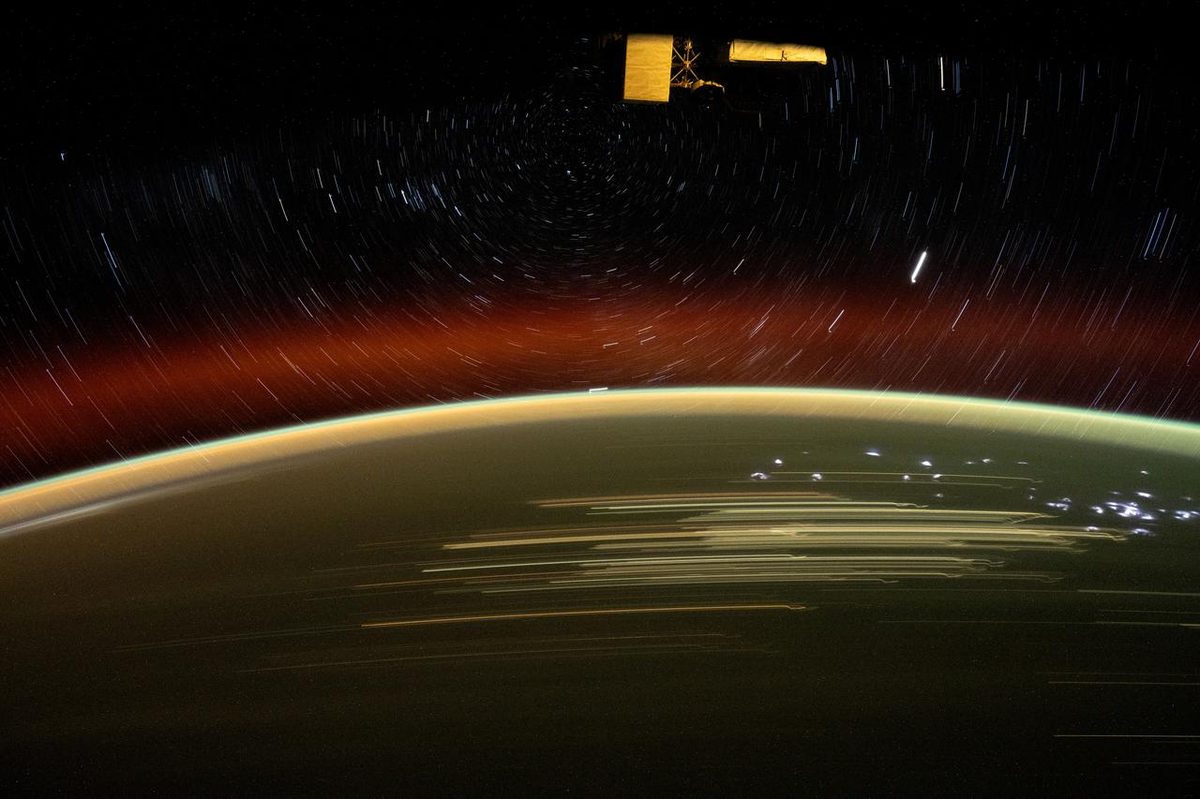
Raw sensor performance solves only part of the problem. The Earth rotates, and during any exposure longer than roughly 15 to 25 seconds at typical focal lengths, stars trail across the frame. For decades, counteracting this required equatorial mounts — large, precisely polar-aligned mechanical platforms that rotate a telescope at exactly the sidereal rate to cancel the planet's motion. A research-grade equatorial mount can weigh hundreds of kilograms. The entry-level astronomy mounts of the 1990s were finicky, difficult to polar-align, and still too large for casual travel.
The star tracker changed this. Devices like the Sky-Watcher Star Adventurer, iOptron SkyGuider Pro, and Omegon Mini Track LX weigh under two kilograms, attach to a standard tripod ball head, and use stepper motors controlled by microprocessors to track the sky with sufficient accuracy for exposures of several minutes at moderate focal lengths. Polar alignment — once requiring star drift tests lasting half an hour — is now accomplished in minutes using polar scope illuminators or smartphone apps that use GPS and accelerometers to guide the process. The mechanical precision of these small trackers, relative to their cost, is a direct consequence of the same miniaturization trends that drove consumer robotics and drone stabilization. A photographer can fit a tracker, a mirrorless body, and a fast wide-angle lens into a hiking pack and be set up on a mountain ridge within twenty minutes of arriving.
Stacking, calibration, and what computation actually does
The third pillar of the modern astrophotography pipeline is image stacking — the practice of combining many individual exposures to suppress noise and recover signal. The mathematics is straightforward: random noise in each frame is uncorrelated between frames, so when you average N exposures, the signal-to-noise ratio improves by a factor of the square root of N. One hundred two-minute frames produces an effective result comparable to a single roughly 200-minute exposure with no read noise. In practice it is more complicated, because you must also account for hot pixels, satellite trails, atmospheric seeing variations, and gradient differences between frames. Software packages like PixInsight, Siril (free and open source), and DeepSkyStacker automate most of this — performing sigma-clipping to reject outlier frames, subtracting dark frames and flat fields to remove fixed-pattern noise, and applying gradient correction algorithms to deal with sky background that varies across the field.
What PixInsight does with a well-calibrated stack of images would have required a professional photometric pipeline in the 1990s. The software can stretch a linear sensor stack — which looks almost entirely black to the eye — into a finished image revealing faint nebulosity, apply deconvolution to sharpen star cores, and separate narrowband emission by color channel using standard RGB data in ways that approximate what dedicated monochrome cameras with hydrogen-alpha filters achieve. This is not image manipulation in the pejorative sense. It is signal processing, and it is the same class of technique used by observatories processing raw data from instruments like the Hubble Space Telescope's Wide Field Camera 3.
Artificial intelligence has recently entered the pipeline in practical ways. Tools like Topaz DeNoise AI and Starnet++ (which removes stars from an image so nebula structures can be processed independently) run neural networks trained on astronomical data. The results are genuinely useful, not gimmicky — denoising a marginally underexposed stack with a trained model recovers detail that would otherwise be indistinguishable from noise. It does not fabricate structure; it reduces the uncertainty in what was already faintly present.
Where the boundary still sits
None of this means the gap between consumer and professional capability has vanished. It has compressed. A backyard imager shooting a faint galaxy cluster from a reasonably dark site can match what a professional observatory's widefield survey camera produced in the early 1990s — and that is a remarkable statement. But the Vera C. Rubin Observatory's LSST Camera, which began its Legacy Survey of Space and Time in 2024 from Cerro Pachón in Chile, captures 3.2 gigapixels per frame with a 8.4-meter primary mirror across 9.6 square degrees of sky every 15 seconds. It will image the entire visible southern sky every few nights for ten years. No consumer equipment approaches this. The Hubble Space Telescope's resolution, operating above the atmospheric seeing limit, remains categorically beyond what any ground-based system — amateur or professional — can replicate from the surface.
What has changed is the threshold at which meaningful, beautiful, and scientifically interesting imagery becomes accessible. A 16-year-old with a secondhand mirrorless body, a borrowed tracker, and a clear night above 5,000 feet of elevation can now produce images of the Orion Nebula, the Pleiades reflection nebula, the Andromeda Galaxy, and the Rho Ophiuchi cloud complex that would have graced the pages of astronomy journals thirty years ago. The physics of photons and silicon has not changed. The accessibility of the tools required to collect and process them has transformed entirely.
