
For decades, the rock that ended the Cretaceous has been a mostly anonymous villain. We knew roughly how big it was, roughly how fast it hit, and that it left a chemical fingerprint of extraterrestrial material smeared across the planet in a thin clay layer. What we did not know was what kind of rock it actually was.
A paper published July 17, 2026 in Science Advances puts a specific name on it, and the name is a strange one. Using high-precision nickel isotope measurements on K–Pg boundary clay, an international team concludes the Chicxulub impactor was a CO chondrite — a carbonaceous chondrite of the Ornans class. It is one of the rarer meteorite types known, and it does not behave the way the standard extinction story assumes.
Reading a 66-million-year-old rock that no longer exists
The impactor itself was annihilated on contact. What survives is its chemistry, vaporized and redistributed globally into the boundary clay. The new study leans on nickel isotopes, which vary in characteristic ratios between meteorite classes and act as a class-level signature rather than a generic "this came from space" marker.
The author list spans Vrije Universiteit Brussel, the University of British Columbia, the Institut de Physique du Globe / Université de Paris, and Vienna — Georgy V. Makhatadze, Frédéric Moynier, Leslie-Anne Brun, Steven Goderis, Philippe Claeys and Christian Koeberl among them. The study is titled "The origin of Cretaceous-Palaeogene impactor revealed by nickel isotopes." The measurements were made on samples collected over years from the thin clay layer deposited worldwide by the impact — which matters for a measurement claiming to characterize a body that was distributed across the entire planet.
"Tracing the precise chemical fingerprint of an impact that took place so long ago is a huge leap forward," said VUB's Prof. Steven Goderis. "Using advanced isotope analysis, we can now determine with much greater precision the specific part of our solar system from which the devastating meteorite originated, providing us with fundamental insights into the dynamics of cosmic impacts on our planet."
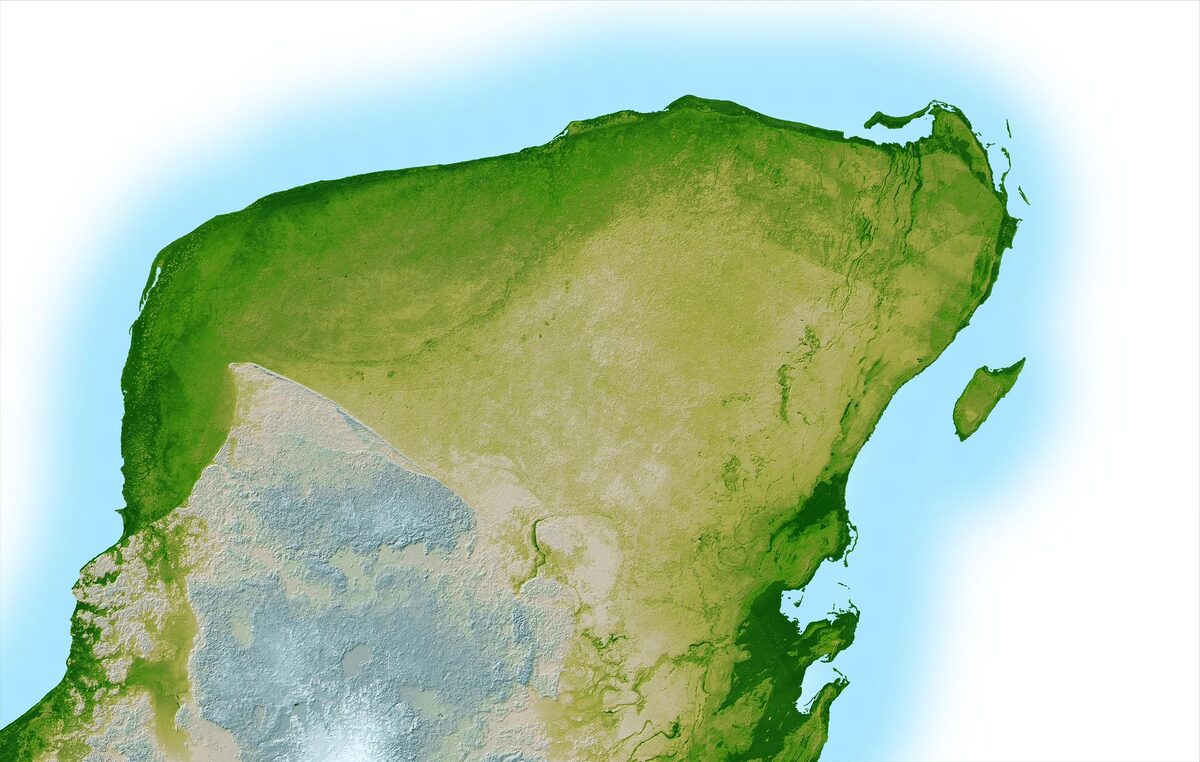
The basic physical picture is unchanged: a body roughly 10 to 15 kilometers across, arriving at about 64,000 km/h, 66 million years ago, carving the Chicxulub crater now buried beneath the Yucatán Peninsula in Mexico, and taking about 75 percent of all animal species with it — non-flying dinosaurs included.
Why "oddball" is the right word
Carbonaceous chondrites make up only about 5 percent of the meteorites sampled on Earth. CO chondrites are a tiny fraction of that. This is not the sort of rock that turns up routinely in a collection drawer.
"CO chondrites are definitely not like the typical meteors you find in museum collections," Claeys told Sci.News.
Their defining oddity is what they lack. "A CO contains much less volatile elements — like carbon, zinc, water and particularly sulfur — than other classes of meteorites we've discovered so far on Earth," Claeys said. Where you might expect the doomsday rock to have been a volatile-rich bomb, the isotopes point to a dry, sulfur-poor body.
The origin follows from the composition. Potential sources, the team says, include the distant, debris-rich regions of the outer solar system, or the outer area of the asteroid belt near Jupiter — a long-haul traveler rather than a local.
The sulfur problem
Here is where the identification stops being trivia and starts rearranging the extinction narrative.
One of the most durable explanations for the K–Pg "nuclear winter" invokes sulfur: the impact injecting enormous quantities of sulfur aerosols into the stratosphere, which reflect sunlight, collapse photosynthesis, and freeze the biosphere. The impact site itself was sulfur-rich — Chicxulub struck the tropical, shallow seas of the sulfur-rich Yucatán Peninsula — but the impactor has often been treated as a contributor too.
If the impactor was a CO chondrite, it had very little sulfur to contribute. Claeys puts the revision plainly: "It doesn't alter our theory of what caused the extinction event, but it makes it less likely that sulfur contained in the impactor was the smoking gun."
What the researchers emphasize instead is mechanical. "The fine debris thrown into the atmosphere would have the primary factor," Claeys said. Pulverized rock lofted to global distribution blocks light on its own, and the new compositional constraint pushes that pathway to the front of the queue.
It is worth being precise about the scope of the claim. This is a statement about the impactor's contribution, not a demonstration that sulfur played no role at all in the aftermath — the sulfur-rich target rock is a separate question, and the study's contribution is to remove the impactor as a major volatile source rather than to rewrite the atmospheric chemistry wholesale.
Why It Matters
Extinction models are only as good as their inputs, and "how much sulfur, carbon and water arrived with the impactor" is one of the load-bearing inputs. Pinning the body to a specific, volatile-poor meteorite class replaces an assumption with a measurement. Models that leaned on impactor-derived sulfur now have to justify that budget from the target rock alone, and the fine-debris mechanism gains relative weight — which changes the expected timing, duration and severity profile of the darkness that followed.
There is a second, quieter implication about where dangerous objects come from. A body drawn from the outer asteroid belt near Jupiter, or from the debris-rich outer solar system beyond it, is a long way from the neighborhood most impact-hazard reasoning starts in. The rock that reset terrestrial life appears to have been an outlier both in composition and in provenance, which is a useful data point for anyone reasoning about the population of bodies capable of doing this again.
And methodologically, this is a demonstration that a 66-million-year-old body that no longer exists can be classified to the level of a meteorite subclass, from clay. The signal survived vaporization, global dispersal and deep time, and high-precision isotope work was enough to read it. That capability generalizes to other impact layers in the record.
Sources
- VUB researchers identify a rare class of 'oddball' meteorite that caused the extinction of the dinosaurs — Vrije Universiteit Brussel
- Researchers identify class of 'oddball' meteorite that killed the dinosaurs — UBC Science
- Scientists identify the rare meteorite that killed the dinosaurs 66 million years ago — ScienceDaily
- Dinosaurs May Have Been Wiped Out by 'Oddball' Space Rock — Sci.News
