
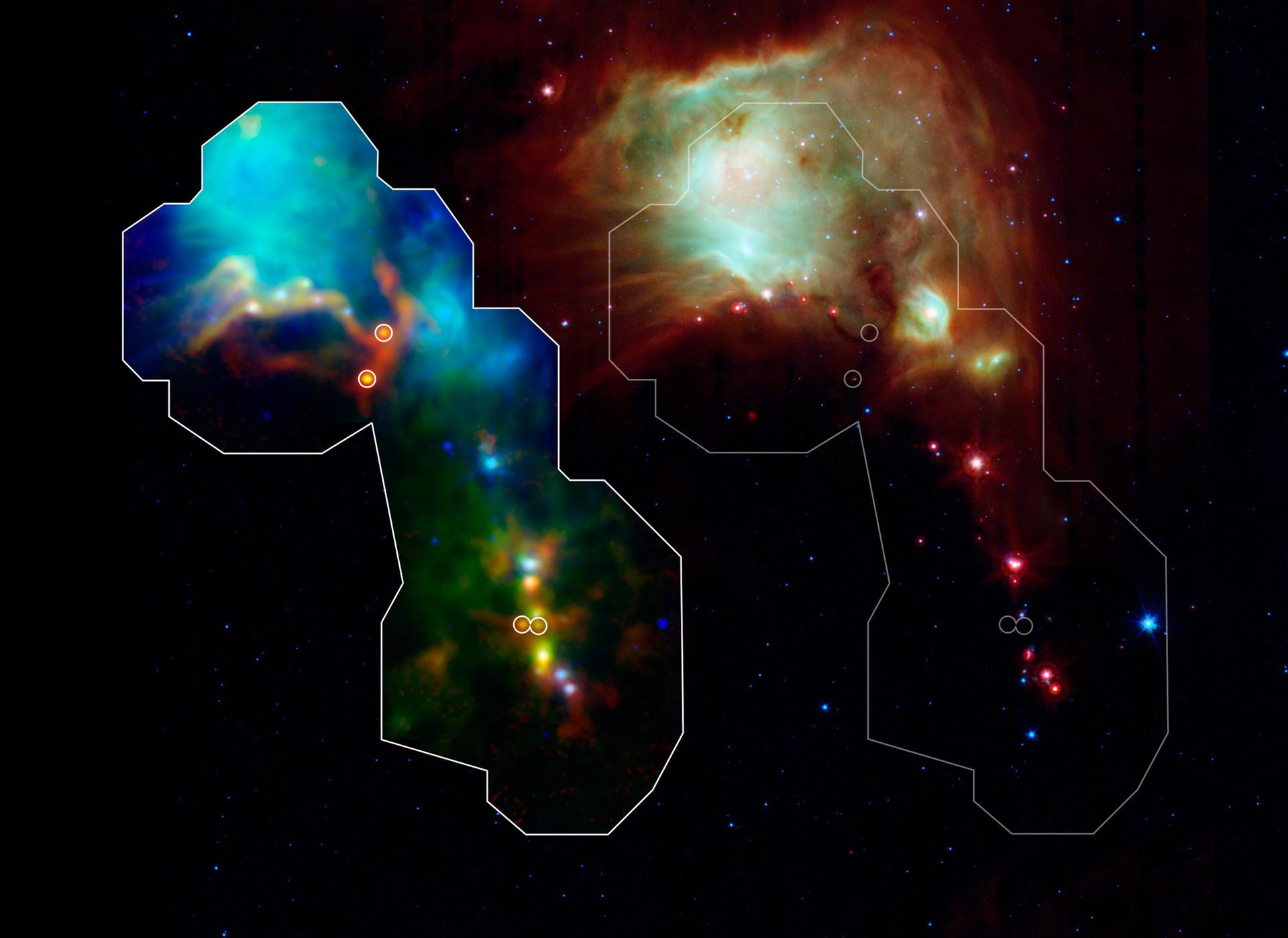
Methanol, the simplest alcohol and the stuff sometimes called wood alcohol, is a familiar molecule in star-forming regions. In deuterated methanol, hydrogen atoms are swapped for deuterium, the heavier isotope of hydrogen. A version with all four hydrogens replaced had never been robustly identified in interstellar space. Now it has, and there is far more of it than current chemistry models predict.
A team led by Arnaud Belloche of the Max Planck Institute for Radio Astronomy (MPIfR) reports the first interstellar detection of fully deuterated methanol, CD3OD, toward a young protostar called IRAS4A2. The source sits in the Perseus molecular cloud, about 1,000 light-years from Earth. According to Universe Today, this is the first time any quadruply deuterated molecule has been found in interstellar space.
A molecule that shouldn't be this common
The headline isn't only that CD3OD exists. It's how much of it there is. Universe Today reports that the molecule is about 100 times more abundant than models predict, which suggests that some formation process nobody has accounted for is at work.
The paper, posted to arXiv on 5 October 2026 as COMPASS VII by Belloche and 14 co-authors, is measured about this. The team used a sensitive imaging spectral survey with the Atacama Large Millimeter/submillimeter Array (ALMA) to study IRAS4A in the NGC 1333 molecular cloud. Toward the binary component IRAS4A2, they detected several methanol isotopologs, meaning versions of the molecule that differ only in which isotopes they contain. CD3OD was among them.
The overall deuteration pattern looks much like what has been measured in other low-mass protostars. The apparent D/H ratio climbs as you move from singly deuterated methanol to the forms with more deuterium. That rising trend is the problem. The authors write that chemical models of prestellar and protostellar cores focused on deuteration do not reproduce the pattern quantitatively, and that detecting CD3OD makes the discrepancy even worse.
Is the chemistry wrong, or the bookkeeping?
When observations and models disagree by two orders of magnitude, either the models are missing physics, the measurements are biased, or both. The COMPASS VII authors lean toward a measurement explanation as at least part of the answer.
Deuteration ratios are relative. To say how enriched a molecule is in deuterium, you divide the amount of the deuterated form by the amount of ordinary methanol. If the ordinary methanol is undercounted, every ratio built on it comes out too high. The team suspects exactly that. Their modeling yields low column density ratios of methanol to its 13C and 18O isotopologs, and they suspect the methanol column density is underestimated. One possible explanation they offer is that the emission is clumpy rather than monolithic.
This is a hypothesis, not a fix. Universe Today, for its part, reports that the abundance suggests an unknown process is driving the formation of fully deuterated methanol, one that current models miss.
Loose ends in the spectrum
The survey also left some puzzles in the data. Universe Today reports that the team detected several spectral lines they cannot yet identify. Given the detection of CD3OD, they suspect these could come from multiply deuterated forms of methanol, such as CH2DOD and CHD2OD. Confirming that requires laboratory data, which the team is working to secure. Silvia Spezzano of the Max Planck Institute for Extraterrestrial Physics (MPE), a co-author, says MPE is conducting a systematic laboratory program on the spectroscopy of deuterated complex organic molecules, including those two. The study involved researchers from MPIfR, MPE and IRAP, among other institutions.
This is how a lot of astrochemistry moves forward. A telescope records lines that nobody can assign. A lab measures candidate molecules on Earth. Then the lines get matched, or they stay a mystery until the next candidate is tested.
The wider survey
CD3OD is one result from a larger campaign. COMPASS is led by Maria Drozdovskaya of the University of Bern, according to Space.com. It involves a team of more than 30 astronomers and targets 11 nearby young, Sun-like protostars. The first results appear in seven papers in the October 2026 issue of Astronomy & Astrophysics.
Space.com reports that the deuterated methanol discovery was made around only one of the 11 protostars, IRAS 4A2. That makes the source unusual within the sample. The survey also found methanol maser emission around more than half of the 11 protostars, favoring the youngest of the stars. Masers are natural microwave amplifiers, a microwave version of a laser. Space.com says COMPASS' observations are the first detection of methanol masers around calmer lower-mass protostars; they had previously been seen around turbulent high-mass protostars.
Why It Matters
Deuterium fractionation is a diagnostic tool. The COMPASS VII authors say the first detection of a fully deuterated complex organic molecule highlights its power for investigating the formation and inheritance of organic molecules during star formation. The material around young stars is the raw stock that planets are built from, and Space.com calls the diversity of complex organic molecules there a "chemical starter kit" for planets and potentially life.
If chemical models can't reproduce how deuterium spreads through methanol around a nearby protostar, then using those models to reconstruct the chemical history of planet-forming material is less reliable than we'd like. The CD3OD result gives the field a clear test. Either a better count of ordinary methanol, perhaps one that accounts for clumpy emission, closes the gap, or the models need a formation route that they currently lack. In both cases, a molecule that had no robust interstellar detection until this month now sets a hard constraint on how young stars build their chemistry.
