
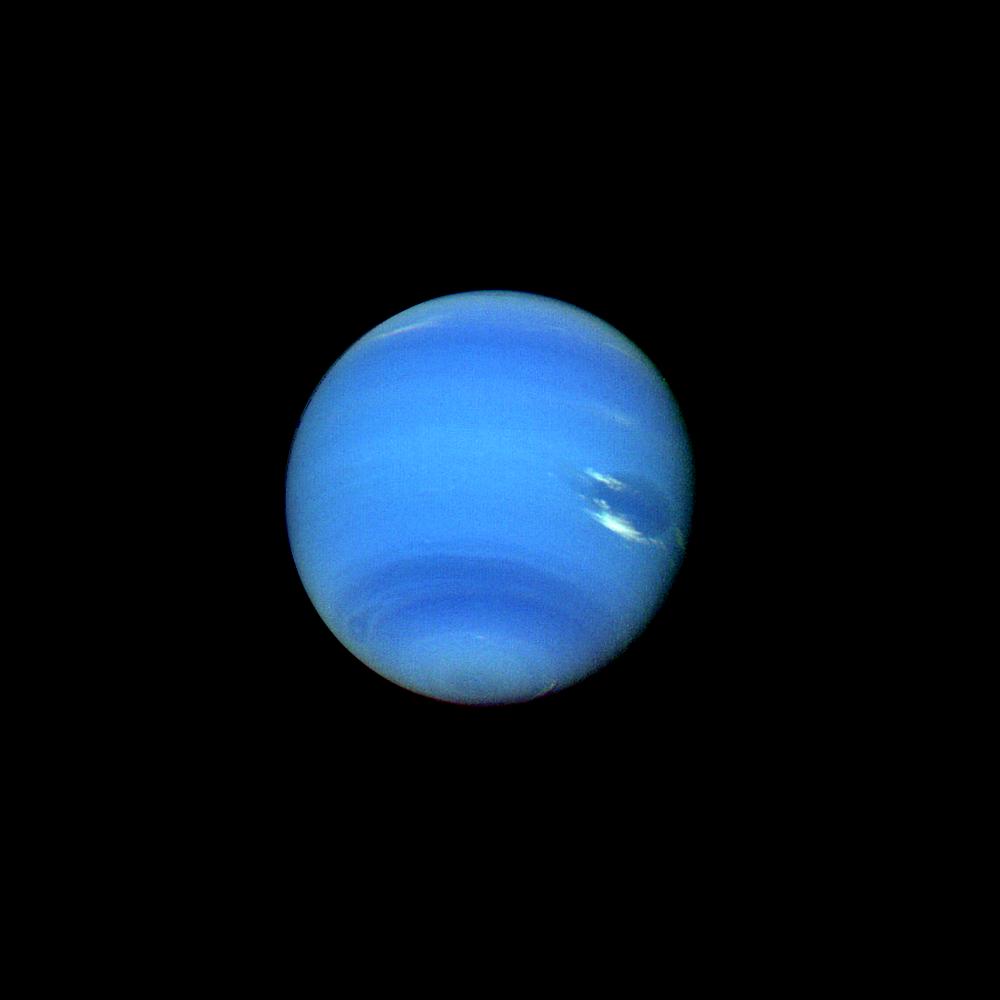
On the night of Sept. 25 into Sept. 26, 2026, Neptune will rise in the east as the sun sets in the west, sitting directly opposite the sun in Earth's sky. Astronomers call this configuration opposition, and for Neptune it falls right around 1 to 2 UTC on Sept. 26 — Universe Today pins it at roughly 1 a.m. UTC (9 p.m. EDT on Sept. 25), while EarthSky puts it about an hour later, at 2 a.m. UTC (9 p.m. CDT on Sept. 25). The timing is a coincidence worth pausing on: it falls almost exactly 180 years after Neptune's discovery on Sept. 23, 1846, an event that remains one of the tidiest demonstrations in the history of science that the universe follows rules you can write down on paper.
A Planet Found by Mathematics Before It Was Found by Eye
Neptune wasn't discovered by someone scanning the sky and stumbling across something new. It was discovered because French mathematician Urbain Le Verrier calculated where it had to be. Astronomers had noticed that Uranus wasn't moving quite the way Newtonian gravity said it should, and Le Verrier worked out that the discrepancy could be explained by an unseen planet tugging on it from farther out. He sent his predicted coordinates to the Berlin Observatory, and on the night of Sept. 23, 1846, astronomers there pointed a 9-inch refractor at that patch of sky. Neptune was sitting almost exactly where the math said it would be.
It's a story that still holds up. Finding a planet with a telescope is one thing; finding it with a pencil, a table of orbital perturbations, and enough confidence to tell someone else where to look is another. Le Verrier's prediction turned Neptune from a hypothesis into a target, and the Berlin Observatory turned the target into a discovery in a single night.
What You'll See (and What You Won't)
Don't expect to just glance up and spot it. Neptune shines at magnitude +7.6 to +7.8 depending on the source and measurement, which is well below the roughly magnitude 6 threshold of naked-eye visibility even under a dark sky. It is, in fact, the only major planet in the solar system that has never been seen without optical aid — not by the ancients, not by anyone, ever. You'll need binoculars at minimum, and a telescope will actually let you resolve it as a tiny disk rather than just another point of light.
That disk is genuinely tiny: about 2.4 arcseconds across, a reflection of just how far away Neptune sits. At opposition it's roughly 240 light-minutes from Earth, or about 28.9 astronomical units — just over 4.3 billion kilometers. Light left the planet's cloud tops four hours before it reaches your eye. This year Neptune is positioned in front of the constellation Pisces and sits near the celestial equator, which is good news for observers: it means the planet climbs reasonably high in the sky for viewers in both the Northern and Southern Hemispheres, rather than favoring one over the other as it does in years when it sits farther north or south of that line.
A Harvest Moon Triangle
NASA's September skywatching guide points out a nice bit of timing on opposition night itself: the Harvest Moon rises in the east near Saturn, and Neptune completes a rough triangle with the two of them. NASA's own description pegs Neptune at around magnitude 8, reiterating the same point — this is a binoculars-or-telescope object, not one you'll pick out by eye even with the Moon and Saturn as guideposts. Still, it's a useful excuse to get equipment out anyway: locate Saturn and the Moon first, then let a telescope or star chart guide you the rest of the way to Neptune's faint point of light. NASA's guide also flags two other September highlights along the way — the equinox on Sept. 22 and Venus reaching its peak brightness on Sept. 18 — bookending a month with plenty going on.
Chasing Triton
For observers with larger amateur telescopes, opposition season is also a good time to hunt for Neptune's largest moon, Triton. At magnitude +13, Triton is a genuine challenge even in bigger scopes, but the odds improve around its greatest elongation from the planet in early October, when it swings out to roughly 15 arcseconds of separation — enough distance from Neptune's glare to actually pick it out. Observers attempting the chase can use the Triton Tracker tool, maintained by the Planetary Data System's Rings Node, to plot exactly where the moon will sit relative to the planet on a given night.
Triton is a strange moon by any measure: it completes a full orbit of Neptune in just six days. It remains one of the least-visited bodies in the solar system in terms of direct observation. Only one spacecraft has ever been to the Neptune system at all — Voyager 2, during its 1989 flyby — and no mission has returned since.
Why It Matters
Neptune's opposition isn't a rare event; it happens every year, drifting later on the calendar over time because Neptune takes about 165 years to complete a single orbit of the sun. What makes 2026 worth flagging is the calendar coincidence stacked on top of an ordinary astronomical alignment: a planet found through prediction rather than luck, reaching its best viewing position of the year almost exactly 180 years to the week after it was confirmed to exist. Neptune also stands as a reminder that "visible" doesn't mean "visible to everyone equally" — it's the one planet in our solar system that has always required a tool between your eye and the sky to see at all, a small but persistent asterisk on the idea of naked-eye astronomy. And its lone visitor, Voyager 2, is still the only direct evidence humanity has ever collected up close of the outermost planet, which makes every opposition a useful nudge that there's a lot about Neptune we still only know from four billion kilometers away.
Sources
- Following Neptune Through Opposition 2026 — Universe Today
- What's Up: September 2026 Skywatching Tips from NASA — NASA
- Neptune's 2026 opposition — EarthSky
