
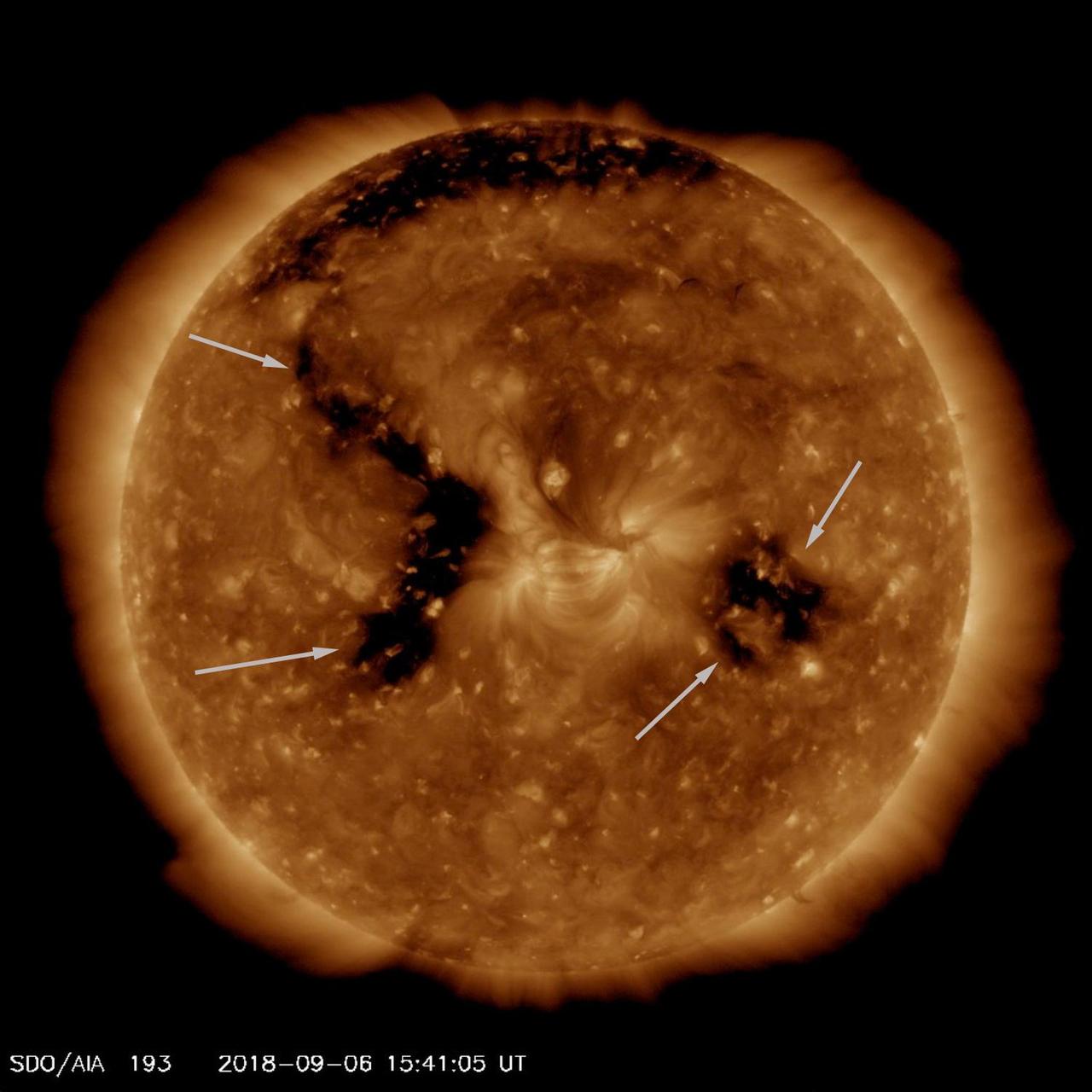
This weekend's aurora forecast doesn't depend on an eruption. It depends on a gap in the sun's corona. A large coronal hole is facing Earth, and the fast solar wind streaming out of it has started to reach us. The NOAA Space Weather Prediction Center (SWPC) now forecasts minor (G1) geomagnetic storm conditions from Nov. 7 through Nov. 9, with a chance of moderate (G2) conditions. If the timing works and the magnetic field cooperates, sky-watchers across the northern United States could see the northern lights.
Here is what the forecasters are saying, why the setup matters, and what will decide whether you see anything.
What's arriving, and when
Coronal holes are regions where the sun's magnetic field opens up into space. Charged particles stream out of these regions, producing high-speed solar wind. When a big hole rotates to face Earth, those streams reach the planet's magnetic field and can stir up geomagnetic activity.
According to EarthSky's Nov. 7 sun update, solar wind speeds were still rising, a sign that the fast wind from the large coronal hole has started to arrive. Space.com reports that the U.K. Met Office forecasts solar wind speeds between 550 and 650 kilometers per second, considerably faster than the typical speed of around 400 km/s.
The official numbers come from SWPC's 3-day forecast issued at 12:30 UTC on Nov. 7. The greatest expected 3-hour Kp index for Nov. 7-9 is 5.00 (NOAA scale G1). The forecast's highest values on the first two days fall in the same late-day window:
- Nov. 7, 21:00-00:00 UTC: Kp 4.67 (G1)
- Nov. 8, 21:00-00:00 UTC: Kp 5.00 (G1)
SWPC also notes a chance of G2 conditions on Nov. 7-9 and attributes the activity to a negative polarity coronal hole high speed stream. EarthSky adds that a glancing blow from a CME the sun launched on Nov. 1 might add to the mix, and that disturbances could last through the weekend.
The sources give slightly different dates. Space.com's report framed the G1 window as Nov. 6-8, with G2 possible on Nov. 7 and Nov. 8. SWPC's newer forecast runs from Nov. 7 to Nov. 9. Forecasts get revised as the stream's real arrival time and strength become clear, so check the latest SWPC product before planning a night out.
Where the aurora might reach
Space.com says that under G1 conditions, auroras may be visible from northern Michigan and Maine. If activity reaches G2, skywatchers farther south, including in New York and Idaho, could see them. These are possibilities, not promises. At the edge of the aurora's reach, the best views usually mean a low glow on the northern horizon rather than a display overhead, and cameras often pick up color the naked eye misses.
The 21:00-00:00 UTC windows fall in the late afternoon and evening across the continental US, before the darkest part of the night for most observers. The forecast shows elevated Kp values in other windows too, so the hours after dark on Nov. 7 and Nov. 8 are worth watching.
The variable that decides everything: Bz
Space.com stresses that aurora forecasts are notoriously tricky and that much depends on the strength and orientation of the magnetic field carried by the incoming solar wind, particularly whether it points southward. Bz is the north-south component of that interplanetary magnetic field. Extended periods of southward Bz favor energy transfer into Earth's magnetosphere, as EarthSky puts it. When Bz points north, that coupling is weak.
There is an early encouraging sign, with a caveat. EarthSky reports that Bz flipped between north and south all day, with a fairly even balance of swings in both directions. Its strongest southward dip reached -9.5 nanoteslas at 9:30 UTC on Nov. 7, but by the time of EarthSky's writing Bz had turned north again, and the geomagnetic field was only quiet to unsettled (Kp 2 to 3). One brief dip doesn't guarantee a good night.
Meanwhile, on the sun's face
The coronal hole is the main story for aurora watchers, but the sun's visible disk has been busy too. EarthSky counts 29 flares in the past 24 hours, all C-class, and all from a single sunspot group, AR4566. The strongest was a C5.9 that peaked at 00:53 UTC on Nov. 7. The region has a beta-gamma-delta magnetic configuration, which EarthSky says gives it the potential to produce M-class and even X-class flares.
Six numbered active regions are currently on the Earth-facing disk, including two newcomers, AR4569 and AR4570. EarthSky puts the chance of M-class flares at 35% and X-class flares at 10%. SWPC's forecast gives a 35% daily chance of R1-R2 (minor to moderate) radio blackouts and a 10% daily chance of R3 (strong) or greater blackouts for each of the three days. The chance of an S1 or greater solar radiation storm is 5% each day, and SWPC expects none.
EarthSky notes that observers spotted no Earth-directed CMEs in the latest period, so the flare odds are a separate matter from the weekend's aurora forecast, which rests on the coronal hole stream.
Why It Matters
Coronal hole storms are less dramatic than CME-driven events, but they are a steady part of space weather. For the public, this weekend is a chance to look for aurora without needing a severe storm. A G1 to G2 event that lines up with clear skies could put the northern lights within reach of parts of the northern US, according to Space.com.
The setup also shows the limits of space weather forecasting. Wind speed and arrival timing can be forecast, but the orientation of the magnetic field carried by the wind is the piece that determines how much energy reaches Earth, and as this weekend shows, it can swing back and forth within a single day. Meanwhile, AR4566's run of C-class flares, along with real odds of M- and X-class events, is a reminder that conditions on the sun can change.
Practical advice: get away from city lights, find a clear view of the northern horizon, and watch after dark on Nov. 7 and Nov. 8. Keep checking SWPC's updated forecasts and aurora forecasts such as the U.K. Met Office product Space.com uses, because southward Bz is the signal that the stream is coupling with Earth.
